Tuesday, May 12, 2020

Where is Keir Starmer leading the British Labour Party?


--- Nasir Khan

Keir Starmer is playing political games to gain electoral support from the large British Indian community to further his political career. To this end, he has chosen to side with the ultra-rightist Hindutva regime of PM Modi.

On 5 August 2019, Modi set aside the constitutional guarantees of the semi-autonomous status to the State of Jammu & Kashmir which the Indian rulers had given to this state after the Partition of India in 1947. When Modi's PJP won a large electoral majority in the Indian national elections in May last year, he set in motion a total blockade of Jammu & Kashmir to impose direct Indian rule there. That was in flagrant violations of the eh UN resolutions and also the guarantees that Indian rulers had given to Kashmiris in 1947.

However, the people of Kashmir never compromised their demands and their national right to self-determination. Their movement for freedom from the Indian rule became an open revolt in 1989. Since then, Inda has done all to crush by its military power the freedom movement of the people of Kashmir, who are mostly Muslims. Indian army has killed over one hundred thousand Kashmiris.

At a time, when the colonised people of Kashmir need the support and solidarity of all freedom-loving people, trade unions and labour organizations, the direction taken by Keir Starmer is the opposite of what a Labour leader should have done.
The steps taken by the British Muslims are fair and must be a reminder to this Labour leader that his policy to appease the Hindu voters is downright opportunistic and degrading. He is pushing the Labour Party in a direction that will make it look like an extended arm of Isareli Zionists and Hindutva fascists.

Ordinary working-class people have been the backbone of the Labour Party. We who have stood by the Labour Party, as I have done for over half-a-century, are deeply anguished to see Keir Starmer turning a blind eye to what the ordinary members of the Labour Party have stood for. It is high time that such people raise their voice collectively and also stand with people who oppose Starmer's political overtures to the brutal oppressors of Kashmir and also Palestine.
 
-
 
 https://5pillarsuk.com/2020/05/10/over-100-mosques-threaten-to-boycott-labour-over-kashmir/?fbclid=IwAR1d6LJi-v5NjmvNxn0meCy0-5o7Tda2CY_llKruJsqelV4WECaYPDVIte4

Over 100 mosques threaten to boycott Labour over Kashmir
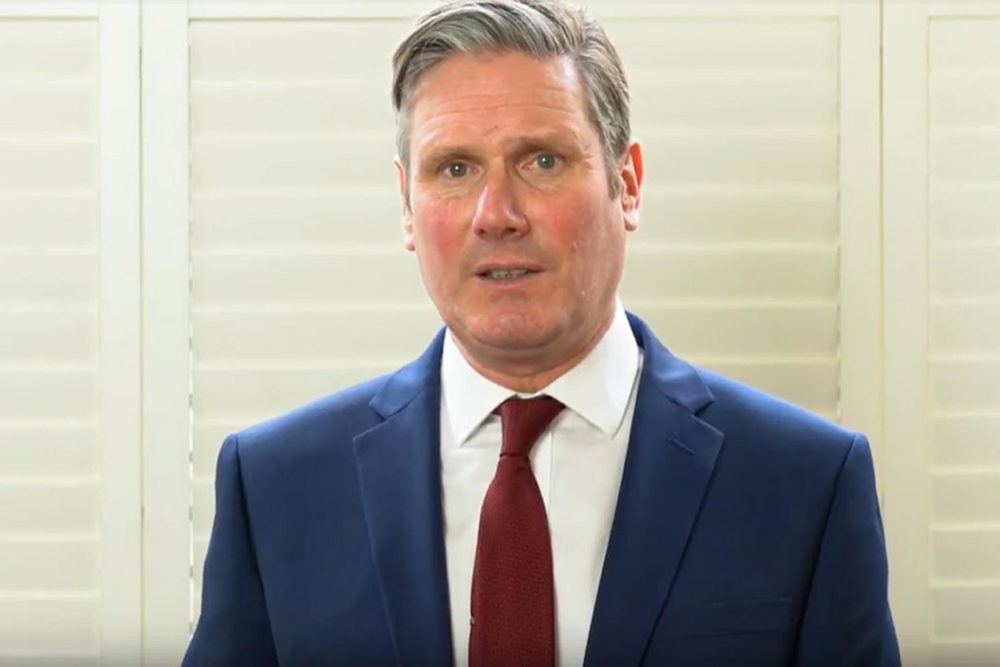
Keir Starmer
Over 100 British mosques and Islamic centres have signed a letter to Labour leader Keir Starmer saying they would support a call for Muslims to abstain from voting for Labour unless it supports Kashmir’s right to self-determination.
The letter came after Starmer described the Kashmir dispute as a “bilateral issue” between India and Pakistan after a meeting with an Indian lobby group at the end of last month.
Starmer’s comments caused outrage among Muslims and eventually led to several Labour Muslim MPs reiterating their support for Kashmiri rights.
The Labour leader has since said that the party’s position on Kashmir has not changed and that it recognises previous UN resolutions on the rights of the Kashmiri people.
Here is the letter from the mosques in full:
We, the undersigned members of the Muslim community living in the UK (many of whom have families in South Asia), are writing to express our utter shock at the contents of your letter in which you clearly express unflinching support for the Indian Government’s position on Kashmir.
This, at a time when the very same Indian Government is engaging in anti-Muslim rhetoric and failing to protect the Indian Muslim community from populist violence, and enacting laws that will potentially render 40 million Muslim citizens in India stateless, which as you well know contravenes international law.
Muslim coronavirus patients are being turned away from hospitals. Kashmir itself has been in lockdown for more than eight months now. India, under the premiership of Narendra Modi, is stepping away from being one of the world’s largest democracies and hurtling instead towards becoming a fascist-led authoritarian state where minorities, Muslims and others, no longer feel safe or protected. It is the members of this very same hate-fuelled ideology who assassinated Mahatma Gandhi.
We wish to remind you that Kashmir is not a bilateral issue, evidenced by the 11 UN Security Council Resolutions which declare Kashmir a disputed territory and that the people of Kashmir have the right to self-determination, something which was enshrined in India’s constitution under Article 370. The meeting at the Security Council last year on 16th August 2019 is further evidence that this is not just a bilateral issue between India and Pakistan.
It is one of the world’s oldest unresolved territorial conflicts that has the potential to lead India and Pakistan into a devastating nuclear war which would have global repercussions. You have not only completely disregarded the international element of the conflict but have also pointedly ignored the Labour Party’s own resolution, voted in at the 2019 conference, which states:
“[We] accept that Kashmir is a disputed territory and the people of Kashmir should be given the right to self-determination in accordance with UN resolutions. The Labour Party to stand with the Kashmiri people fighting against occupation, this is vital as we stand for social justice and ethical foreign policy.”
It would seem to us that holding foreign governments to account over their discriminatory policies and human rights abuses does not seem to be a foreign policy goal under your leadership. As a former barrister, you will clearly be aware of the seriousness of India’s violation of UN resolutions. In addition, you, as the new leader of the Labour Party ought to shoulder greater responsibility on this issue given that the partition which led to this conflict was overseen by a Labour government at the time.
Indian occupation forces in Kashmir
It seems to us that there is an ingrained view that the British Muslim vote has and always will be a secure one for the Labour Party, to be taken for granted with little consideration of the issues and concerns which matter to us as British Muslim communities. In view of the concerns raised above, we strongly urge you to reconsider the party’s position.
We hereby state in no uncertain terms that should you fail to modify your position on the issue of Kashmir and by extension, the plight and oppression of the large Indian Muslim minority within India, then we will consider the Labour Party to have simply taken advantage of the Muslim community.
We will, therefore, have no option but to support a call for the Muslim community to abstain from voting for Labour at all upcoming elections. We hope that this will not be necessary and that the Labour Party will continue to stand against human rights abuses wherever they may be. We urge you not to underestimate the strength of our feeling on this issue.
Yours sincerely,
Federation of Redbridge Muslim Organisations (FORMO) – 17 organisations
Hazrat Sultan Bahu Trust – 22 centres
Indian Muslim Federation UK
Muslim Association of Kent – 20 organisations
South East London & Kent Council of Mosques (SELKOM) – 7 organisations
Waltham Forest Council of Mosques (WFCOM) – 9 organisations
Al-Hira Masjid Newham
Academy of Inspiration
Al Ansar Masjid
Al-Emaan Centre (Keston Mosque)
Al Madina Mosque Barking
Al Noor Foundation
Anjuman-e-Islamia Newham
Apex Trust
Association of Muslim Lawyers
Attiq Malik on behalf of Liberty Law
Barking Muslim Social and Cultural Society
Brent Central Mosque
BWA Muslim Cultural Centre (New Cross Mosque)
Chingford Islamic Society
Gardens of Peace Muslim Cemetery
Faizan-e-Islam
Finsbury Park Mosque
Ghosia Masjid WFIA (Lea Bridge Road Mosque)
Great Barr Muslim Foundation Birmingham
Harrow Central Mosque
Hounslow Jamia Masjid
IG-Soc (“Connecting Muslims in Redbridge”)
Ilford Islamic Centre (Albert Road)
Ilford Muslim Society (Balfour Road)
International Business and Professional Corporation,
Redbridge Jamia Masjid and Islamic Centre (JMIC)
Stoke Poges Lane Masjid
Kent Muslim Welfare Association (Gillingham Mosque)
Lewisham Islamic Centre
Leyton Jamia Masjid MCT
Leytonstone Masjid Majlis-e-Ulama-e-Shia-Europe
Masjid Abu Bakr
Masjid Al Humera Newham
Masjid-e-Owais-e-Qarni (Belgrave Road)
Masjid-e-Quba Newham
Masjid-e-Tauheed Manor Park
Masjid-e-Umer
Masjid Falah
Masjid Tawhid
Muslimah Sports Association
Muslim Public Affairs Committee (MPAC)
Neasden Mosque & Islamic Centre
Newbury Park Mosque
Newham Community Project
Newham North Islamic Association
Noor-ul-Islam
North West Kent Muslim Association (Crayford Mosque)
Pakistan Welfare Association (PWA) Slough
Qur’ani Murkuz Trust (South Woodford Mosque) Redbridge Islamic Centre (Redbridge and Gants Hill) Redbridge Talks
Seven Kings Muslim Educational Trust
Shirley Muslim Association
Sri Lankan Diaspora UK
Tehreek-e-Kashmir UK, London
The Mosque & Islamic Centre of Brent
Ujala Foundation Slough
UKIM Masjid Ibrahim and Islamic Centre Newham

Saturday, April 11, 2020

An Open Lettter to the Leader of the Labour Party in the UK

Dr Ian Wellens, a member of the Labour Party in the UK, has written a candid letter to his party leader Sir Keir Starmer, in which he has expressed his profound suspicions about the direction Keir is steering the party because he is a Zionist.
This letter needs the attention of all members and supporters of the Labour Party, labour organisations and political activists who oppose racism, colonial oppression and stand for the national rights of the people of Palestine whose suffering at the hands of Israeli colonisers has no end in sight.

---Nasir Khan
--

Dr Ian Wellens writes, "There has been murder, ethnic cleansing, theft of land, property, farms and factories on an epic scale; Palestinians have been beaten, tortured or deliberately crippled; imprisoned without trial; penned into the Gazan ghetto; . . . And yet, Keir, you say that you support Zionism, and not only that: you support it “without qualification”. I find it hard to express how troubling that is."
 
---


An open letter to UK Labour leader Keir Starmer


on  


Dear Keir,

congratulations on your victory. I hope you keep the broad policy direction of the last five years and I wish you the very best of luck in bringing Labour to power, after which I hope you will lead the country in the radical new direction we so badly need.

I have to say, however, that I didn’t vote for you. There was a decisive moment for me in the campaign when the Board of Deputies of British Jews presented candidates with ‘Ten Pledges for Labour leadership’. Ostensibly intended to deal with Labour’s ‘antisemitism crisis,’ it was transparently clear to myself and many others that they actually formed part of the ongoing campaign to silence anti-Zionist and pro-Palestininan voices within the party (number 6, for instance, being the pledge to adopt the IHRA definition of antisemitism fully and without caveat– a definition that effectively includes anti-Zionism). Your acceptance of these made my support unthinkable. And on the day your win was announced, the Times Of Israel reminded us that you had previously told Jewish News: “I said it loud and clear – and meant it – that I support Zionism without qualification.” As I considered what your leadership would mean for Labour – and for me as a Party member with a strong connection to the Palestinian issue – it seemed that I was faced with an uncomfortable choice.

My dilemma was brought into focus by a news report from Israel in the Middle East Monitor accompanied by a picture of a house just outside Jerusalem. It is a very striking aerial photograph, showing the house separated from its neighbours by high walls and barbed wire, overseen by security cameras. Access is by a narrow walkway, also closed off. The inhabitants of the house can see nothing of the outside world. It is as if they are prisoners, and – effectively – they are. This grim scene is compounded by the fact that all around the house – on the other side of the walls – is what looks like a comfortable housing estate, complete with swimming pools. You will be unsurprised to hear that the family in the house are Palestinians, whilst the neighbours who caged them in this way are Israelis.

This foto appeared in an article in Middle East Monitor on April 4, titled, “Israel settlement turns Palestinian house into a cage,” and it was captioned, the Gharibs’ house in Beit Ijza, caged by a fence and surrounded by the Israeli settlement of Givon Hahadasha, as seen here in a 2018 satellite image, west of Jerusalem [screen grab from Geomolg]

The background to this case makes it very clear that the difference in treatment stems entirely from the ethnicity of the house’s inhabitants, and I think that in itself this could constitute evidence for Israel being ‘a racist endeavour’. But I believe it has a greater significance. It seems to me that it symbolises the effect of Zionism on the Palestinians over the last hundred years. The whole point of that ideology, and the state it created, is to distinguish relentlessly between Jews and non-Jews; to privilege the former and discriminate against the latter. The Palestinian family in our example has been singled out for isolation by concrete and razor wire – but discrimination against Palestinians more generally has been, and is, of every type and at every level.
 There has been murder, ethnic cleansing, theft of land, property, farms and factories on an epic scale; Palestinians have been beaten, tortured or deliberately crippled; imprisoned without trial; penned into the Gazan ghetto; denied access to maternity wards, swimming pools or parks; their political parties are never allowed into a ruling coalition; they are prevented from building new houses or extending old ones, and there are huge areas of the country and hundreds of towns where they are simply not allowed to live. And – like the residents of the house in the picture – all this is done to them purely because they are what the Israelis call ‘arabs’ – or to put it another way, because of what they are not. That is: they are not Jews. Our photograph therefore symbolises the fate of the indigenous Palestinian people at the hands of the Zionist-inspired colonisers – both before and after the creation of Israel, under all types of government (and perhaps most of all under the ‘labour’ ones). It dramatises an ethnic discrimination which is in Israel’s DNA, and without which the project would have been pointless. And yet, Keir, you say that you support Zionism, and not only that: you support it “without qualification”. I find it hard to express how troubling that is.
Troubling because it means the leader of my party subscribes to an ideology which was rooted in the racism, colonialism and ethnic nationalism of the nineteenth century in which it was born, and the practical application of which (i.e the creation of Israel) has showed their pernicious influence at every stage. Keir, you say that people have different ideas about what Zionism is. Might I suggest you consult its victims? They will quickly enlighten you, describing a settler-colonial project which – like all the others – was marked by the racist attitudes of Europeans towards indigenous non-European people. They will tell you that the creation of a Jewish state in an overwhelmingly non-Jewish country was illegitimate. And they will describe all the details of the particular version of apartheid which has been developed to ensure that they are quite literally second class citizens.
As a Labour Party member I like to think that my party stands with the oppressed, not the oppressor. That indeed, was one of the reasons why I joined. And at home I dearly wish for the sort of social transformation that a Labour government could bring. But my politics is rooted in values, and chief among these are an opposition to all forms of racism and discrimination, and an insistence on equal rights which I am not prepared to compromise. It is these principles have shaped my attitudes to Palestine/Israel. However, my party now has a leader who has pledged his unqualified support to a country and a system which is utterly at odds with those same values.
There is a further problem. According to Israel’s apologists, saying all this makes me a racist, and from everything you have said both before and after being elected leader, I think it is highly likely that you will agree with them. It is, I must say, a truly Alice In Wonderland situation when Israel’s relentless practice of institutionalised ethnic discrimination is deemed not to be racist … but calling it out is.
So it seems that in the Labour Party I face the prospect of being deemed a racist if I speak my mind on Palestine/Israel. And to be absolutely clear, I believe that the idea of a state ‘for Jews’ is wrong. It is, after all, completely at odds with the principles that are supposed to underpin liberal democracies, and instituting anything of a similar character in Europe would be unthinkable (at least, for anyone except the very far Right). I fail to see why an idea which is anathema in Europe should be endorsed elsewhere. And if the idea was wrong, the choice of an overwhelmingly non-Jewish territory made its realisation inherently unjust. It was bound to be a disaster – and it has been. Unless and until Israel re-constitutes itself into a single state with equal rights for all its inhabitants, I would argue that it should not expect any support from the Labour Party. And whilst I reluctantly accept that there is a long history of pro-Zionism in the party and can accept the idea of Zionists being Party members, my own view is that this as a moral error which is incompatible not just with socialist values but with general liberal-democratic ones as well.

Based on your acceptance of the BoD’s ‘Ten Pledges’, your recent letter to that body and your Times of Israel interview, I suspect that in your mind all of this makes me one of the antisemites who must be ‘torn out’ of the party. That will be the Party’s decision. But I have a choice to make as well. I have to consider whether, under your leadership, the Labour Party will be an appropriate place for someone with my values, and whether it is an institution I can continue to support.

I am therefore looking for reassurance. A good starting point would be an unequivocal statement that members will be free to hold and express anti-Zionist views, that Labour regards such views as legitimate, and that under your leadership the Party will energetically defend the right to freedom of thought and freedom of speech on Palestine/Israel.

I look forward to hearing from you,

Yours,
Dr Ian Wellens
 

Monday, March 30, 2020

Two influential poets Ghalib and Iqbal


--- Nasir Khan

Mirza Ghalib (1797 - 1869) and Mohammad Iqbal (1877 - 1938) are two great poets in their own ways. Iqbal is also a politician, a populist, an ideologue of Islam where he expounds Islam along mystical and unclear paths (his 'Reconstruction of Religious Thought in Islam' being a clear expression of his confused thinking and lack of clarity despite his pedantic English that only few can understand or digest!). But his command of Urdu and Farsi in conveying his poetic message and ideas is impressive. 

His poetry covers many areas and it can't be labelled under any one theme. His revolutionary and progressive ideas are appreciable but his tilt towards religiosity, mysticism and Islamic nationalism in the latter part of his life was a big waste of the intellect of a good man. The Pakistani reactionary political establishment took full advantage of his shoddy Islamist ideology and transformed him into a mullah which he was not! 

In contrast to Iqbal, Ghalib was only a poet and not a politician or messenger of any political revolution. In his verse, he conveyed his sublime ideas in a way unmatched in this language. His word has enriched the Urdu language by his poetic expression and his style of prose (see his letters). If we can extend the area of philosophy to general wisdom, deeper insights in human psychology and human condition then Ghalib stands far higher than Iqbal in such areas. He is a universalist, not bound by faith, creed or ideological nihilism as Iqbal seems to be. Iqbal's origin as a Kashmiri Pandit, about which  I feel happy as being a Kashmiri myself, but that is not decisive when I assess him. I end this piece with a verse of everlasting Ghalib:

Ham kahan ke danaa the, kis hunar main yakta the
Be sababb hua Ghalib, dushman aasman apna


ہم کہاں کے دانا تھے کس ہنر میں یکتا تھے 

  بے سبب ہوا غالبؔ دشمن آسماں اپنا


 Image may contain: 1 person, beard


  Mirza Ghalib


Thursday, March 26, 2020

Religions and their Followers - a reply


-- Nasir Khan

Mr. Woodward, I hope you don't misunderstand me when I write this as a freethinking humanist. I know that religions have caused much bloodshed and misery in human history. But religions have no real content. It is the followers of a religion who give meaning or importance to what their religion is and what it is not.

Religions have been a powerful factor in human history which the rulers used for their political domination and the servility of their subjects. That role is still there and is used by present-day rulers as it suits them, except for the countries where State and Religion are separated.

The second point in this context I would like to make is that religion is an idea often based on some dogmas. Such dogmas become essential parts of a religion that people interpret and sometimes come up with varying interpretations, leading to inter-religious conflicts. Such things have been the cause of much blood-shedding in Christianity and Islam, etc. Anyone who has read the histories of these religions knows that.

Religion and its followers are not the same. That should be easy for us to see. For instance, a group of fanatic followers may misuse their religion. In fact, such things have happened in all recorded history. If they use it to justify the killing of other people for some reason by using the name and cover of religion, who can stop them? None, in my view.

Religion as a collection of ideas does not impose itself upon humans; humans do that. Vicious people will use it as they want. But humane and noble people who want to use their religion for doing some good work are also free to do that. Such conflicting uses of religion are not a secret. We have to understand that in this world there are believers of religions. As long as they do not leave their religions, no one should force them to do so.

In that case, my attitude towards these people is simply this: As long as they do not harm others and use their religions as their personal beliefs, then we should respect them. They are our fellow human beings and they use the freedom to choose and practise their religion. But as a humanist, I should not abuse and dehumanize them. Instead, we who are freethinking people should work systematically to bring information to these people in a manner that they don't feel threatened. You know how people react when they feel their beliefs and valuable things in life are under threat. Before we can teach others, we have to learn ourselves to carry on our work.

Saturday, March 07, 2020

The Sunni-Shia division in Islam


The following brief account may help some curious readers about the Sunni-Shia divide in Islam that also affects political affairs in the Middle Eastern region.

Remarks on the Sunni-Shia division in Islam

-- Nasir Khan

The division of Islam into Shia and Sunni branches from the mid-seventh century was more due to the political factors than with the fundamentals of the faith because they were the same for all people including the power elites. Obviously, two rivals engaged in a struggle to gain the upper hand in a political race cannot win unless they strike some compromise and avoid the conflict. This was possible between the rival claimants, Ali bin Abi Taleb and Muwaiya bin Abi Sufyan, but did not happen in the early phase of the growing polarization that was taking place in the Muslim community.

One puritan group, the Kharijites, saw the developments with apprehension for the new faith and the Muslim community, which by now was large and was rapidly spreading in many regions of the world. The Kharijite solution to stem the tide of power-politics that was damaging the new nation was a radical one: liquidate the rival claimants to the Caliphate and save the faith and the Caliphate. Despite what they did, the problem did not vanish.

Now the Sunni and Shia forms of thought about the office of the Caliph started to diverge. Afterward, even the theological differences started to grow. Inevitably, the Sunni and Shia doctrinal differences became more pronounced and the different schools of jurisprudence put their stamp on the growing disparity between the two groups. Therefore, what started as a political factor eventually developed into two rival sects within Islam.

What sort of relationship emerged between the two branches when Islam became a world religion and Islamic Empire grew in size and power can be briefly put this way: The Sunni Islam became dominant but Shias were not victimized. The relationships were mostly cordial and one of toleration and mutual respect.

The intolerance towards Shia and the victimization of Shias in countries like Pakistan in these times is a tragic story of a faith that has been hijacked by some fanatic ignorant people in the name of their brand of 'puritan' theology. But these criminals and assassins are a right-wing fringe element within Pakistan. The great majority of ordinary Sunni Muslims has nothing against Shia Muslims and vice versa. Both of them look upon each other as brothers and accept each other's right to follow Islam according to their traditions and customs.

But in Iraq under President G.W. Bush American invaders and occupiers of the land fanned the sectarian divide, resulting in the bloodshed of Iraqis. The suppression of the Shias in Saudi Arabia is also a manifestation of how the Wahabbi rulers impose their morbid religious cult in violation of the fundamental principle of the freedom of religion which is followed in the civilized world.

Wednesday, February 12, 2020

Nasir Khan: Israel Pushing US to War with Iran


Nasir Khan: Israel Pushing US to War with Iran

 
Nasir Khan: Israel Pushing US to War with Iran
TEHRAN (FNA)- Nasir Khan, historian and peace activist, says Donald Trump, the US President, issued the assassination order of Lieutenant General Soleimani under the influence of Netanyahu’s allies working in his Administration.
 
In an exclusive interview with FNA, Nasir Khan said, “[Netanyahu] had people like Secretary of State Pompeo and former National Security Advisor Bolton doing their work for him.”

“Netanyahu has used all the ploys. He has played a key role in pushing Trump to unilaterally retreat from the international nuclear agreement with Iran, and has done all to influence Trump to attack Iran”, he added.

Nasir Khan, Ph.D. Philosophy, is a historian and political analyst. He has authored several books and written numerous articles on international politics, socialism, religion and human rights.

Below is the full text of the interview:

Q: How do you see Lieutenant General Soleimani's role in the fight against Daesh, also known as ISIL or ISIS?

A: The emergence of Daesh was primarily due to the general instability caused by the US war of aggression on Iraq in 2003. The systemic destruction of Iraq, its army and infrastructure had created a complicated and confusing situation in and around Iraq. As a result, Daesh was able to expand in Iraq and Syria, where a disastrous civil war had started. The Syrian forces had lost large areas to Daesh.

General Soleimani as a bold military strategist played a pivotal role in defeating Daesh in Iraq and Syria. For instance, his role in breaking the siege of Amirli in 2014, liberating Jurf Al-Sakhr and planning the operation to take Tikrit in Iraq in 2015 from Daesh are memorable. In 2013, he coordinated the military plans with the militias and Hezbollah fighters and captured Qusayr, a town on the Syria-Lebanon border. In 2015, Russian military intervention on the side of President Assad was decisive, but it was Soleimani who had masterminded the ground support to fight against the Syrian rebels.

Q: Why do you think the US targeted Lieutenant General Soleimani, who played a major, active role in defeating Daesh?

A: First, after the defeat of Daesh the US saw Soleimani as an able military strategist of Iran, who had the potential to become a serious obstacle to the US imperial designs on Iran. Therefore, according to US imperial outlook, Soleimani’s death will make the US goals in the region easier. Secondly, both Israel and the US had coordinated their plans to assassinate him. He was perceived as a threat to the interests of the two close allies in the region.

Trump was impeached and Israeli PM Netanyahu was indicted last year. Trump and Netanyahu aim to win elections this year. The two will present the killing of Soleimani as a trophy to the electorate of America and Israel. Netanyahu knows how easy it is for him to influence American political establishment, the US Congress and American voters. Thus Trump has a big supporting ally in Netanyahu to win the election again. To our dismay, major international hegemons help each other in such devious ways.

Q: During his presidential campaigns, Trump claimed he would prevent further wars. What has pushed him in the last three years to the brink of a new war?

A: Netanyahu has used all the ploys. He has played a key role in pushing Trump to unilaterally retreat from the international nuclear agreement with Iran, and has done all to influence Trump to attack Iran. In this, he had people like Secretary of State Pompeo and former National Security Advisor Bolton doing their work for him.

To our surprise, Trump resisted any such military solution last year. He stopped only just ‘ten minutes to go’ before his order to attack Iran was carried out. He sacked war hawk Bolton. But all that political scenario has now changed with the assassination of General Soleimani. Trump has prepared the groundwork for a war on Iran that can lead to catastrophic consequences for the region and the world. The only person who benefits from such a conflict will be Netanyahu who is fighting for his political survival. The lives of people have no meaning for him if he can have his way.

-
http://en.farsnews.ir/newstext.aspx?nn=13981120001187&fbclid=IwAR3IPyp9HNfqqC9fesaEza6e7wkUTUdO4puNHYkZ82la08qHX2sNeZliIVY


Saturday, December 28, 2019

Women of India - Poem by Badri Raina

Indian poet and writer Badri Raina praises the women of India who are in the forefront of the ongoing protests and political struggle against the brutal Hindutva regime of PM Modi.
-
Women of India

By Badri Raina
-
ZNet, December 27, 2019
-

Sitting out the chilling night
At Shaheen Bagh, you lead
India’s second struggle for freedom,
shaming men who would come
But are held back by fright.
-

Women of India, your resolve
Against tyranny once made,
Brooks no politic retreat.
Firm in mind, you are firm
On your freezing feet.
-

A face of impish delight smiles
Upon you.
Tucked in his lungi, he seems to know
That you will defeat the guiles
Of the day’s defrauders,
As you did of colonial marauders.
-

Those that worship the armed goddess
In the plush confines of temples
Now confront her in the flesh.
Looking at your sentient courage,
My defiant soul leaps out
Of my old age.
-

To declare to my beleaguered nation
That the republic is safe
In your incandescent passion
Against a state of things where
Laws may accommodate
Subliminal hate.
---
Indian women shout slogans during a protest against the Citizenship Amendment Act in the city of Guwahati on Saturday. | AP