Tuesday, September 15, 2020

𝐀𝐫𝐚𝐛 𝐝𝐞𝐬𝐨𝐩𝐭𝐢𝐜 𝐫𝐞𝐠𝐢𝐦𝐞𝐬 𝐚𝐧𝐝 𝐏𝐚𝐥𝐞𝐬𝐭𝐢𝐧𝐢𝐚𝐧𝐬 𝐮𝐧𝐝𝐞𝐫 𝐨𝐜𝐜𝐮𝐩𝐚𝐭𝐢𝐨𝐧

 --Nasir Khan

Jeremy Bowen is an experienced journalist who has covered the Middle Eastern region for long. In his latest article, he discusses the ramifications of the peace deals of Israel with the two Gulf kingdoms. Other Arab regimes may also fall in line with the ongoing process which the Trump administration started to obliterate the "Palestinian Question" once and for all as the Zionist rulers of Israel and their international supporters had demanded and worked for.

Contrary to some political observers' reactions who have downplayed the importance of these deals, Jeremy Bowen shows how they are not merely a window-dressing but substantial that would have long-term effects on the geopolitics of the whole of the Middle East.

Callously, the US imperialists have left the captive people of Palestine to the bayonets and bullets of the Israeli military machine. Where will that lead to is the question political writers and activists who stand for the UN Charter, international law and the rights of the Palestinian people should be asking.

As the Arab despots are throwing away their cloaks of hypocrisy and coming out in their true colours, the struggle of the people of Palestine for freedom and national liberation will enter a new stage.
 .
 
 -

Five reasons why Israel's peace deals with the UAE and Bahrain matter

By Jeremy Bowen
BBC Middle East editor

Published

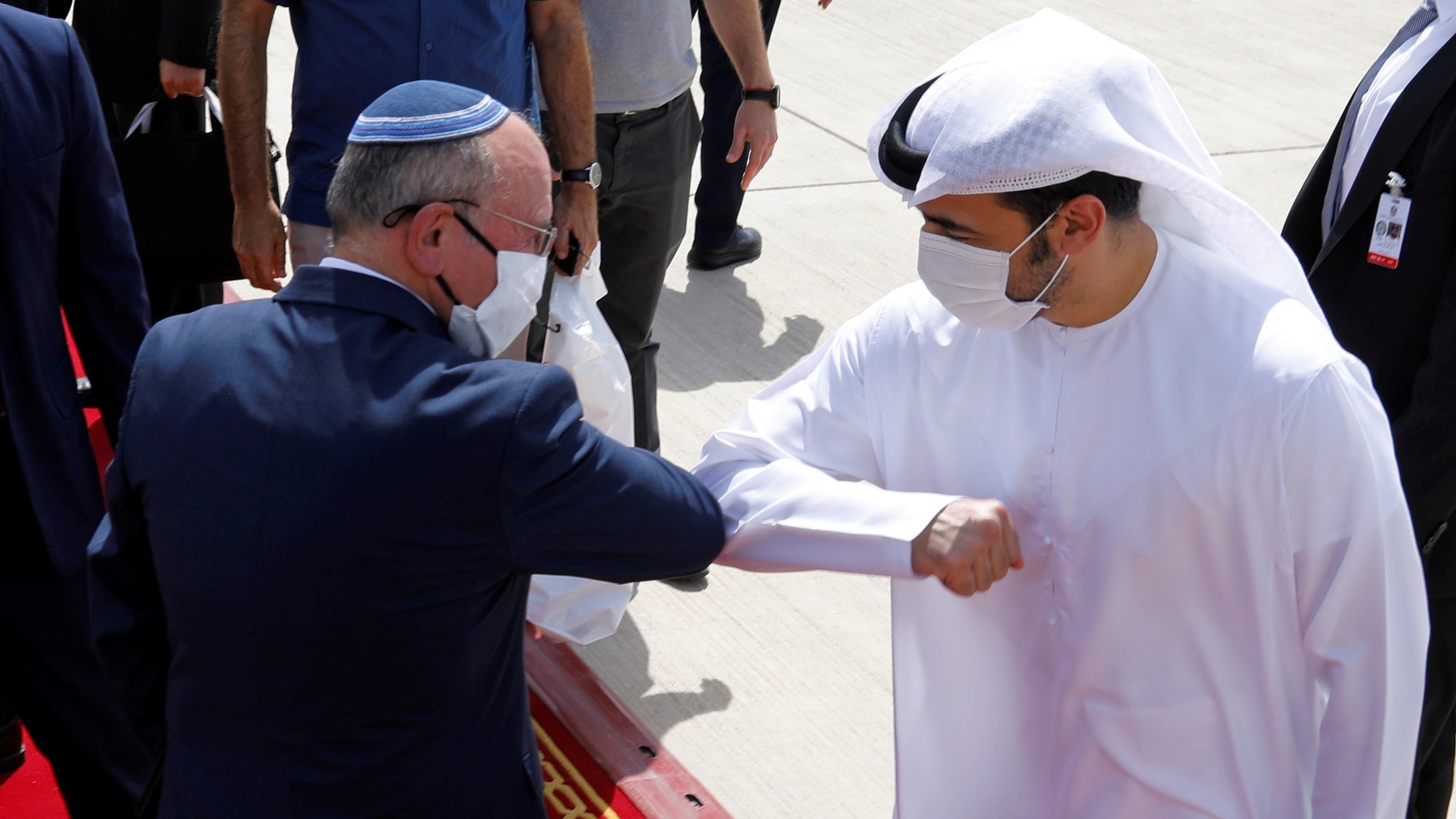
Israeli National Security Adviser Meir Ben-Shabbat elbow bumps with an Emirati official at Abu Dhabi airport in the United Arab Emirates (1 September 2020)image copyrightReuters
image captionIsrael's national security adviser was on board a historic flight to the UAE on 1 September
High-level delegations from Israel and the United Arab Emirates (UAE) will sign a historic US-brokered peace deal at the White House on Tuesday.
Bahrain's foreign minister will attend the event and sign its own agreement to normalise relations with Israel, announced by President Donald Trump last week.
This is why the deals are significant.

1. The Gulf states see opportunities for trade and more

The deal helps the ambitious Emiratis, who have built themselves into a military power as well as a place to do business or go on holiday.
It looks as if the Americans helped seal the deal with the promise of advanced weapons that in the past the UAE has barely been able to window-shop. They include the F-35 stealth fighter and the EA-18G Growler electronic warfare aircraft.
The UAE has used its already well-equipped armed forces in Libya and Yemen. But its most serious potential enemy is Iran, just on the other side of the Gulf.
media captionJared Kushner: "A new script for a new Middle East"
Israel and the US share Emirati suspicions of the Iranians. So does Bahrain. Until 1969 Iran used to claim Bahrain was by rights part of its territory. Bahrain's Sunni rulers also regard sections of its restive Shia majority as a potential fifth column for Iran.
Both Gulf states already had barely concealed ties with Israel. They will look forward to trading openly; Israel has one of the world's most advanced high tech sectors.
In non-Covid times, Israelis are avid holidaymakers who will be keen to explore the deserts, beaches and malls of the Gulf. It is good business all round.

2. Israel lessens its regional isolation

Normalising relations with the UAE and Bahrain is a genuine achievement for the Israelis.
Prime Minister Benjamin Netanyahu is a believer in the strategy first described in the 1920s of an "Iron Wall" between the Jewish state and the Arabs.
The idea is that Israeli strength will in the end make the Arabs realise that their only choice is to acknowledge its existence.
Israelis do not like being isolated in the Middle East. Peace with Egypt and Jordan has never been warm. They might be more hopeful about future relations with Gulf countries a long way from the cockpit of Jerusalem and the occupied territories.
Strengthening the alliance against Iran is another big plus. Mr Netanyahu sees Iran as Israel's number one enemy, at times comparing its leaders to the Nazis. He has muted his original complaints about the UAE's possible arms deal.
Mr Netanyahu is also beleaguered, facing a trial for corruption that might land him in jail. His handling of the coronavirus pandemic started well and has gone badly wrong. Opponents stage weekly rallies outside his residence in Jerusalem.
A ceremony at the White House could not come at a better time.

3. Donald Trump celebrates a foreign policy coup

The deal works on a number of levels for the US president.
It is a big boost for his strategy of "maximum pressure" on Iran. It is also useful ammunition, especially in an election year, to back his boast that he is the world's best dealmaker.
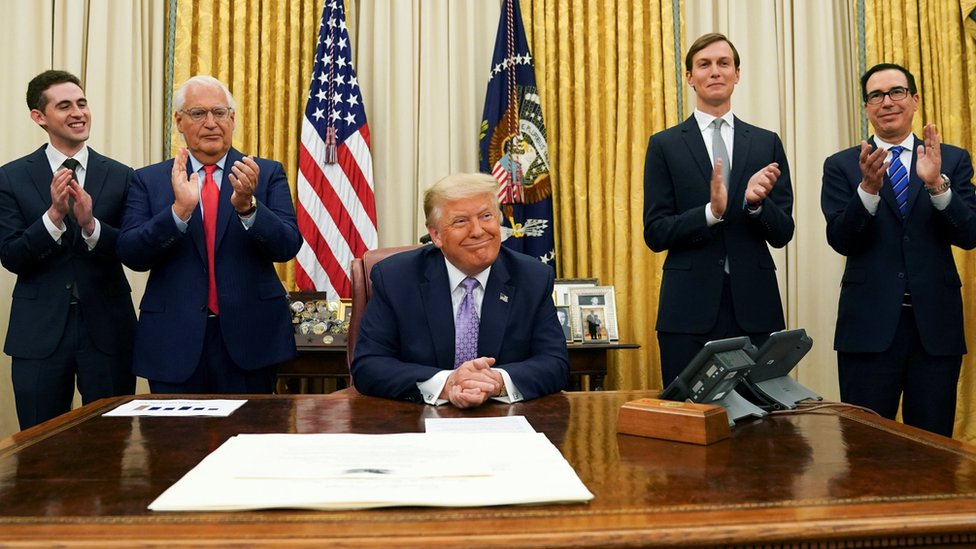
Donald Trump after announcing that Israel and the UAE have agreed to normalise relations (13 August 2020)image copyrightReuters
image captionDonald Trump announced the so-called "Abraham Accords" at the White House in August
Anything he does that benefits Israel, or more specifically the government of Benjamin Netanyahu, goes down well with American Christian Evangelical voters, an important part of his electoral base.
The "friends of America" alliance against Iran should work more smoothly if the Gulf Arabs can be open, rather than secretive, about their relations with Israel.
President Trump's so-called "Deal of the Century" to make peace between Israel and the Palestinians is a non-starter.
But the "Abraham Accords", as the Israel-UAE agreement is known, is a significant shift in the balance of power in the Middle East and is being presented by the Trump White House as a major foreign policy coup.

4. The Palestinians feel betrayed

Once again, they are left holding the wooden spoon.
They have condemned the Abraham Accords as a betrayal. The new agreement breaks a long-standing Arab consensus that the price of normal relations with Israel was independence for the Palestinians.
But now Israel is cementing new public relationships with Arab states while the Palestinians still languish under occupation in East Jerusalem and the West Bank, and in what amounts to an open prison in Gaza.
Abu Dhabi Crown Prince Mohammed bin Zayed Al Nahyan, the UAE's de facto ruler, says that his price for the deal was Israel's agreement to stop the annexation of large parts of the West Bank.
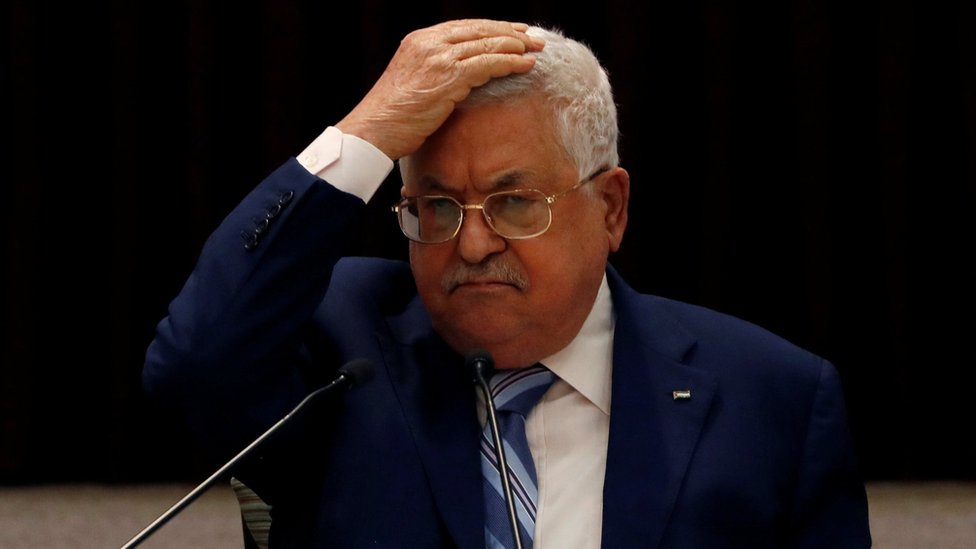
Palestinian Authority President Mahmoud Abbas puts his hand on his head during a meeting of the Palestinian leadership (18 August 2020)image copyrightReuters
image captionPalestinian leaders have denounced the two Gulf countries' moves to normalize ties with Israel
But Prime Minister Netanyahu seemed to have backed away from the idea, for now at least, because of overwhelming international pressure. The Emiratis offered him a way out of what had become an awkward political cul-de-sac.
The Palestinian nervousness will increase now that Bahrain has joined the agreement.
That would never have happened without approval by Saudi Arabia. The Saudis were the authors of the Arab peace plan that demanded Palestinian independence.
King Salman's status as custodian of Islam's two holiest shrines gives him enormous authority. It is unlikely that he will suddenly recognise Israel.
His son and heir, Mohammed bin Salman, might be less reluctant.

5. Iran has a new strategic headache

The deal has been roundly condemned by the Iranian leadership.
It is more than rhetoric. The Abraham Accords put them under extra strain.
President Trump's sanctions are already causing real economic pain. Now they have a strategic headache too.
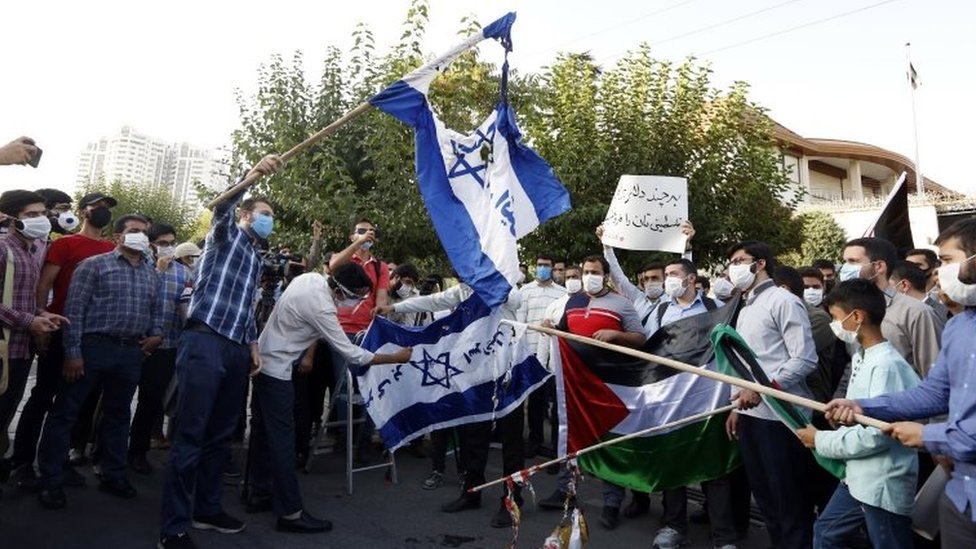
Iranian students burn Israeli flags during a protest outside the UAE embassy in Tehran, Iran (15 August 2020)image copyrightEPA
image captionThe UAE's agreement with Israel triggered protests in Iran
Israel's home airbases are a long flight from Iran. The UAE's are just across the waters of the Gulf. That would be highly significant if there was a return to talk of air strikes against Iran's nuclear sites.
Israel, the US, Bahrain and the UAE have a range of new options.
The Iranians find their room for manoeuvre has been reduced.


Sunday, September 13, 2020

𝐀 𝐜𝐨𝐦𝐦𝐞𝐧𝐭 𝐨𝐧 𝐭𝐡𝐞 𝐜𝐚𝐩𝐢𝐭𝐚𝐥𝐢𝐬𝐭 𝐬𝐲𝐬𝐭𝐞𝐦


-- Nasir Khan

No one should discount the importance of noble feelings to seek solutions that people need. But in a political and social order that is based upon class divisions, and even caste system in countries like India, where racial supremacy of some over others is believed to be the 'law of nature', the masters will remain masters and the 'lower' classes will remain at the mercy of their masters. The wheels of class domination and oppression will not stop circling.
 
Peoples' prayers and appeals to some heavenly powers or warmongering imperialists and brutal colonialists will not change the status quo. 
 
The challenge to the existing oppressive system in a consistent and systematic way comes only from the revolutionary path of Marxism-Leninism. That's why imperialists, fascists, Zionists, Islamists, Hindutva supremacists and all reactionaries have been and are the relentless enemies and falsifiers of Marxism.

Thursday, August 13, 2020

𝐓𝐨 𝐠𝐞𝐧𝐞𝐫𝐚𝐥𝐢𝐬𝐞 𝐨𝐫 𝐧𝐨𝐭 𝐭𝐨 𝐠𝐞𝐧𝐞𝐫𝐚𝐥𝐢𝐬𝐞

 ---Nasir Khan

"An idea is always a generalization, and generalization is a property of thinking. To generalize means to think."

-- German philosopher Georg Wilhelm Friedrich Hegel (1770-1831)

Hegel puts it precisely about the interrelationship between thinking and generalising. We all think about various things in our daily lives. Out from our observations and experiences, we also draw some general conclusions or generalise that is more of an evaluative process.

We also meet people who hold an opinion or view to be only a ‘generalisation’; therefore, by calling it a generalisation what they imply is that it should be cast aside as ‘non-factual’ or ‘illusory’. However, that’s a simplistic view. On the contrary, in the hands of thinkers and critical observers, their views are based on empirical data and a rational analysis of such data. As a result, for them to offer generalisations is an essential part of communicating some facts that are part of a cognitive process. Thus by generalising, a specific instance is extended to cover a wider range of similar cases.

No wonder, all thinkers and mentally mature people generalise. That helps us to see their views as sound and verifiable. But all generalisations do not meet this criterion. By adducing evidence, we can show the erroneous assumptions on which such generalised views may be based.

For instance, we have seen that whenever the US rulers have invaded any country, they have killed very many innocent people and caused much damage as they did in Vietnam, Laos, Cambodia, Iraq, Afghanistan, etc. etc. From these instances, we as observers of international events conclude that US militarism is dangerous and murderous. That is our generalisation about the US militarists. But if they stop doing what they have been doing for so long, we may change our generalised view about them. However, the prospects of any such change in American policies seem remote.

Thursday, July 23, 2020

The goals of Hindutva fascists in India

-- Nasir Khan
In the following article, Indian author A.G. Noorani gives a brief account of the politics of Hindutva in India. Many people are not aware that Hindutva is not the same as Hinduism. Hinduism is an ancient religion that evolved in India, but Hindutva is an extremist religious-nationalist ideology that is opposed to the idea of a democratic India, based upon the principle of secularism, equality of all its citizens, irrespective of their religion, creed and caste.
Hindutva rejects the ideas of such equality of all its citizens but, instead, aims at transforming India into a Hindu polity - Hindu Rashtra - where only Hindus will be supreme. In such a state, 200 million Muslims and 30 million Christians will be made second-class citizens.
Hindutva as an extremist nationalist ideology uses the cover of Hinduism to justify atrocities against Muslims, Christians and Dalits. It founders and mentors have copied and developed further the authoritarian and military model of fascism that was practised by Benito Mussolini and Adolf Hitler.
Since 2014, the BJP government had power in India under the premiership of Narendra Modi, who has the notorious record of being an ardent anti-Muslim and anti-Pakistan leader for decades. After BJP's sweeping electoral success in May last year, the Modi regime started implementing the political programme of Hindutva fascists. After imposing direct Indian rule over Jammu and Kashmir, his party led the terrorist campaign against Muslims in Delhi, where Hindu militants and gangsters plundered the shops owned by Muslims and then torched their homes and properties. They killed over 50 Muslims in Delhi alone. All this took place under PM Modi's nose. That was Hindutva in action.'
---
https://clarionindia.net/why-we-need-to-know-and-understand-hindutva-a-g-noorani/?fbclid=IwAR3HLAIPe06LGva0ommYBAKFbRcH_JLpw1miggd9JAUZU6LPNAK0Npk30yo


 Why We Need to Know and Understand Hindutva – A G Noorani


0


Members of Rashtriya Swayamsevak Sangh take part in the daily morning drill.

Hindutva is the ideology of the Rashtriya Swayamsevak Sangh. The election manifesto of the Bharatiya Janata Party — the party in power and political front of the RSS — has sworn by it since 1996. What is more, Hindutva provides ample warning for what is in store for the future of India’s democracy and secularism. It splits the nation into ‘us’ and ‘them’, and discards Indian nationalism in favor of Hindu nationalism

A G NOORANI

[dropcap]H[/dropcap]INDUTVA sums up the ideology that moved champions of Hindu nationalism for decades before Partition. In 1923, V.D. Savarkar coined the term in his essay, Hindutva: Who is a Hindu? As an atheist, he took pains to emphasize that Hindutva was not synonymous with Hinduism. It is important to understand the term, in all its nuances, because of its past and present significance.
Hindutva is the ideology of the Rashtriya Swayamsevak Sangh. The election manifesto of the Bharatiya Janata Party — the party in power and political front of the RSS — has sworn by it since 1996. What is more, Hindutva provides ample warning for what is in store for the future of India’s democracy and secularism. It splits the nation into ‘us’ and ‘them’, and discards Indian nationalism in favor of Hindu nationalism.

Savarkar wrote, “… Hindutva is not identical with what is vaguely indicated by the term Hinduism. By an ‘ism’ it is generally meant a theory or a code more or less based on spiritual or religious dogma or system. But when we attempt to investigate the essential significance of Hindutva we do not primarily — and certainly not mainly — concern ourselves with any particular theocratic or religious dogma or creed”. His concern was politics; the political mobilization of Hindus into one nation.
If not religion, what, then, is the basis for the divide? With crystal clarity, he wrote, “To every Hindu … this Sindhusthan is at once a pitribhu and a punyabhu — fatherland and a holy land. That is why in the case of some of our … countrymen, who had originally been forcibly converted to a non-Hindu religion and who consequently have inherited along with Hindus, a common fatherland and a greater part of the wealth of a common culture — language, law, customs, folklore and history — are not and cannot be recognized as Hindus.

For though Hindusthan to them is fatherland as to any other Hindu yet it is not to them a holy land too. Their holy land is far off in Arabia or Palestine. Their mythology and god-men, ideas and heroes are not the children of this soil. Consequently their name and their outlook smack of a foreign origin”.

Modern hatreds are supported by ancient (real or not) wrongs.


The divide cannot be bridged except by obeying Hindutva’s demand for conversion to Hinduism. Savarkar exhorted, “Ye, who by race, by blood, by culture, by nationality possess almost all the essentials of Hindutva and had been forcibly snatched out of our ancestral home by the hand of violence — ye, have only to render wholehearted love to our common mother and recognise her not only as fatherland (Pitribhu) but even as a holy land (Punyabhu), and ye would be most welcome to the Hindu fold”.

Gandhi’s assassination put paid to Savarkar’s ambitions, but the RSS picked up the baton. Its supremo, M S Golwalkar, drew inspiration from Hindutva and coined its synonym, ‘cultural nationalism’, in contrast to ‘territorial nationalism’ in his book, A Bunch of Thoughts (1968). Everyone born within the territory of India is not a nationalist; the nation is defined by a common ‘culture’ (read: religion).

Golwalkar wrote, “… here was already a full-fledged ancient nation of the Hindus and the various communities which were living in the country were here either as guests, the Jews and Parsis, or as invaders, the Muslims and Christians. They never faced the question how all such heterogeneous groups could be called as children of the soil merely because, by an accident, they happened to reside in common territory under the rule of a common enemy … The theories of territorial nationalism and of common danger, which formed the basis for our concept of nation, had deprived us of the positive and inspiring content of our real Hindu nationhood …”

This explains the RSS’ ghar wapsi (‘return to your home’) campaign, simply a repeat of the past shuddhi (‘purification’) movement. Nothing has changed; an unbroken ideological thread binds Savarkar’s Hindutva, Golwalkar’s ‘cultural nationalism’ and the RSS-BJP policies today. On Sept 24, 1990, BJP president L K Advani launched “a crusade in defense of Hindutva”, which culminated in the demolition of Babri Masjid, in his presence, on Dec 6, 1992.

Since 1996, the BJP’s election manifestos for Lok Sabha elections pledge to espouse Hindutva in these terms: “The cultural nationalism of India … is the core of Hindutva.” This explains the Modi government’s systematic purge of educational and cultural institutions. It is a quarrel with history. As scholars Susanne and Lloyd Rudolph remarked, modern hatreds are supported by ancient, remembered wrongs, whether real or imagined. The RSS-BJP combine rejects the concept of composite culture that Jawaharlal Nehru and others propounded.–Courtesy Dawn

Wednesday, June 24, 2020

Islamists control educational system in Pakistan

 --- Nasir Khan

Pakistani physicist Dr. Hoodbhoy's dismissal proves once again that there is no place for any enlightened academic or scientist in Pakistan who does not follow the official line of the horrid ignorance that is imposed in the name of Islam. The Islamist right-wingers have the final say what is to be taught in the educational institutions. 
 
Thus ignorant people have a decisive voice in shaping the educational policies of the educational institutions. They decide what a teacher of science or other subjects should say and not say. We have heard and witnessed over the decades that Pakistani ruling elites and exploiters of Islam proclaiming time and again that in Pakistan everything taught should be according to the teachings of the Quran. But the irony is that these people even don't know this basic fact that the Quran is a sacred book of Muslims, not a guide or manual on physics, chemistry, geology, history, geography or cosmology, etc.
 
--


Religion vs. Reason


File photo of Dr. Pervez Hoodbhoy. Attila Kisbenedek—AFP
Dr. Pervez Hoodbhoy’s dismissal from Lahore’s FCC University is a win for irrationality
Professor Dr. Pervez Amirali Hoodbhoy, currently teaching physics and math at Lahore’s Forman Christian College University, has been informed that his contract will not be renewed in 2021. The same week, Punjab Governor Chaudhry Mohammad Sarwar announced that all universities of the province would be required to teach the holy Quran as a compulsory subject, with students allowed to graduate only after the course has been completed.

Hoodbhoy, born in 1950, is a Ph.D. in nuclear physics; he objects to acts of state and society against reason. His book Islam and Science: Religious Orthodoxy and the Battle for Rationality explains the source of his trouble with the ideological state of Pakistan. It is not that he hates religion; he objects to acts of irrationality in the name of religion. The two scientists he most admires, Ramanujan and Abdus Salam, were deeply religious.

He protested, however, when Punjab Governor Salmaan Taseer’s own police guard murdered the politician after Taseer defended a Christian woman accused of insulting Islam’s Prophet under Pakistan’s draconian anti-blasphemy law. Having lived under General Ziaul Haq’s Islamic martial law, he was put off by a 1987 conference on “scientific miracles” in which Muslim scientists mixed religious miracle with scientific discovery. Pakistani scientists, encouraged by a funding of Rs. 6,600,000 (half provided by Saudi Arabia), flew off the handle and talked rubbish about science and demeaned the divine writ of the Quran.

Pakistan’s chief scientist, Salim Mehmud, tried to give himself a leg-up by making a hash of the theory of relativity after linking it with the “mairaj” (ascension) of Islam’s Prophet. Another scientist, lucratively employed at The Holy Quran Research Foundation, proposed that taming “jinns could solve the country’s energy-related problems” as the creatures are made of fire. Many others, lured by the limelight, delivered of themselves gems of medieval gibberish in the name of Islamic science.
Hoodbhoy has examined the roots of these ridiculous attitudes among Muslim scientists and come up with a well-researched book about the maltreatment of the scientific principle in Muslim societies. He asked Nobel Prize laureate Abdus Salam to write its preface because the professor had already made a plaintive appeal to the Muslim world to spend money on scientific advancement instead of “conquering” science through dogma.

Hoodbhoy tells us that scientific facts are contingent on reality. They are empirically proven but subject to change upon further discovery. In his view, it is wrong to link the eternal truth of Islam to this evolving understanding of natural phenomena. Science relies on observation and logic whose predictability is not destroyed by the new understanding of quantum physics. For a believer, it is important to separate divine knowledge from empirical fact, but this separation should not impinge on the ferocious Islamic polemic against secularism.

Science in Islam was destroyed because it was never applied enough to involve the common man. Kings often employed scientists, but they were at times killed after the death of their patron. Al-Kindi was lashed 50 times in front of an illiterate approving crowd; Al-Razi was hit on the head with his own book on rationalism till he lost his eyesight; Ibn Sina’s entire life was spent running away from one prince after the other for fear of being killed for heresy; Ibn Khaldun, the great social scientist discovered by the West, was condemned by Taha Hussain as a non-believer pretending to be a Muslim.

In his book, Hoodbhoy quotes Syed Ameer Ali on Islamic thinkers who thought the scientific method anti-Islamic: Al-Ashari, Ibn Hanbal, Al-Ghazali and Ibn Taymiyya. He examines the case made by leading Asharite Imam Ghazali against the study of logic and mathematics and thinks that this was to become the greatest intellectual hurdle against the learning of science. He criticizes contemporary Islamic scholar Hussein Nasr for blaming the sciences for the misdirection of the Muslim mind. His critique of Ziauddin Sardar for introducing the polemic of secularism into the sciences is balanced and fair.

Hoodbhoy steps beyond the pale of anti-scientism in today’s new intellectual trend when he gives statistics about the poverty of science learning in the Muslim world. The gap between India and Pakistan is significant because it goes beyond the argument of population ratios. One has to helplessly concede that where Muslims control societies, the one branch of knowledge that becomes neglected is the sciences. Prof Salam’s advocacy of the pure sciences becomes meaningful when one realizes that professional disciplines far outstrip the disciplines that teach science.

Hoodbhoy is not the only dissenting voice to have been dismissed from the echelons of academia in recent weeks. Author Mohammad Hanif posted on Twitter that he, too, had been let go from Karachi’s Habib University. Similarly, Prof. Ammar Ali Jan, also affiliated with FCCU, has also claimed on the social network that he had been released as visiting faculty over his public activism that was making the varsity “controversial.”

Pervez Hoodbhoy’s book has diagnosed what is happening to the Muslim mind toward the end of the 20th century. This mind is not only producing strange reactions to the sciences in general; it is also trying to tackle the question of governance without separating the state from religious belief. The new coercive order spreading over Muslim society is not political but intellectual. The tragic fact however is that this experiment is too late in the day and quite redundant in the light of what the institution of the state has gone through in Islam’s own history and in other civilizations.
   

Sunday, June 07, 2020

The Media Has Conveniently Forgotten George W. Bush's Many Atrocities


  • bush 9-11 guantanamo torture war


Former president George W. Bush has returned to the spotlight to give moral guidance to America in these troubled times. In a statement released on Tuesday, Bush announced that he was “anguished” by the “brutal suffocation” of George Floyd and declared that “lasting peace in our communities requires truly equal justice. The rule of law ultimately depends on the fairness and legitimacy of the legal system. And achieving justice for all is the duty of all.”
Bush’s declaration was greeted with thunderous applause by the usual suspects who portray him as the virtuous Republican in contrast to Trump. While the media portrays Bush’s pious piffle as a visionary triumph of principle, Americans need to vividly recall the lies and atrocities that permeated his eight years as president.

In an October 2017 speech in a “national forum on liberty” at the George W. Bush Institute in New York City, Bush bemoaned that “Our politics seems more vulnerable to conspiracy theories and outright fabrication.” Coming from Bush, this had as much credibility as former president Bill Clinton bewailing the decline of chastity.

Most media coverage of Bush nowadays either ignores the falsehoods he used to take America to war in Iraq or portrays him as a good man who received incorrect information. But Bush was lying from the get-go on Iraq and was determined to drag the nation into another Middle East war. From January 2003 onwards, Bush constantly portrayed the US as an innocent victim of Saddam Hussein’s imminent aggression and repeatedly claimed that war was being “forced upon us.” That was never the case. As the Center for Public Integrity reported, Bush made "232 false statements about weapons of mass destruction in Iraq and another 28 false statements about Iraq’s links to Al Qaeda." As the lies by which he sold the Iraq War unraveled, Bush resorted to vilifying critics as traitors in a 2006 speech to the Veterans of Foreign Wars.
Bush’s lies led to the killing of more than four thousand American troops and hundreds of thousands of Iraqi civilians. But since those folks are dead and gone anyhow, the media instead lauds Bush’s selection to be in a Kennedy Center art show displaying his borderline primitive oil paintings.
In February 2018, Bush was paid lavishly to give a prodemocracy speech in the United Arab Emirates, ruled by a notorious Arab dictatorship. He proclaimed: “Our democracy is only as good as people trust the results.” He openly fretted about Russian “meddling” in the 2016 US election.
But when he was president, Bush acted as if the United States were entitled to intervene in any foreign election he pleased. He boasted in 2005 that his administration had budgeted almost $5 billion “for programs to support democratic change around the world,” much of which was spent on tampering with foreign vote totals. When Iraq held elections in 2005, Bush approved a massive covert aid program for pro-American Iraqi parties. The Bush administration spent over $65 million to boost their favored candidate in the 2004 Ukraine election. Yet, with boundless hypocrisy, Bush proclaimed that “any (Ukrainian) election…ought to be free from any foreign influence.” US government-financed organizations helped spur coups in Venezuela in 2002 and Haiti in 2004. Both of those nations, along with Ukraine, remain political train wrecks.
In that October 2017 New York speech, Bush proclaimed: “No democracy pretends to be a tyranny.” But ravaging the Constitution was apparently part of his job description when he was president. Shortly after 9-11, Bush turned back the clock to before 1215 (when the Magna Carta was signed), formally suspending habeas corpus and claiming a prerogative to imprison indefinitely anyone he labeled a terrorist suspect. In 2002, Justice Department lawyers informed Bush that the president was entitled to violate the law during wartime—and the war on terror was expected to continue indefinitely. In 2004, Bush White House counsel Alberto Gonzales formally asserted a “commander-in-chief override power” entitling presidents to ignore the Bill of Rights.
 Under Bush, the US government embraced barbaric practices which did more to destroy America’s moral credibility than all of Trump’s tweets combined. Bush’s “enhanced interrogation” regime included endless high-volume repetition of a Meow Mix cat food commercial at Guantanamo, head slapping, waterboarding, exposure to frigid temperatures, and manacling for many hours in stress positions. After the Supreme Court rebuffed some of Bush’s power grabs in 2006, he pushed through Congress a bill that retroactively legalized torture—one of the worst legislative disgraces since the Fugitive Slave Act of 1850. During his years in the White House, Bush perennially denied that he had approved torture. But in 2010, during an author tour to promote his new memoir, he bragged about approving waterboarding for terrorist suspects.
Is Bush nominating himself to be the nation’s racial healer? When he was president, Bush inflicted more financial ruin on blacks than any president since Woodrow Wilson (who brought Jim Crow barbarities to the federal government). Bush trumpeted his plans to close the gap between black and white homeownership rates and promised in 2002 to “use the mighty muscle of the federal government” to solve the problem. Bush was determined to end the bias against people who wanted to buy a home but had no money. Congress passed Bush’s American Dream Downpayment Act in 2003, authorizing federal handouts to first-time homebuyers of up to $10,000 or 6 percent of the home’s purchase price. Bush also swayed Congress to permit the Federal Housing Administration to make no–down payment loans to low-income Americans. Bush proclaimed: “Core American values of individuality, thrift, responsibility, and self-reliance are embodied in homeownership.” In Bush’s eyes, self-reliance was so wonderful that the government should subsidize it. And it didn’t matter whether recipients were creditworthy, because politicians meant well. Bush’s 2004 reelection campaign trumpeted his down payment giveaways, a shining example of “compassionate conservatism.”
Thanks in large part to his policies, minority households saw the fastest growth in homeownership leading up to the 2007 recession. The housing collapse ravaged the net worth of black and Hispanic households. “The implosion of the subprime lending market has left a scar on the finances of black Americans—one that not only has wiped out a generation of economic progress but could leave them at a financial disadvantage for decades,” the Washington Post reported in 2012. The median net worth for Hispanic households declined by 66 percent between 2005 and 2009. That devastation was aptly described in a 2017 federal appeals court dissenting opinion as “wrecking ball benevolence” (quoting a 2004 Barron’s op-ed I wrote). But almost none of the media coverage of the ex-president reminds people of the economic carnage of this Bush vote-buying binge.
It is possible to condemn police brutality and, even more importantly, the evil laws and judicial doctrines that enable police to tyrannize other Americans without any help from a demagogic ex-president who ravaged our rights, liberties, and peace. As I commented in an August 2003 USA Today op-ed, “Whether Bush and his appointees will be held personally liable for their [Iraq War] falsehoods is a grave test for American democracy.” The revival of Bush’s reputation vivifies how our political media system failed that test. As long as George Bush doesn’t turn himself in for committing war crimes, all of his talk about “achieving justice for all” is rubbish.

Author: 
 
James Bovard is the author of ten books, including 2012’s Public Policy Hooligan, and 2006’s Attention Deficit Democracy. He has written for the New York Times, Wall Street Journal, Playboy, Washington Post, and many other publications.


Wednesday, May 27, 2020

Not the One but the Many - poem by Badri Raina

Introductory remarks: In his poems and articles, Badri Raina often reflects upon the social and political conditions in his native land, India. He knows how Hinduva's fascist nationalists have hijacked the secular direction of the Indian polity which accorded full recognition to ethnoreligious diversity of the state after the end of the British colonial rule in 1947. 
 
Many left-wing people also became convinced that India's constitution will protect the minorities of India under an independent judiciary. But such hopes were shattered when the Hindutva emerged as a dominating force that had broad support in the Hindu population. 
 
Badri Raina's new poem is a reflection of his long-held views and struggles. However, the ideas he advances in this poem are also applicable to many countries where morbid rightists use the cover of religion and populist demagoguery to further their sectarian objectives.
 
--Nasir Khan
---

Not the One but the Many

By Badri Raina, ZNet, May 24, 2020
-
One swallow does not a summer make,
Nor one race or caste a nation;
And no nation, however exceptional,
Tantamounts to creation.
-
What cruelties we perpetrate
To make one size fit all,
When various are our expressions,
And multifarious Nature’s call.
-
Think what calamity would ensue
If birds were just one bird,
And flowers all of a single hue,
And all humans just a herd.
-
God gave us variety,
We seek a domination
Of the syllables that fell to us
As universal conversation,
-
The bird that sings a different tune,
And wears a different plume
We see as threat to our clime,–
An estrangement and doom.
-
The brain, one thought, would evolve
To embrace abundance;
Alas our blinkers are fortified
The more we advance.