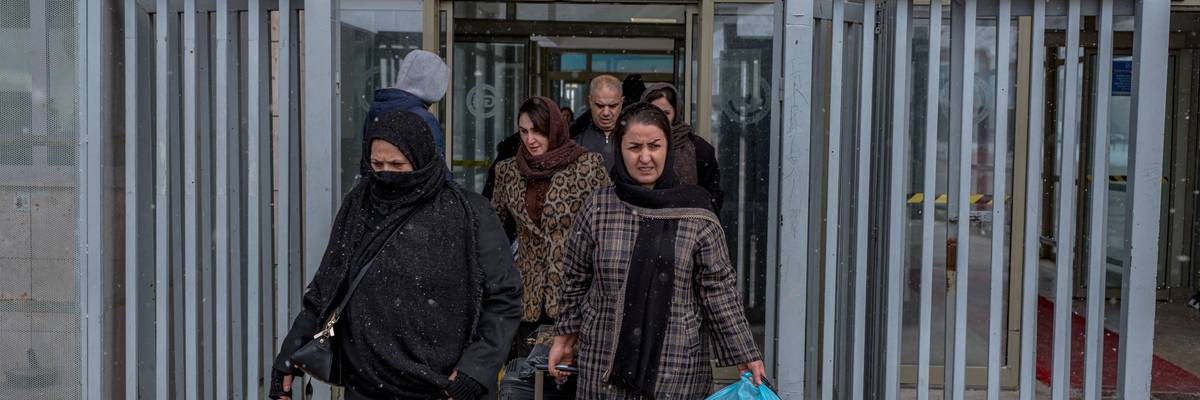
People, mostly Iranians who crossed from Iran at the Kapikoy border crossing, pull luggage in Turkey’s eastern Van province on March 6, 2026, as the US-Israel war on Iran drove a rise in cross-border travel and displacement.
(Photo by Murat Kocabas/Middle East Images/AFP via Getty Images)
“If this evolves into a long-term war, and particularly if internal conflict emerges in Iran, the humanitarian consequences could worsen dramatically,” said the president of Refugees International.
Stephen Prager, Common Dreams, Mar 12, 2026
In less than two weeks, the US-Israeli war in Iran has caused a displacement crisis that Refugees International warns is “on course for cataclysmic civilian harm, displacement, and humanitarian need,” amid repeated strikes on civilian sites and infrastructure.
As many as 3.2 million people are estimated to be temporarily displaced inside Iran, according to a report released Thursday by the Office of the United Nations High Commissioner for Refugees (UNHCR).
RECOMMENDED…
‘The Behavior of Rogue States’: Global Revulsion as US and Israel Launch War on Iran
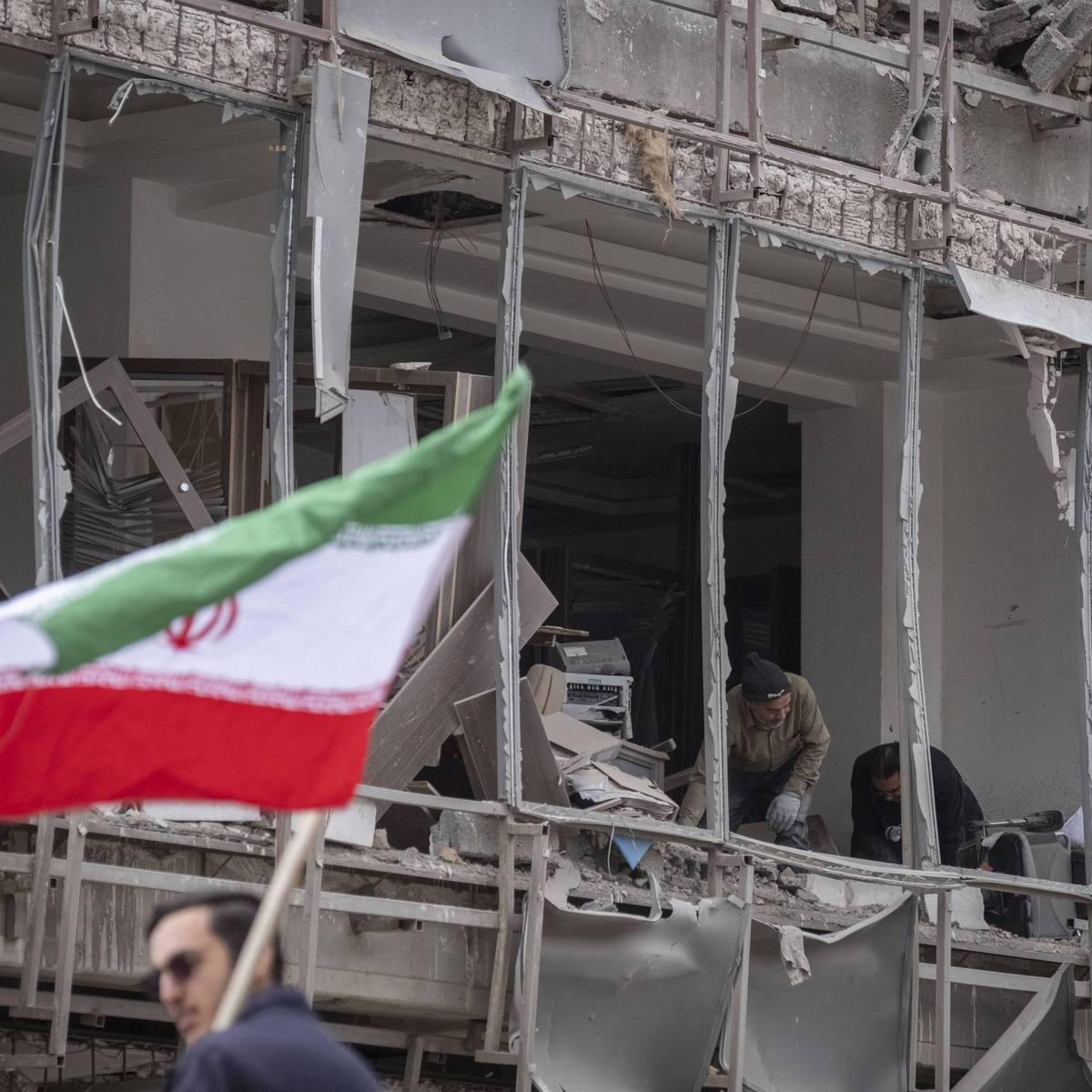
‘Unlike the United States,’ Says Security Chief, Iran ‘Has Prepared Itself for a Long War’
Most of those who’ve been forced to flee their homes have been in Tehran and other urban centers, where US and Israeli airstrikes have been the heaviest, the report said.
Since the war was launched on February 28, Iranian authorities and humanitarian groups have reported widespread attacks on civilian areas and infrastructure by US and Israeli forces.
The Iranian Red Crescent Society reported on Wednesday that nearly 20,000 civilian buildings, including at least 16,000 residential units, have been affected by strikes, along with 77 healthcare facilities and 65 schools.
About 200 children in Iran are among approximately 1,300 killed and 9,000 injured in less than two weeks of war, according to the World Health Organization (WHO), which cited figures from national authorities.
“The war launched by the United States and Israel against Iran has been characterized by multiple strikes on civilian sites and infrastructure by all sides, often with flagrant disregard for civilian safety,” said Jeremy Konyndyk, the president of Refugees International, on Wednesday. “The United States/Israeli coalition has struck numerous civilian sites in Iran, and the Iranian military has struck multiple civilian sites in Israel and in multiple Gulf countries.”
“These attacks on civilians have already caused hundreds of needless deaths and displaced hundreds of thousands of people,” he added. “The humanitarian impact could expand exponentially if this develops into a prolonged war.”
The deadliest single attack on civilians has been the bombing of the Minab elementary school in southern Iran on the first day of the war, where at least 175 people, mostly girls ages 7-12, were massacred. Preliminary findings of an investigation by the Pentagon reportedly indicate that the United States was responsible for the attack. Konyndyk said it was “likely the largest number of child casualties in a single US military attack since the My Lai massacre in Vietnam in 1968.”
“But the Minab strike is far from the only strike on civilian sites. US and Israeli attacks have struck other schools, multiple medical facilities, numerous residential areas, and a water desalination plant. Iranian attacks have also struck civilian targets and infrastructure, including a desalination plant and urban residential areas,” Kondynyk said. “All such sites are protected under international humanitarian law (IHL), raising the serious prospect that these strikes could constitute war crimes.”
He added that “It is difficult to regard the pattern of US strikes on civilian sites as mere tragic accidents when the United States has systematically removed many of the safeguards that once helped prevent harm to civilians.”
He condemned comments by US Secretary Pete Hegseth dismissing the “stupid rules of engagement” and his closure of a Pentagon office tasked with preventing civilian harm in order to maximize “lethality,” according to a recent investigation by ProPublica.
Hegseth emphasized last week that the United States was not planning to take in a, “new wave of Middle Eastern refugees” that might be forced to flee the region by continued attacks on Iran and other countries.
The Trump administration has let in virtually zero refugees from anywhere in the world since October, with the exception of white South Africans.
There are already around 25 million people living in the Middle East who are considered refugees, internally displaced, or had recently been returned after being displaced.
The defense secretary has said countries in the region are “capable” of handling the new influx of potentially millions more displaced people, even as the US has drastically reduced funds for international organizations that administer humanitarian aid and refugee resettlement.
There are more than 1.65 million refugees living in Iran, around 750,000 of whom are from Afghanistan. Kondynyk noted that many of them already “have limited access to their rights or safe passage and already face rights violations and scapegoating by the Iranian state.”
More than 800,000 people in Lebanon have been forced to flee their homes this month, according to Lebanese authorities, following Israeli orders clearing over 100 villages in the south and outside Beirut.
Meanwhile, the vast majority of Gaza’s nearly 2 million people still remain displaced after more than two years of genocidal war waged by Israel, which destroyed most civilian infrastructure, according to the International Organization for Migration.
“If this evolves into a long-term war, and particularly if internal conflict emerges in Iran, the humanitarian consequences could worsen dramatically,” Kondynyk said. “A prolonged conflict risks creating displacement and humanitarian crises on a massive scale, even as US cuts have kneecapped the global humanitarian system built to respond to such crises.”


No comments:
Post a Comment