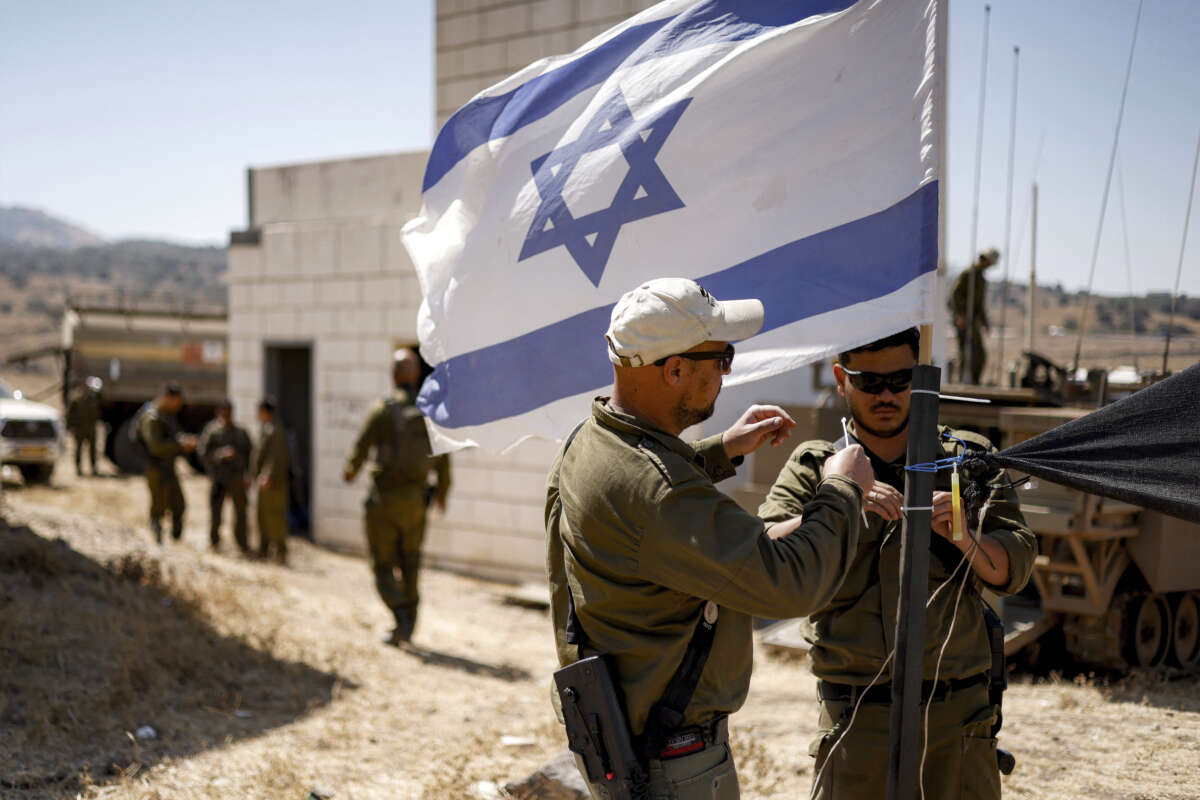
The settlers are increasingly crossing the border into Syria, with at least tacit support from the Israeli military.
By Theia Chatelle , Truthout Published April 28, 2026
Truthout is an indispensable resource for activists, movement leaders and workers everywhere. Please make this work possible with a quick donation.
Syrian journalist Oudai Efnikher is deeply familiar with life under Israeli occupation. He was born in Kafer Hareb, a village in Syria’s Golan Heights, from which he and his family were expelled after Israel seized the territory during the 1967 Six-Day War.
Now he is once again facing down Israeli forces, as they “take our land, kill our crops, and abduct our fathers.”
“This is a slow occupation, but soon, we will lose what they have not yet taken,” Efnikher told Truthout.
After Bashar al-Assad was ousted by Syrian rebels in December 2024, Israeli forces wasted no time before launching a massive aerial bombardment campaign on the country, destroying almost 80 percent of the military capacity left behind by the Assad regime.
Israeli forces also entered the demilitarized buffer zone established by a UN Security Council resolution in 1974 between the Israeli-occupied Golan Heights and the rest of Syria. They seized the territory and then established a “security buffer” beyond the last demarcation line administered by UN observer forces.
Related Story
|
“Price Tag” Attacks Part of Effort to Expand Israeli Settlements in West Bank
200 masked settlers descended on the West Bank on March 22, throwing Molotov cocktails and terrorizing Palestinians. By Theia Chatelle , Truthout
March 28, 2026
The area now under Israeli military control is off-limits to Syrian civilians and government forces. Farmers have been unable to tend to their land, and landowners have little hope they will ever be able to access it again
In total, Israel now occupies an additional 177 square miles of Syrian territory than it did before the fall of Assad.
“Maybe Israel will take it all. They already have a safe zone in southern Syria, so that could ultimately be the best option for Israel,” Syrian political analyst Issam Khoury told Truthout.
But what is most concerning for Efnikher is not the Israeli military’s presence in Syria, but what has become regular incursions by Israeli settlers.
On April 22, a group of roughly 40 settlers affiliated with the far right Halutzei HaBashan movement, or the Pioneers of Bashan — a reference to the name in the Torah for the fertile territory located northeast of the Sea of Galilee, which the Torah says was once ruled by the tyrant King Og before Moses defeated him — entered Syrian territory and asked the Israeli government to legalize settlement activity there.
According to Efnikher, who has been working to monitor Israeli settlement activity in Syrian territory since Assad’s fall in December 2024, this was the fifth such incursion by Israeli settlers into Syria.
According to Etkes, this is how the Israeli settlement movement functions: by “changing the facts on the ground” until what was once unthinkable becomes reality.
The settlers see themselves as fulfilling a biblical mandate. They consider this Syrian territory part of the ancient land of Israel. Still, the Israeli military condemned the incursion, calling it “a criminal offence that endangers civilians and IDF troops.” Dror Etkes, a longtime Israeli settlement monitor who led the advocacy group Peace Now’s Settlement Watch project and later founded Kerem Navot, an organization that tracks Israeli land seizures in the West Bank, says none of this comes as a surprise.
“Nothing is surprising anymore, not after Gaza,” he said. “Many things I didn’t think would happen have happened, so I think I should be pretty cautious when it comes to predicting what will happen in this country.”
Etkes watched settlers build their first outposts in the West Bank in the 1960s, and then, after the Second Intifada, the construction of the separation barrier. “If you had asked me 10 years ago, five years ago, two years ago, not to mention 50 years ago, whether half a million Jews would be living in the West Bank, whether we would have 350, 360, 370 outposts in the West Bank, of course nobody would have said yes,” he added.
According to Etkes, this is how the Israeli settlement movement functions: by “changing the facts on the ground” until what was once unthinkable becomes reality. And this, he says, is the goal of the settlement movement — whether it’s in Syria, Lebanon, Gaza, or the West Bank.
The Pioneers of Bashan is not the only settler organization entering closed military zones to pressure the Israeli government to legalize settlements in foreign territory.
In southern Lebanon, a group called Uri Tzafon has worked to build a movement to establish outposts in territory currently occupied by the Israeli military. The group has flown drones into Lebanese territory, urging residents to leave, and planted trees to cement a claim to the land.
It was the same in Gaza with the far right Tzav 9 movement, which on more than one occasion since October 7, 2023, attempted to enter the enclave and establish outposts.
Slowly, the borders of the Israeli imagination — much like the state’s own physical borders — are being expanded by the settlement movement.
Slowly, the borders of the Israeli imagination — much like the state’s own physical borders — are being expanded by the settlement movement. In many cases, these incursions have taken place with the implicit endorsement of the Israeli military.
According to both Etkes and Efnikher, it would have been impossible for the settlers to enter Syrian territory without at least the tacit approval of Israeli forces. There are hundreds of miles of fencing dividing the Israeli-controlled Golan from Syrian territory, reinforced by hundreds of thousands of mines.
Efnikher added that there are a number of gates in the fencing that allow the Israeli military to cross into and beyond the demilitarized buffer zone, which is how the Pioneers of Bashan were able to enter Syrian territory.
The Israeli military said in a statement after detaining and escorting the settlers back to Israeli-controlled territory that “settlement in Bashan is essential to preserve the achievements of the war.”
The push for these settlements is part of the project of Greater Israel, which seeks to expand Israel’s borders to what some settlers and religious nationalists claim were the boundaries of the ancient Israelite kingdom — a biblical vision, contested by mainstream archaeology, that imagines a realm stretching from the Euphrates to the Nile, encompassing parts of modern-day Saudi Arabia, Jordan, Iraq, and Egypt
But the expansionist drive is not only about land. It is also about water. Efnikher pointed to the Mantara Dam, the largest dam in Syria’s Quneitra Governorate. The dam controls water flow into the Yarmouk River, another critical water supply for southern Syria.
Before he was a journalist, Efnikher owned a restaurant overlooking the dam. It has been closed since Israeli forces expanded their occupation of the territory — a significant financial blow to him and his family, though he stressed that he is better off than most.
Israeli forces have destroyed thousands of dunams of farmland with pesticides in the process of building their outposts, and have established checkpoints — including aerial ones — to regulate the movement of Syrians near the buffer zone.
“There is a heavy psychological toll, falling heaviest on children and the elderly,” Efnikher said. “We’re talking about villages displaced since 1967 and families still affected across generations, now living through yet another occupation.”
He pointed to the West Bank as emblematic of what the Quneitra Governorate might soon become.
Israel has held control of the West Bank for so long that many Palestinians and Israelis in the territory, more than a third of whom are children, do not remember a time when it was free of Israeli outposts and settlements. Now, according to the UN’s High Commissioner for Human Rights, there are more than 279 illegal settlements and 700,000 settlers living in the West Bank.
“This is a model [they’re] trying to copy-paste in Syria and in Lebanon. It’s the same people, coming from the same places, from the same ideological greenhouses.”
The commitments of the settlement movement vary, but at its forefront are those who see it as their personal mission to restore Jewish sovereignty over the land they claim as Greater Israel, even if it must be paid for in blood.
“It’s been almost 58 years since this project started. And all of it started actually illegal[ly] or half-legal, started without official authorization. This is a model [they’re] trying to copy-paste in Syria and in Lebanon. It’s the same people, coming from the same places, from the same ideological greenhouses,” Etkes said.
Efnikher warned that Israeli forces are intensifying their incursions in the Quneitra region: They enter the villages, make arrests — by his tally, more than 70 Syrians from the Quneitra Governorate are currently held in Israeli prisons — set up checkpoints, and then withdraw.
But Efnikher fears it is only a matter of time before they stay. The presence of the Pioneers of Bashan is one troubling sign. “They are winning,” Efnikher said of the Israeli forces. Even for Etkes, there is little hope.
“Look at what they achieved in the last 58 years in the West Bank,” he said. “They have very good reasons to be very optimistic.”
Press freedom is under attack
As Trump cracks down on political speech, independent media is increasingly necessary.
Truthout produces reporting you won’t see in the mainstream: journalism from the frontlines of global conflict, interviews with grassroots movement leaders, high-quality legal analysis and more.
Our work is possible thanks to reader support. Help Truthout catalyze change and social justice — make a tax-deductible monthly or one-time donation today.
about:blank This article is licensed under Creative Commons (CC BY-NC-ND 4.0), and you are free to share and republish under the terms of the license.

Theia Chatelle is a freelance journalist and photographer covering conflict, human rights, and displacement across the Middle East, Europe, and the United States. Based in Jerusalem, she reports on war and social movements, with a focus on human-interest storytelling and investigations into state power. Her work has appeared in The Forward, The Nation, Haaretz, and the Jewish Telegraphic Agency, among other outlets. Her photography has been published by MS NOW and USA Today, among others. Chatelle holds bachelor’s and master’s degrees in American Studies from Yale University. She was a 2025 fellow at the International Women’s Media Foundation and is an alumna of the Rory Peck Trust and the Type Media Center.
Share


No comments:
Post a Comment