I was born in Poonch (Kashmir) and now I live in Norway. I oppose war and violence and am a firm believer in the peaceful co-existence of all nations and peoples. In my academic work I have tried to espouse the cause of the weak and the oppressed in a world dominated by power politics, misleading propaganda and violations of basic human rights. I also believe that all conscious members of society have a moral duty to stand for and further the cause of peace and human rights throughout the world.
Iran’s Foreign Ministry has described accusations of Iranian involvement in various security incidents, including the suspected plot on the RAF Fairford airbase in the UK, as a “raft made of lies”.
“False flags are an old craft: manufacture the incident, assign the blame and harvest the consequences,” Iranian Foreign Minister spokesman Esmaeil Baqeai said in a social media post.
As the international public grows sceptical of “an unlawful war of aggression against Iran, and where the aggressors have no honest way to justify a war of choice, even a raft made of lies can look like salvation to those who are drowning,” Baqeai said.
Yesterday, we reported that UK police arrested a 22-year-old British national on suspicion of a “terror” offence. The arrest was linked to a security incident near the UK airbase that hosted US warplanes used in the Iran war.
False flags are an old craft: manufacture the incident, assign the blame, and harvest the consequences.
In a world where the American and international public is weary of an unlawful war of aggression against Iran, and where the aggressors have no honest way to justify a war of… pic.twitter.com/RNKTilUrTv
Israeli politician Moshe Feiglin, the leader of Israel’s Zehut party, who has a clear path to a seat in the Knesset in the upcoming election, has said in a new interview that it would be “moral” to kill babies in Gaza.
Feiglin made headlines last year when he declared that every child and every baby in Gaza is the “enemy,” a viewpoint he doubled down on in an English-language interview that was published by The Jerusalem Post on Monday.
Feiglin said in the interview that he personally doesn’t want to see babies killed even though he thinks it is “morally” the right thing to do, and that he would prefer all Palestinians to be expelled from Gaza instead.
“I’m saying again again because I’m Jewish and I guess I’m a bit a little bit weak morally. I don’t want to see babies killed, okay? Morally, that should have been done, because of everything I explained. So, but because … I’m Jewish with a soft heart, I would open the borders and let them all go, but no one can stay. And it has to be a part of the Jewish land, Jewish state,” he said.
Elsewhere in the interview, Feiglin said it was “100%” a Jewish point of view to “wipe out” Gaza, expel all the Palestinians, and annex Gaza and the West Bank. He labeled all of Gaza as the “enemy,” not just Hamas.
“The baby that would be born — I’ll say something very tough now, excuse me for saying it — the baby that will be born tomorrow in Gaza, the Arab baby. Notice I’m not saying Hamas, I’m not saying Palestinian … the enemy is Gaza, not Hamas. The baby that will be born in Gaza tomorrow will do exactly the same — God forbid — to your baby that would be born in Jerusalem,” he said.
Feiglin served in the Knesset from 2013 to 2015 as a member of Prime Minister Benjamin Netanyahu’s Likud party and founded Zehut in 2015. Zehut is now running on a joint electoral list with Religious Zionism, the party led by Finance Minister Bezalel Smotrich, another outspoken proponent of the ethnic cleansing of Gaza. Feiglin holds the No. 2 spot on the joint list, and recent polling has shown the alliance clearing the electoral threshold needed to win seats in the Knesset.
‘It will take generations to recover from the harm that has already been done over the past three years,’ MSF says
İlayda Çakırtekin, AA.com,
05 October 2026
İSTANBUL
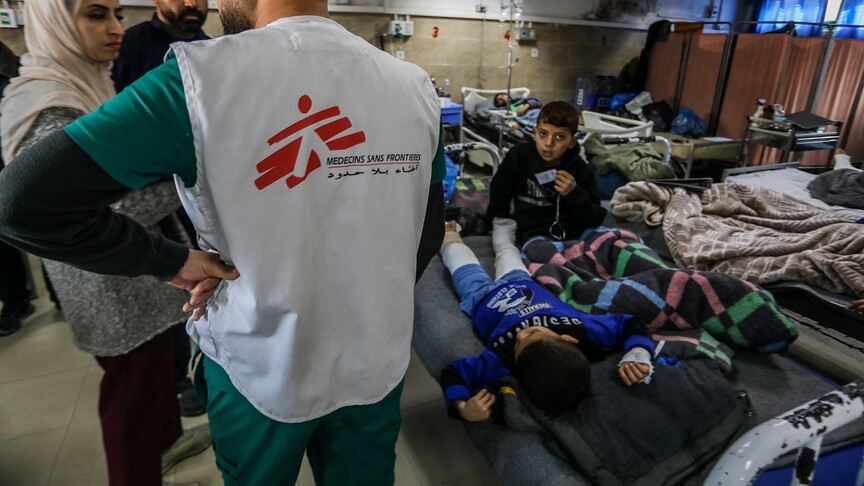
Doctors Without Borders (MSF) said on Monday that Israel was continuing its genocide in Gaza and was “progressively asphyxiating” the region, urging governments to take immediate action.
In a statement, MSF said the conditions for the people’s survival were being “systematically destroyed” through sustained violence, “deliberate” blockade of essential supplies and the destruction of healtcare as well as infrastructure.
“In the past year, the physical trapping of people in Gaza has been made increasingly definitive by the establishment of Israel’s Yellow Line,” the French medical charity said.
Recalling that it was originally presented as temporary, MSF noted that the line is now reinforced by military positions, berms and ongoing demolitions while it has continued to move west, “squeezing people into a smaller and smaller area.”
MSF said people risk being shot by Israeli forces when approaching the area, while its teams continue to treat those wounded by gunfire nearby.
“The Yellow Line cannot be treated simply as a line on a map,” said Amande Bazerolle, MSF head of emergency response in Gaza. “It has become a mechanism of encirclement and ethnic cleansing, while cutting communities off from the infrastructure, healthcare, water and other essentials they need to survive.”
MSF said violence was not only confined to the areas around the “Yellow Line,” reporting having treated over 1,200 cases of violent trauma across Gaza in June and July alone.
It recalled that MSF teams treated more than 200,000 trauma cases over the past three years while Israel’s military offensive killed over 74,000 people.
The organization said overcrowding and limited access to clean water, sanitation, shelter and healthcare are contributing to the spread of disease. Its teams also treated over 11,000 skin disease cases and 1,500 chickenpox cases in June and July.
It also pointed to the dramatic deterioration of access to healthcare over the past three years as hospitals run out of basic supplies and patients unable to access essential medicines and treatment.
“Restrictions on essential supplies, such as engine oil and spare parts, are also crippling the infrastructure needed to keep hospitals, ambulances and water systems running, with generators already breaking down and water-trucking operations reduced,” the statement said.
It added that the crisis is not limited to Gaza as violent occupier attacks, military operation and raids on homes, displacements as well as home demolitions escalated rapidly across the occupied West Bank and East Jerusalem.
“It will take generations to recover from the harm that has already been done over the past three years, and in the preceding decades, while the excruciating consequences of Israel’s ongoing genocide are still being felt every day,” Bazerolle said.
She warned that Israel carried out destruction, displacement and deprivation “with impunity” while such practices became “normalised.”
“Governments must act now to ensure Israel stops the destruction and killing, prevents ethnic cleansing, and stops denying Palestinians the means of survival,” Bazerolle added.
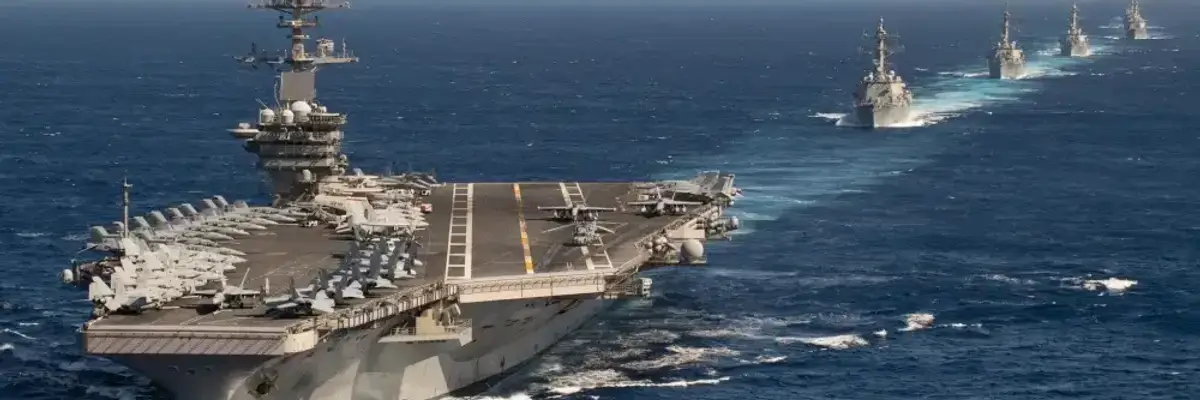
In this photograph released by the U.S. Navy, military planes stand on the flight deck of the Nimitz-class aircraft carrier USS Theodore Roosevelt, July 4, 2024, in the South China Sea. [AP Photo/Seaman Ryan Holloway]
The events of the past week leave no doubt that the Trump administration, w complicity of the entire US political establishment, is preparing a major escalation of the Iran war. Having failed to achieve its objectives through a massive bombardment and then a blockade of the country, the White House is preparing a new and desperate gambit, potentially involving the deployment of ground troops or even the use of nuclear weapons.With the complicity of media and Democrats, Trump prepares major escalation of Iran war
The greatest danger is the chasm between the scale of what is being prepared and the public’s awareness of it. One month before the 2026 midterm elections, Trump’s conspiracy to escalate the war is being greeted with a wall of silence by the US media—which devoted just minutes to the war in this weekend’s Sunday talk shows—and by the Democratic Party, which has done nothing to alert the public to the renewed onslaught against Iran that the administration is preparing.
On September 22, US President Donald Trump threatened in his speech before the United Nations to “annihilate the Islamic Republic, and do it quickly.” His threat followed a secret White House meeting, reported by the journalist Seymour Hersh on June 10, at which Trump spoke “about a nuclear option that could perhaps bring a quicker end to the war.”
These threats cannot be dismissed as bluster. Trump is the president of the United States and has already killed thousands of people in the months-long bombardment of Iran. The forces now converging on the Persian Gulf give him the means to carry out his threats. Nothing would be more dangerous than complacency.
After seven months of war, US imperialism has failed to achieve its aims of dominating the Strait of Hormuz, militarily defeating Iran and overthrowing its government. The administration is improvising, desperately seeking a way out of the political disaster the war has produced. But its improvisation is driven by the logic of events. American imperialism cannot accept defeat in the Persian Gulf, and each failure becomes the basis for an ever-greater escalation.
Last week, the Wall Street Journal and the Associated Press reported that the White House had sent a third aircraft carrier to the Middle East. The USS Theodore Roosevelt left San Diego on September 27, followed the next day by the amphibious assault ship USS Makin Island with about 2,200 Marines. They will join the carrier USS George Washington and more than 50,000 US troops deployed across the region.
Trump “has told aides he expects to resume bombing Iran after the November midterms,” the Journal reported September 25. He was briefed in August on opti
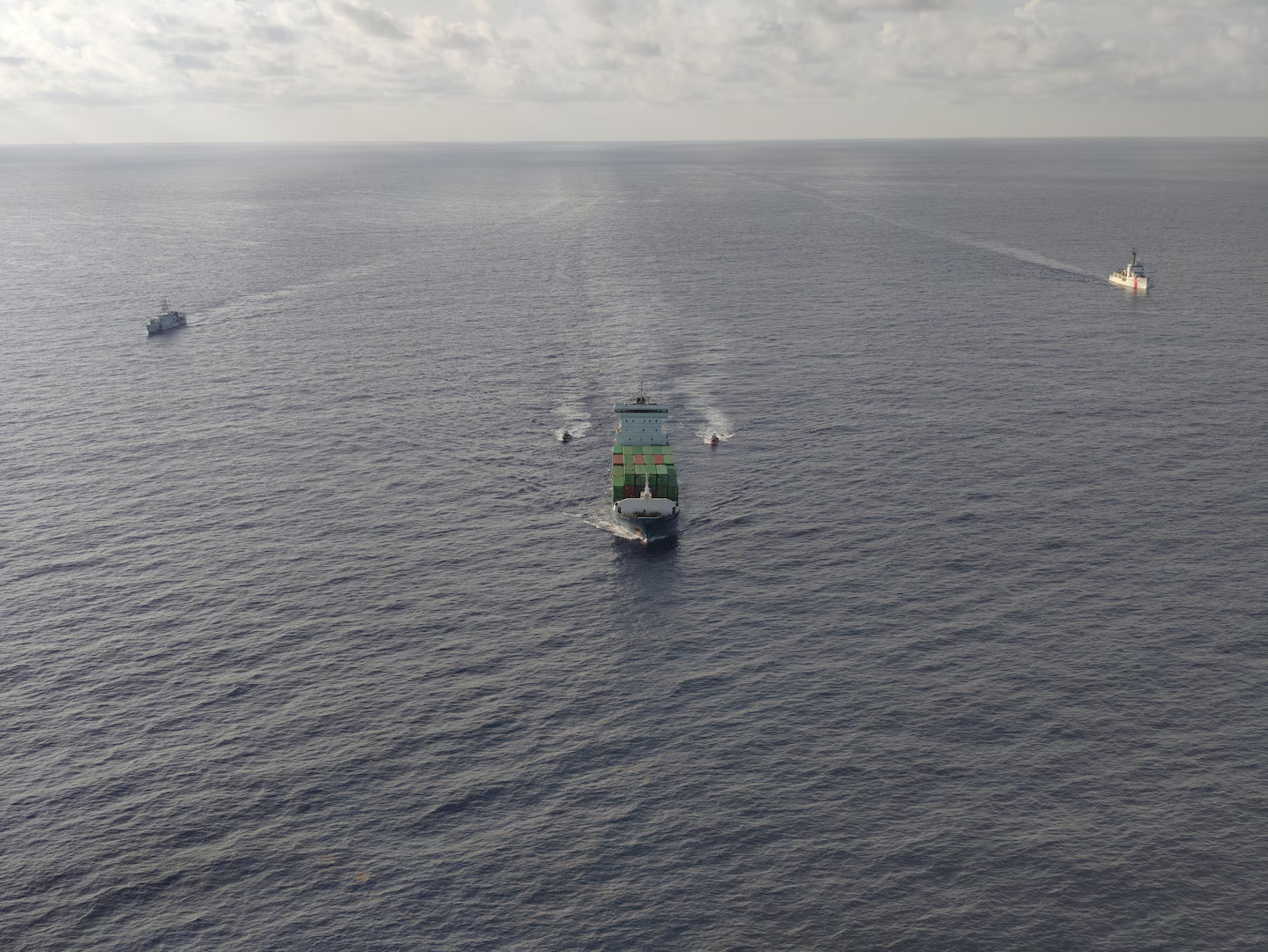
The US Coast Guard said Friday that its forces intercepted a ship that was attempting to bring fuel to Cuba, as the US continues to enforce a ramped-up oil embargo on the country, which has caused a devastating humanitarian crisis.
The Coast Guard said that the incident occurred in early September, when a “Coast Guard tactical team” boarded the M/V Grace, a 300-foot-long container ship, in the Caribbean Sea.
Photo of the interception released by the Coast Guard
The Coast Guard said it then escorted the ship to Mexico, where Mexican authorities found fuel stored in the ship’s ballast tanks. It said that earlier in the summer, US Coast Guard personnel stopped and boarded the M/V Jaira Provider, another vessel it accused of carrying fuel bound for Cuba.
The Trump administration ramped up the oil embargo on Cuba after it attacked Venezuela to abduct President Nicolas Maduro in January, which gave the US the power to cut off Venezuelan oil shipments to the island nation. The US also pressured Mexico to end its oil exports to Cuba.
The embargo has caused daily blackouts, which have been detrimental to the civilian population of Cuba. Cuban doctors told The New York Times back in March that patients were dying due to the US blockade, as the conditions at hospitals caused by the fuel shortages were leading to preventable deaths.
The escalated blockade has come with threats and preparations for military action against Cuba. CBS Newsrecently reported that the US Military has been working to establish “the groundwork for potential action around Cuba.”
The USS Theodore Roosevelt, left, and the USS Carl M. Levin prepare for a refueling in the Pacific Ocean, Nov. 16, 2025. [Photo: Navy Petty Officer 3rd Class Aaron Haro Gonzalez ]
The Trump administration is sending the aircraft carrier USS Theodore Roosevelt and three amphibious warships carrying about 2,000 Marines to the Middle East. The ships will reinforce the US forces arrayed against Iran with as many as 10,000 sailors and Marines, the Wall Street Journal and Bloomberg News reported Thursday, citing US officials.
The deployment follows US President Donald Trump’s threat before the UN General Assembly on September 22 to “annihilate the Islamic Republic and do it quickly” and to “drive them into hell with no chance of survival and no hope of future greatness or generations.” Two days later, Israeli Prime Minister Benjamin Netanyahu told the General Assembly that Iran’s “murderous regime will be toppled,” declaring: “This evil regime will fall, and we will all celebrate that day.”
The buildup puts the White House on a course to massively accelerate the war following the US midterm elections on November 3, which are expected to reflect the overwhelming unpopularity of the war among workers and young people. But while the Democrats may be the beneficiaries of the elections, they have pledged, like Trump, to ensure the subjugation of Iran to American interests.
The Journal reported September 25 that Trump “has told aides he expects to resume bombing Iran after the November midterms.” The Journal wrote Thursday, citing US officials, that the ships would arrive by late November.
Bloomberg, citing a US official, wrote that the deployment “gives American commanders more options if President Donald Trump chooses to escalate attacks on Iran.”
Axios quoted a US official Thursday as saying the region “could potentially have up to three aircraft carrier strike groups. This is much more firepower.”
The Roosevelt sailed from San Diego on Sunday, and the USS Makin Island amphibious group followed on Monday. Whether the Roosevelt will add to the carriers already in the region or replace one of them has not been decided, Axios reported, citing a second official. The United States already has more than 50,000 troops in the region.
In recent weeks the Trump administration has also sent two more Patriot missile batteries to Saudi Arabia and Qatar, Axios reported Thursday, to protect energy facilities “in case President Trump decides to resume major combat operations against Iran.”
On Thursday, as he left the White House, Trump said: “They’ll either sign a very fair deal, or they won’t exist any longer,” The Hill reported.
In an interview with Time magazine conducted Monday and published Thursday, Trump was asked whether he would “ramp up bombing after the midterms.” He answered: “Possible.”
Pressed again, Trump said: “We have a lot of weapons. You know, we’ve been stocking up for the last six months.” Reminded of his threat at the UN to “annihilate” Iran, he said: “Yeah, I would do that. It’s possible.”
Dominant sections of the US media are agitating for an escalation of the war.
In an editorial headlined “The Battle of Hormuz Is Turning,” the Journal’s editors declared Thursday that the US military had “turned around the battle of the Strait of Hormuz.” They wrote: “This is what progress looks like: Iran’s oil is blocked while the world’s oil increasingly gets through.”
The editorial concluded: “The challenge now is to sustain the pressure and push the US tactical advantage to accomplish strategic objectives—finishing the nuclear program or the regime itself.”
At least five tankers have come under attack in or near the Strait since Monday, the shipping news site Riviera reported Friday. On Thursday the Kuwaiti supertanker Kazimah III caught fire after it was struck by what the UK Maritime Trade Operations center called “an unknown projectile.”
The US Navy has blockaded Iran’s ports since July. By Wednesday it had redirected 125 commercial ships, according to the US military, and on September 26 Trump boasted that the blockade was “a wall of steel.”
Reuters reported Thursday, citing three senior Iranian officials and an insider, that Iran is preparing “a broader and more forceful response if the United States resumes large-scale military attacks.” According to the news agency, “Senior commanders are reviewing plans to expand potential targets beyond US-linked assets to countries that support US military operations and possibly to locations outside the Middle East.”
Official figures compiled by Al Jazeera count at least 3,527 people killed in Iran by US and Israeli bombing between February 28, when the two powers launched the war, and August 28. By September 28, the US military had counted 19 American service members dead and 861 wounded.
Leading Democrats spent the past week attacking Trump for losing the war and for “weakness” toward China.
Democratic Senator Ruben Gallego of Arizona told CNN on Wednesday that Defense Secretary Pete Hegseth should be “figuring out how to win this war in Iran.”
Democratic Representative Jake Auchincloss of Massachusetts accused Trump of losing the war in an interview with CNN on September 25. Trump, he said, had sent Russian President Vladimir Putin and Chinese President Xi Jinping a message “of appeasement and weakness.”
In remarks on Capitol Hill about Xi’s state visit last week, aired Sunday on “Fox News Sunday,” Democratic Senator Richard Blumenthal of Connecticut denounced Trump for “feting and celebrating Xi while he is aiding Iran, which is trying to kill our sons and daughters.” He said he was “shocked and deeply alarmed that the president, in effect, is kowtowing to him and failing to release the money that Taiwan needs to defend itself.”
Democratic Senator Mark Kelly of Arizona, interviewed Sunday on ABC’s “This Week,” declared: “We can’t leave the Strait in the hands of the Iranians.”
The buildup against Iran is proceeding alongside the escalation of the US-NATO war against Russia, which Moscow has answered with the threat to use nuclear weapons if NATO moves to cut off Kaliningrad, the Russian exclave on the Baltic Sea between Poland and Lithuania.
“Russia would be ready to use all its arsenal, including nuclear weapons, to defend its territory if NATO countries try to isolate Kaliningrad region from the rest of the country,” the Russian embassy in Ireland wrote on September 29.
Russian President Vladimir Putin repeated the threat Thursday at the annual meeting of the Valdai Discussion Club, a Russian foreign-policy forum. “If it comes to a direct attack on the Russian Federation—in this case, Kaliningrad, although it could potentially involve other territories as well—the question of Russia using all the weapons at its disposal would inevitably and immediately arise,” he said.
Asked about Russia’s warning at a Euronews conference in Brussels on Wednesday, NATO Secretary General Mark Rutte responded: “We will defend every inch of NATO territory.”
The World Socialist Web Site is the voice of the working class and the leadership of the international socialist movement. We rely entirely on the support of our readers. Please donate today!
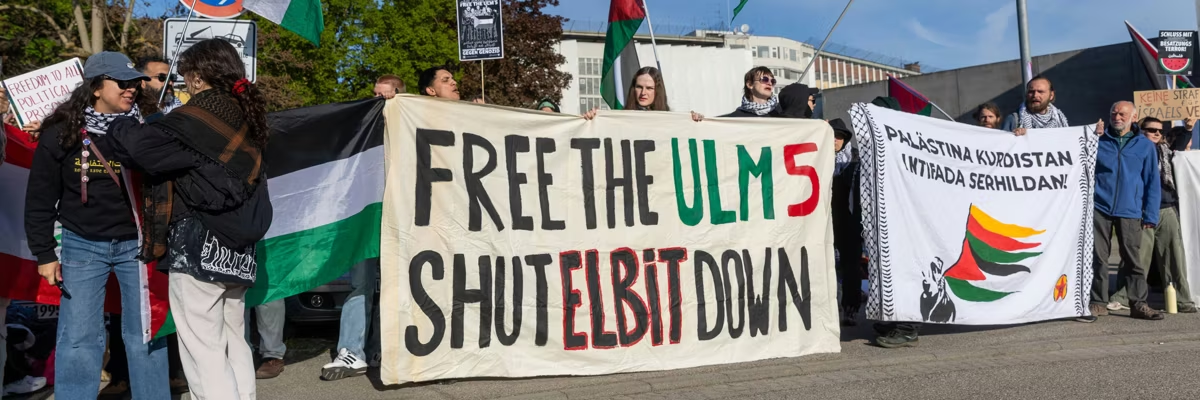
In front of the court building, activists gathered for a solidarity rally before the start of the trial against five pro-Palestine activists, holding a banner reading, “Free the Ulm 5, shut elbit down” on April 27, 2026 in Baden-Württemberg, Stuttgart, Germany.
(Photo by Julian Rettig/picture alliance via Getty Images)
The trial of five Palestinian rights activists, now approaching its final stage, has exposed for all to see not only Germany’s increasingly neofascist playbook for silencing dissent but complicity in Israel’s genocide.
Germany is a country with a long and complex relationship to authoritarianism. It is also of course the country that gave birth to the most evil political regime, Nazism, in the modern era.
The Allies agreed on the denazification of Germany as a goal after the end of World War II, but the general consensus is that it wasn’t a success. Some high-ranking Nazis were put on trial and sentenced to death, others were removed from public positions, but the majority of Nazis were reintegrated into postwar German society and even landed high-ranking positions.
Now, Germany is again displaying worrying signs of authoritarianism, as evidenced by the meteoric rise of the far-right Alternative for Germany (AfD) party. However, Germany’s love affair with authoritarian rule runs deeper than the current surge of the AfD. Its legal and judicial system has become notorious for its restrictions on freedom of speech and its penchant for framing dissent “not as a democratic expression but as a threat to public order.”
The treatment of the Ulm5 young activists is in clear violation of European human rights law.
The Ulm5 trial underway in Stuttgart, and now approaching its final stage, has exposed for all to see not only Germany’s increasingly neofascist playbook for silencing dissent but complicity in Israel’s genocide.
In the early hours of September 8, 2025, five young pro-Palestinian activists broke into the German branch of Israeli arms manufacturer Elbit Systems in Ulm, southern Germany. Once inside, they broke windows and destroyed furniture and technical equipment. They also sprayed slogans on the walls, such as “Free Palestine” and “Germany finances, Israel bombs.” No one was injured in the attack, and the activists not only remained on site but called the police themselves and waited to be arrested.
Since their arrest, the five activists—Daniel Tatlow-Devally (an Irish citizen), Leandra Rollo (a Spanish-Argentinian citizen), Crow Tricks and Zo Hailu (British citizens), and Vi Kovarbasic (a German citizen)—have been held in separate prisons and under highly degrading conditions. They are subjected to solitary confinement conditions lasting 23 hours a day, with just a couple of very short family visits per month. Irish politicians who visited Daniel Tatlow-Devally in prison were shocked by what they witnessed.
The Ulm5 activists are being treated like terrorists; in fact, they are being treated in a similar fashion as were the kidnappers, bank robbers, and murderers of the militant “Red Army Faction” group during their arrest in the 1970s. It is thus no coincidence that the trial of the Ulm5 activists is being held at Stuttgart-Stammheim, the very venue where the terrorist trials of the 1970s were held.
The defense team of Ulm5 has asked repeatedly why the trial is being held at high-security Stuttgart-Stammheim courthouse when the five defendants merely caused property damage without anyone being hurt, but no answer has been provided. Yet the answer is clear. It’s because German authorities treat Palestinesolidarity as support for terrorism. In the eyes of current German laws, especially in connection with the long-standing political assertion that “Israel’s security is Germany’s raison d’état,” the genocidal party must, by necessity, be protected and those who protest against its crimes must, by extension, be treated as nothing more than criminals or plain terrorists.
Conveniently enough, the Ulm5 pro-Palestinian activists are being charged under Section 129 of the German Criminal Law, which is directed toward ordinary organized crime and criminalizes “whosoever forms an organization, the objectives or activities of which are directed toward the commission of crimes, or whoever participates in such an organization as a member, recruits for it, or supports it.” Section 129 has two components. Subsection (a) is labeled “forming terrorist organizations” and applies to “whosoever forms an organization whose aims or activities are directed at the commission of murder… or genocide… or crime against humanity… or a war crime;” subsection (b) is directed toward any person or organization whose aim is to cause “serious physical or mental harm to another person;” commit offenses against the environment; and commit offenses under the provisions of the Weapons of War Act.
If anything, 129a applies to Israel for carrying out genocide, war crimes, and crimes against humanity. Israel’s crimes against Palestinians have been well documented by scores of international bodies and international human rights organizations while many Holocaust scholars, including Israeli organizations, have concluded that Israel’s actions in Gaza should be treated as a case of genocide. Hamas and other Palestinian armed groups also committed crimes against humanity on October 7, according to international human rights organizations such as Human Rights Watch.
Charging the Ulm5 pro-Palestine activists under Criminal Code Section 129 is a criminal act in itself by the German authorities. It shows that Germany is unwilling to tolerate any dissent or protest and will employ the repressive apparatus of the state to the possible maximum extent in order accomplish this goal. Indeed, this is not the first time that Criminal Code Section 129 has been used to suppress protests. A nationwide raid was carried out in May 2023 against the climate change protest group “Last Generation” after, ironically enough, the parliamentary body of the AfD had called on the Federal Government to examine the conditions for a ban on the organization, alleging that it was in violation of the constitutional order. And in March 2025 German public prosecutors filed charges against five members of the group for “forming a criminal organization.”
In Berlin alone, more than 3,000 climate activists have been sentenced over the past few years, according to the German newspaper Die Zeit.
Both climate activists and pro-Palestinian activists are being thoroughly pursued in Germany by its police state. Marginalized groups in cities like Berlin and elsewhere are also feeling “the politics of extreme policing,” as Berlin-based journalist and author Hanno Hauenstein put it.
The grotesque Ulm5 trial has multiple critical hearings scheduled for the month of October (the trial is slated to end in January 2027) as prosecutors seek to convict the young activists with being members of a criminal organization, which carries a sentence of up to five years in prison. The defendants are always handcuffed when they walk into the courtroom and are held in a bullet-proof glass cage.
This is an image straight out of Vladimir Putin’s Russia or Kim Jong Un’s North Korea. Or perhaps what one might have expected to see with the AfD in power. But it’s all quite revealing of how far contemporary Germany has gone into becoming once again a police state. And if this state of affairs has become again “normal” in mainstream German society, it is nonetheless an utterly disgraceful situation for the rest of Europe. The treatment of the Ulm5 young activists is in clear violation of European human rights law, as the defense lawyer of one of the accused young activists has already argued, and using the Criminal Code 129 to target protest movements and activists is plain fascism.
It’s been nearly 30 years since I co-founded Common Dreams with my late wife, Lina Newhouser. We had the radical notion that journalism should serve the public good, not corporate profits.
It was clear to us from the outset what it would take to build such a project. No paid advertisements. No corporate sponsors. No millionaire publisher telling us what to think or do.
Many people said we wouldn’t last a year, but we proved those doubters wrong.
Together with a tremendous team of journalists and dedicated staff, we built an independent media outlet free from the constraints of profits and corporate control. Our mission has always been simple: To inform. To inspire. To ignite change for the common good.
Building Common Dreams was not easy. Our survival was never guaranteed. When you take on the most powerful forces—Wall Street greed, fossil fuel industry destruction, Big Tech lobbyists, and uber-rich oligarchs who have spent billions upon billions rigging the economy and democracy in their favor—the only bulwark you have is supporters who believe in your work.
But here’s the urgent message from me today. It’s never been this bad out there. And it’s never been this hard to keep us going. At the very moment Common Dreams is most needed, the threats we face are intensifying. We need your support now more than ever.
We don’t accept corporate advertising and never will. We don’t have a paywall because we don’t think people should be blocked from critical news based on their ability to pay. Everything we do is funded by the donations of readers like you.
When everyone does the little they can afford, we are strong. But if that support retreats or dries up, so do we.
Will you donate now to make sure Common Dreams not only survives but thrives?
—Craig Brown, Co-founder
about:blank
about:blank
Our work is licensed under Creative Commons (CC BY-NC-ND 3.0). Feel free to republish and share widely.
C.J. Polychroniou is a political scientist, political economist, author, and journalist who has taught and worked in numerous universities and research centers in Europe and the United States. His main research interests are in US politics and the political economy of the United States, European economic integration, globalization, climate change and environmental economics, and the deconstruction of neoliberalism’s politico-economic project. He has published scores of books and over 1,000 articles which have appeared in a variety of journals, magazines, newspapers, and popular news websites. Many of his publications have been translated into a multitude of languages, including Arabic, Chinese, Croatian, Dutch, French, German, Greek, Italian, Japanese, Portuguese, Russian, Spanish, and Turkish. His latest books are The Precipice: Neoliberalism, the Pandemic, and the Urgent Need for Radical Change (an anthology of interviews with Noam Chomsky, 2021); Economics and the Left: Interviews with Progressive Economists (2021); Illegitimate Authority: Facing the Challenges of Our Time (an anthology of interviews with Noam Chomsky, 2023); and A Livable Future Is Possible: Confronting the Threats to Our Survival (an anthology of interviews with Noam Chomsky, 2024).
The Pentagon is preparing to dramatically expand the American military presence in the Middle East as President Donald Trump weighs renewed attacks on Iran, with thousands of additional troops and a third aircraft carrier being readied for deployment, even as the conflict he has repeatedly declared “over” or “won” threatens to erupt into a new and potentially broader phase.
The Washington Postreported Thursday that the Pentagon is preparing options that could put as many as three US aircraft carriers and their accompanying warships in the Middle East.
According to The Associated Press, around 9,000 additional sailors and Marines are being dispatched aboard the USS Theodore Roosevelt carrier strike group and the USS Makin Island amphibious readiness group. The buildup could push the number of US personnel in the region above 20,000 by late October.
The Roosevelt is being sent to relieve the USS George Washington, while a third carrier, the USS George HW Bush, is also already in the region.
The new deployment plans come as diplomacy between Washington and Tehran remains stalled, and as Trump has repeatedly threatened to resume large-scale military action—including the total annihilation of the nation of over 90 million people—after the November midterm elections.
“Either they’ll do something very proper and smart, or they won’t be around very long,” Trump said of the Iranian government Thursday in Denton, Texas. “Frankly, I hate to see that, but they won’t be around very long.”
Iran, meanwhile, has reportedly begun preparing for a more expansive retaliation should the United States launch another major attack in the illegal US-Israeli war of choice against the Middle East nation.
Hamidreza Azizi, a senior Iran analyst at the International Crisis Group, told Reuters Thursday that the Iranian government seems “determined not to respond symbolically to a symbolic move and instead to escalate in the hope of reestablishing deterrence.”
Republican National Committee Co-Chair Lara Trump—the president’s daughter-in-law—warned during a Wednesday interview with British journalist Harry Cole that the increasingly protracted Iran War could not only tarnish Trump’s legacy, but could also cost Republicans next month’s midterm elections.
“Well, it’s possible,” Trump—who campaigned as the “peace president” on a promise of no new wars—said of the midterm risks Thursday on his way to Texas, before adding that “it should help because Iran will not have a nuclear weapon.”
The intelligence consensus of every US administration since former President George W. Bush—including during both of Trump’s terms—has been that Iran has not been trying to develop nuclear weapons.
Moscow’s call for Palestinian statehood is empty rhetoric from a state that chose Israel in 1948 and stands by it today through genocide in Gaza and war on Iran
Russian Foreign Minister Sergei Lavrov addresses the 81st session of the UN General Assembly in New York on 26 September 2026 (Charly Triballeau/AFP)
In his address to the 81st session of the UN General Assembly last week, Russian Foreign Minister Sergei Lavrov emphasised: “The time has also come to address the main issue in the Middle East – ensuring the Palestinian statehood on the basis of countless United Nations decisions.”
Support for Palestinian statehood has been Moscow’s position since the Soviet Union backed partition in 1947, and it has remained so since the Russian Federation’s establishment in December 1991.
Rather than providing the Palestinians with substantial support against their Israeli colonisers, the Russian Federation has, since 1991, at best offered nothing more than empty diplomatic rhetoric in support of a defunct two-state solution while maintaining cordial relations with Israel.
Even after Israel openly aligned itself with the all-out western war against Russia through the war in Ukraine, the Russians have not abandoned their alliance with Israel. In that alliance, and in its pretence of “both-sidesism” through continued support for the defunct two-state solution, the Russian Federation has fared much worse than the USSR.
Aside from meaningless diplomatic declarations like Lavrov’s last week, Russia’s lukewarm support for Iran in the current war is hardly a major deviation from the Soviets’ careful balancing act in the post-war period. The Soviet and subsequent Russian commitment to alienating the Arab public continues apace.
New MEE newsletter: Jerusalem Dispatch
Sign up to get the latest insights and analysis on Israel-Palestine, alongside Turkey Unpacked and other MEE newsletters
Far from forging a new path, the Russian Federation has refused to change its policies towards the Palestinians and Zionism, except by increasing trade and security coordination with Israel over the past three and a half decades. Its support for the Palestinian Authority (PA), which collaborates with Israel and the West, hardly counts as support for the Palestinians.
Given these realities, it is curious that no one in Russia’s ruling circles has thought of radically changing its failed Middle East policy.
Soviet alternatives
The Russian Bolsheviks, both Christians and Jews, had all along vehemently opposed not only Zionism but even the anti-Zionist Jewish nationalism of the General Jewish Labour Bund in Lithuania, Poland and Russia (known as the Bund), which called for non-territorial Jewish cultural autonomy.
It was after the Russian Revolution and the establishment of the Soviet Union that Bolshevik opposition to Zionism became state policy, while their earlier opposition to Bundist Jewish nationalism wavered. The Bund soon dissolved itself, and most of its members joined the Communist Party of the Soviet Union (CPSU).
Indeed, many former Bundists became officials in the party’s Jewish Section (Yevsektsia), implementing Soviet cultural and linguistic (Yiddish) policies towards the union’s Jewish population.
It was after the Russian Revolution and the establishment of the Soviet Union that Bolshevik opposition to Zionism became state policy
It was the Jewish Section of the CPSU that led the charge against Zionism in the country. Zionist organising became illegal in the USSR, and prominent Soviet Jewish and Christian figures railed against the settler-colonial movement in speeches and publications, describing Zionists as colonialists who aimed to subordinate indigenous Palestinian workers to British capital.
At the same time, the Soviets embarked on a policy that continued the tsars’ sponsorship of Jewish agricultural colonisation inside the country, which dated back to the late 18th century.
Under the tsars, Russian Jews were dispatched to Siberia, southern Russia, the Caucasus and Crimea to establish agricultural settlements, a number of which were still prospering at the time of the Russian Revolution.
The onslaught of the tsarist White armies and their western European sponsors against the revolution devastated the Pale of Settlement, where most Jews had lived under the tsars, killing upwards of 100,000 Jews and destroying the livelihoods of the survivors.
It was in that context that the nascent Soviet government co-sponsored and co-financed a new project with the American Jewish Joint Distribution Committee to establish more agricultural colonies for Jews in southern Ukraine, the North Caucasus, the Volga region and Crimea. The project ran from 1924 until 1938, when the joint committee ran out of the funding to continue.
Soviet Zion
In 1934, the Soviets, who refused to create a “Jewish” province in Crimea because of opposition from the indigenous Crimean Tatars, created one in sparsely populated Birobidzhan. This was intended to satisfy anti-Zionist Jewish nationalists who saw the principled Soviet policies of fighting antisemitism and integrating Soviet Jews as the best riposte to settler-colonial Zionism.
While many Jewish officials opposed the project, a pro-Birobidzhan article in the Communist International’s (Comintern) International Press Correspondence (Inprecor) declared:
Now proof has been furnished that the Jews, like all the other peoples, are able like pioneers, under the hardest physical conditions, to convert an undeveloped country into a country of socialist culture. There is no “Arab question”, no conflict of imperialist interests, no flight from one anti-Semitism to another. That is the solution to the Jewish question by the Soviet Power.
The article, by an author identified only as MZ, was titled “Socialist Construction in the Soviet Union: Biro Bijan, an Autonomous Jewish Province” and appeared in Inprecor, volume 14, number 32, on 1 June 1934.
Indeed, it was the soft Zionist and hard anti-communist Hannah Arendt who admitted as much: “The Russian Revolution has dealt a blow to the first [Zionist] contention that the Jewish Question can be solved only in Palestine and that antisemitism is only to be eradicated by the building up of Palestine, in other words by the exodus of Jews from their former homelands.”
Still, the majority of Soviet Jews remained anti-nationalist and supported assimilation into Soviet society. Only a small percentage moved to Birobidzhan or to the agricultural colonies, while the majority moved to large Soviet cities in Russia, Belorussia and Ukraine, spurning Jewish nationalism in all its guises – Zionist, Bundist and Soviet-sponsored alike.
By the Second World War, Jews were so integrated into Soviet society that more than 100 Jewish generals served during the war in the Red Army, which the Jewish Bolshevik Leon Trotsky had founded and led.
The Soviets and their Communist International defended the Palestinians’ right to revolt against the British and the Zionists in both the 1920s and the 1930s, condemning the Zionists outright. In the wake of the 1929 Palestinian Buraq Wall uprising, Georgy Safarov, deputy director of the Comintern’s Eastern Department, strongly condemned the “Zionist colonies in Palestine”, describing “the Jewish community in Palestine [as] a British imperialist avant-garde”.
By the end of the war and after the Holocaust, however, Stalin had made an about-face.
Zionist reversal
Zionist lobbying of Soviet embassies in Britain and Turkey helped, but was not the main reason. At the beginning of the Cold War, the reactionary Arab monarchies and the conservative Palestinian leadership were allied with the imperialist West. Their post-war alliances and hostility to communism did not endear them to the Soviets.
Zionist pretensions to being committed socialists and non-partisan in the Cold War helped convince the Soviets to support a one-state solution for Palestinians and Jewish settlers or, failing that, the partition of Palestine into two states – one for the settlers and the other for the indigenous population.
The Soviet ambassador to the UN, Andrei Gromyko, received new instructions from Moscow in April 1947 that upended the previous Soviet anti-Zionist position. Gromyko gave impassioned speeches in May and November 1947, defending the Jewish settlers’ alleged right to establish a state in Palestine while blaming western European countries for failing to help Jews during the war.
When Israel was proclaimed, the Soviets rushed to recognise it, earning the hostility of the majority of the Arab world and permanently alienating all Arab communist parties, which toed the Soviet line, from the Arab public. If the Soviets thought they had gained an ally in the Middle East by supporting the Zionists, they soon realised their miscalculation.
Still, under Nikita Khrushchev, who had succeeded Stalin as party leader the previous year, the Soviet legation in Israel was upgraded to an embassy in June 1954.
It was the Arab republics, however, that would prove the friendliest Arab regimes to the Soviets: Egypt from the mid-1950s, Iraq after 1958 and Algeria after 1962, followed by others.
The Soviets continued their diplomatic relations with Israel, while their support for the Arab republics remained lukewarm compared with western imperialism’s support for Israel and the reactionary Arab regimes.
Israel’s alliance with imperialism and hostility to the Soviets were such that it launched a campaign branding the Soviets, the first regime in the world committed to fighting antisemitism in word and deed, as “antisemites”.
As Jews in western countries refused to move to Israel and immigration dried up, the Israelis sought to bring Soviet Jews to populate their settler-colony. That was the context in which they charged the Soviets with antisemitism for refusing to allow Soviet Jews to leave for Israel.
Diplomatic limits
The Soviets cut off relations with the Jewish settler-colony after the Israeli invasion of three Arab countries in 1967. Israel then intensified its campaign against Soviet “antisemitism” until the Soviets finally succumbed and allowed large-scale Jewish emigration from 1971 onwards. Half of those who left chose the US rather than Israel.
The relaxation was part of the Soviet attempt to maintain detente with the US, which led the anti-Soviet campaign on Israel’s behalf. It was Soviet leader Mikhail Gorbachev who relaxed emigration restrictions between 1987 and 1989, allowing a million Soviet Jews to leave the collapsing USSR for Israel, the only country that would readily take them.
Gorbachev re-established diplomatic relations with Israel in October 1991, and on 16 December that year, under US pressure, the Soviet Union voted to repeal the UN’s “Zionism is racism” resolution, which the Soviets had supported in 1975.
Unless it radically changes its Middle East strategy, Russia will remain an insignificant factor in the ongoing struggle to end Zionist settler-colonialism and Israeli regional imperialism
If Stalin’s about-face on Zionism was motivated by the Holocaust, the Cold War and the dearth of pro-Soviet Arab rulers, would the current western war against Russia, the genocide of the Palestinians and the anti-imperialism of Iran and the Lebanese and Palestinian resistance not be sufficient to prompt another reversal?
It is true that all the Arab regimes, including the collaborationist PA, are in the West’s back pocket today, as they were in 1948. They are not, however, the only players in the political field.
Western support for the Zionist project was aimed, as the antisemitic Winston Churchill put it in his 1920 article “Zionism versus Bolshevism”, at striking a blow against the Russian Revolution and “international communism”, which he identified as a Jewish “world-wide conspiracy”.
Britain’s Balfour Declaration, issued in 1917 in support of what Churchill called the “National Jews”, five days before the triumph of the Russian Revolution, was engineered to prevent Russian Jewish support for the revolution. The plan failed.
Under Gorbachev, however, the Soviet Union aptly cast one of its last votes at the UN to rehabilitate Zionism. By supporting the repeal of the “Zionism is racism” resolution days before the curtain dropped on the USSR, it erased the Soviet era’s anti-Zionism once and for all.
In view of this history, the Russian Federation should expect little change in its standing in the Middle East. Unless it radically changes its Middle East strategy, it will remain an insignificant factor in the ongoing struggle to end Zionist settler-colonialism and Israeli regional imperialism.
The views expressed in this article belong to the author and do not necessarily reflect the editorial policy of Middle East Eye.
Joseph Massad is professor of modern Arab politics and intellectual history at Columbia University, New York. He is the author of many books and academic and journalistic articles. His books include Colonial Effects: The Making of National Identity in Jordan; Desiring Arabs; The Persistence of the Palestinian Question: Essays on Zionism and the Palestinians, and most recently Islam in Liberalism. His books and articles have been translated into a dozen languages.
As the Trump administration fights to keep deporting immigrants to countries where they have no connections, we studied the system that profits from these grave abuses.
The Intercept, September 29, 2026, 11:00 a.m. ET Share
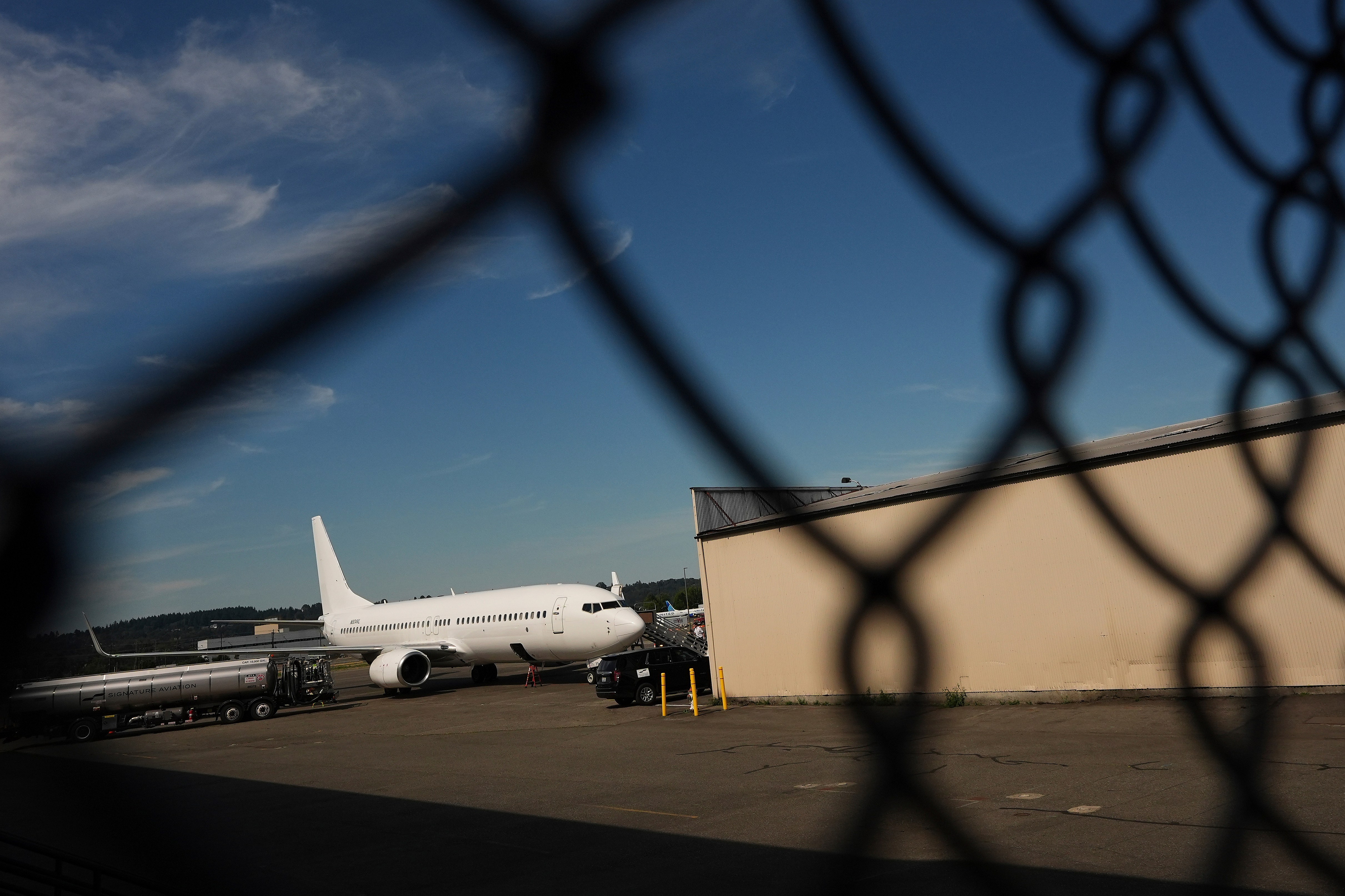
An ICE flight operates out of King County International Airport, also known as Boeing Field, on Aug. 23, 2025, in Seattle. Photo: Lindsey Wasson/AP
Tyler McBrien is the managing editor of Lawfare.
More than 25,000 people have had their lives upended and been forced into unfamiliar cultures, governments, and legal systems when the Department of Homeland Security deported them to so-called “third countries,” places where immigrants previously living in the United States have no connections and few rights — and where a deportation business booming under the second Trump administration finds its murky endpoints.
“The point is to scare people,” said one Trump administration official, according to a Senate Foreign Relations Committee minority report. “With countries like Palau or Eswatini, the point is that the Administration can threaten people that they will literally be dropped in the middle of nowhere.”
As is the case for many tools of its cruelty, the Trump administration did not invent third-country removals — it refashioned them to serve its own excesses. In the past, the U.S. used the obscure administrative compromise for people who could prove they would face persecution or harm if returned to their home country yet did not meet other requirements for asylum. The U.S. had to meet humanitarian and legal obligations, such as ensuring third countries would not turn around and deport migrants right back to their home countries. It was a last-resort tool that still left people displaced from their homes and communities in service of the country’s arcane immigration laws. But the current Trump administration’s policy, premised on agreements with at least 35 countries, has been anything but humane.
Nor has it been particularly legal. After the 1st U.S. Circuit Court of Appeals struck down the third-country deportation scheme, DHS scheduled a flight to deport migrants involved in a class-action lawsuit challenging the policy to Burundi, Rwanda, and the Central African Republic. Despite a successful emergency motion their lawyers filed last week, an Immigration and Customs Enforcement jet flew to two African countries that hold third-country removal agreements, according to the American Prospect. It is not yet clear who was on the plane or whether ICE carried out third-country removals in violation of a federal court order, and the Trump administration is now aiming to take the legal fight to the Supreme Court.
The saga illustrates the Trump administration’s proclivity for obfuscation, secret contracts, nondisclosure, and dealmaking of the backroom variety. Whether digitally disappearing people from ICE’s online detainee locator tool last week, or inking multimillion-dollar sole-source contracts with inexperienced companies of questionable provenance, the Trump administration has pursued its immigration goals under the cover of darkness, often justifying the secrecy with invocations of national security, all while attempting to shield itself from public scrutiny and accountability in the process.
“Deportation, Inc.: The Rise of the Immigration Enforcement Economy,” an ongoing investigative video series from Lawfare and SITU Research, in partnership with The Intercept, examines how U.S. immigration enforcement has evolved into a multibillion-dollar industry shaped by private profit and political power — where contracts, capital flows, and institutional incentives increasingly govern detention, deportation, and surveillance. The project joins other efforts to shed light on the often invisible economy of immigration enforcement, including the Berkeley Human Rights Center, Human Rights First, Third Country Deportation Watch, and others.
The first installment, released last December, focuses on the business of migrant detention and profit motive underpinning the brutality of privately run ICE detention facilities. The second chapter, out today, looks at the network of flights shuffling migrants between those facilities, as well as the shady deals brokered with the governments of deportation destinations.
Many details of these bilateral third-country removal agreements are not public, but the logic is transactional: Countries accept asylum-seekers and other immigrants from the United States in exchange for aid or other forms of financial compensation. Many of the countries involved in what The Intercept’s Nick Turse has called Trump’s “global gulag” are so dangerous that the State Department includes them on its “Level 4 Do Not Travel” list, “the highest advisory level due to life-threatening risks. And the very fact that these people are sent to a third country, rather than repatriated, means they have at least a viable asylum case.
Some but not all of the underlying texts of these agreements have come to light, often popping up in far-flung corners of the internet. This is not only a bad practice in government transparency, but a potentially illegal one as well. Lawfare, where I serve as managing editor, has argued as much in a federal district court in Washington, D.C., where the publication has sued the State Department over its failure to disclose international agreements into which the Trump administration has entered — in violation of the Case-Zablocki Act.
Though accelerated by the Trump administration, the secrecy that has enabled the growth of the vast, invisible economy of immigration enforcement traces back to at least 2001 with the creation of the Department of Homeland Security. Following the September 11 attacks, the new Cabinet-level department, along with other federal reforms, for the first time linked immigration with national security, which resulted in massive budget increases, new abilities to shield immigration information from the public, and general judicial deference to the executive branch that accompanies matters of foreign policy and national security.
Even the current Trump administration’s third-country deportation apparatus is beginning to build up its own record of cruel precedent. In the same class-action case last year, the Department of Homeland Security attempted to deport class members to Libya and South Sudan, in apparent violation of a temporary restraining order granted by a federal judge only weeks prior. During a hastily arranged hearing, a federal judge asked a Justice Department lawyer about the plane’s whereabouts, to which the government attorney responded, “I’m told that that information is classified, and I am told that the final destination is also classified.” Asked under what authority the government had classified the location, the Justice Department lawyer did not have an answer.