Wednesday, September 13, 2023

“A Good Investment”: The Ukraine War and the US Arms Racket

By Binoy Kampmark Via Counterpunch, Sep 12, 2023

It all tallies. War, investments and returns. The dividends, solid, though the effort expended – at least by others – awful and bloody. While a certain narrative in US politics continues in the vein of traditional cant and hustling ceremony regarding the Ukraine War – “noble freedom fighters, we salute you!” twinned with “Russian aggressors will be defeated” – there are the inadvertently honest ones let things slip. A subsidised war pays, especially when it is fought by others.

The latter narrative has been something of a retort, an attempt to deter a growing wobbling sentiment in the US about continuing support for Ukraine. In a Brookings study published in April, evidence of wearying was detected. “A plurality of Americans, 46%, said the United States should stay the course in supporting Ukraine for only one to two years, compared with 38% who said the United States should stay the course for as long as it takes.”

In early August, a CNN survey found that 51% of respondents believed that Washington had done enough to halt Russian military aggression in Ukraine, with 45% approving of additional funding to the war effort. A breakdown of the figures on ideological grounds revealed that additional funding is supported by 69% of liberals, 44% of moderates and 31% of conservatives. In Congress, opposition to greater, ongoing spending is growing among the Republicans, reflecting increasing concern among GOP voters that too much is being done to prop up Kyiv.

Such a mood has been anticipated by number crunching types keen to reduce human life to an adjustable unit on a spreadsheet. The Centre for European Policy Analysis, for example, suggested that a “cost-benefit analysis” would be useful regarding US support for Ukraine. “Its producing wins at almost every level,” came the confident assessment. In spectacularly vulgar language, the centre notes that, “from numerous perspectives, when viewed from a bang-per-buck perspective, US and Western support for Ukraine is an incredibly cost-effective investment.”

War-intoxicated Democrats would do well to remind their Republican colleagues about such wins, notably to those great patriots known as the US Arms Industry. Aid packages to Ukraine, while dressed up as noble, democratic efforts to ameliorate a suffering country’s position vis-ร -vis Russia, are much more than that.

In May 2022, for instance, President Joe Biden signed a bill providing Kyiv $40.1 billion in emergency funding, split between $24.6 for military programs, and $15.5 billion for non-military objects. Even then, it was clear that one group would prove the greatest beneficiary. Stephen Semler of the Security Policy Reform Institute was unequivocal: US military contractors.

Of the package, rich rewards amounting to $17.3 billion would flow to such contractors, comprising goods, be they in terms of weapons and equipment, or services in the form of training, logistics and intelligence. “It allows the Biden administration,” writes Semler, “to continue escalating the United States’ military involvement in the war as the administration appears increasingly disinterested in bringing it to an end through diplomacy.”

Broadly speaking, the US military-industrial complex continues to gorge and merely getting larger. Whatever the outcome of this war – talk of absolute victory or defeat being the stuff of dangerous fantasy – it remains the true beneficiary, the sole victor fed by new markets and opportunities. Former Israeli foreign minister Shlomo Ben-Ami, now vice president of the Toledo Center for Peace, had to concede that the US arms industry was the “one clear winner” in this bloody tangle.

The addition of new member states to NATO, in this case Finland and Sweden, will, Ben Ami suggests, “open up a big new market for US defence contractors, because the alliance’s interoperability rule would bind them to American-made defence systems.” The evidence is already there, with Finland’s order of 64 new F-35 strike fighters developed by Lockheed Martin, Northrop Grumman and BAE Systems. The Ukraine War has been nothing short of lucrative in that regard.

Such expansion also comes with another benefit. The interoperability requirement in the NATO scheme acts as a bar to any alternatives. “The market for their goods is expanding,” writes Jon Markman for Forbes, “and they will face no competition for the foreseeable future.”

It should come as little surprise that the US defence contractors have been banging the drum for NATO enlargement from the late 1990s on. While a good number of those in the US diplomatic stable feared the consequences of an aggressive membership drive, those in the business of making and selling arms would have none of it. The end of the Cold War necessitated a search for new horizons in selling instruments of death. And with each new NATO member – Hungary, Poland, the Czech Republic – the contracts came. Washington and the defence contractors, twinned with purpose, pursued the agenda with gusto.

In 1997, Democratic Senator Tom Harkin was awake to that fact in hearings of the Senate Appropriations Committee on the cost of NATO enlargement. He was particularly concerned by a fatuous remark by Secretary of State Madeleine Albright comparing NATO’s expansion with the economic Marshall plan implemented in the aftermath of the Second World War. “My fear is that NATO expansion will not be a Marshall plan to bring stability and democracy to the newly freed European nations but, rather, a Marshall plan for defense contractors who are chomping [sic] at the bit to sell weapons and make profits.”

The moral here from the US military-industrial complex is: stay the course. The returns are worth it. And in such a calculus, concepts such as freedom and democracy can be commodified and budgeted. As for Ukrainian suffering? Well, let it continue.

Binoy Kampmark was a Commonwealth Scholar at Selwyn College, Cambridge. He lectures at RMIT University, Melbourne. Email: bkampmark@gmail.com


Tuesday, September 12, 2023

๐”๐’ ๐’๐ž๐œ๐ซ๐ž๐ญ๐š๐ซ๐ฒ ๐จ๐Ÿ ๐’๐ญ๐š๐ญ๐ž ๐๐ฅ๐ข๐ง๐ค๐ž๐ง: ๐”๐’ ๐ƒ๐จ๐ž๐ฌ ๐๐จ๐ญ ๐Ž๐ฉ๐ฉ๐จ๐ฌ๐ž ๐”๐ค๐ซ๐š๐ข๐ง๐ž ๐“๐š๐ซ๐ ๐ž๐ญ๐ข๐ง๐  ๐‘๐ฎ๐ฌ๐ฌ๐ข๐š๐ง ๐“๐ž๐ซ๐ซ๐ข๐ญ๐จ๐ซ๐ฒ ๐–๐ข๐ญ๐ก ๐”๐’-๐๐ซ๐จ๐ฏ๐ข๐๐ž๐ ๐Œ๐ข๐ฌ๐ฌ๐ข๐ฅ๐ž๐ฌ

ABC News reports that the US is likely to arm Ukraine with ATACMS, which have a range of up to 190 miles


by Dave DeCamp, Antiwar. com, September 11, 2023

Secretary of State Antony Blinken said Sunday that it was up to Ukraine whether or not to target Russian territory with US-provided weapons, a policy that brings the US and Russia closer to a direct clash.
Blinken made the comments after ABC News reported that it’s likely the Biden administration will soon arm Ukraine with Army Tactical Missile Systems (ATACMS), which have a range of up to 190 miles.
While appearing on ABC’s ‘This Week,’ Blinken was asked if he was OK with Ukraine using ATACMS to hit targets deep inside Russian territory. “In terms of their targeting decisions, it’s their decision, not ours,” Blinken replied.
When asked about the increasing Ukrainian drone attacks inside Russia, Blinken claimed the US does not “encourage” or “enable” the operations. However, The Economist recently reported that Ukrainian drone attacks on Russia frequently use intelligence gathered by Kyiv’s Western backers.
As the war has dragged on, the Biden administration has been less and less concerned about the risk of Ukrainian attacks inside Russia escalating the war. The administration previously feared that Russia could respond to such attacks by targeting a NATO country.
The US has also brushed off Russian warnings against providing Ukraine with longer-range missiles, as Moscow has previously called them a “red line.” According to a US official speaking to ABC, the ATACMS “are coming.”

Monday, September 11, 2023

Fifty years after Chile’s coup, the region still not safe from US meddling


Destructive US efforts to control its ‘back yard’ continue to this day.

John Kirk
John Kirk is Professor Emeritus of Latin American Studies at Dalhousie University, Canada

Stephen Kimber
Professor of journalism at the University of King’s College

Al Jazeera, 11 Sep 2023

Today is the 50th anniversary of a devastating military coup in Chile which gave way to one of the most brutal dictatorships in Latin American history.

On September 11, 1973, a military junta, led by General Augusto Pinochet, overthrew the democratically elected government of President Salvador Allende. What followed was a 17-year dictatorship which tortured 40,000, killed more than 3000 and “disappeared” more than a thousand others. Hundreds of thousands were forced into exile.

The Nixon administration in the United States encouraged and supported the coup that paved the way for these atrocities.

Since former US President James Monroe effectively announced a protectorate over the Western Hemisphere in December 1823, known as the Monroe Doctrine, the US has been interfering in nations across Latin America, often in pursuit of its own interests, but always under the guise of protecting democracy and human rights in its “backyard”.

The 1973 coup in Chile was one such intervention.

Official documents and telephone call transcripts that were declassified and made public over the years paint a clear picture of how Washington worked to ensure Allende’s downfall ever since he scored a narrow victory in the September 8, 1970, presidential election.

According to handwritten notes of then CIA Director Richard Helms, just more than a week after Allende’s victory, on September 15, 1970, President Richard Nixon ordered him to “make the economy scream” in Chile to “prevent Allende from coming to power or to unseat him”. Three days earlier, in a phone call to Helms that he recorded, Nixon’s national security adviser, Henry Kissinger, had already confirmed the administration’s intention to overthrow Allende, noting “We will not let Chile go down the drain.”

And on September 16, 1973, just six days after Pinochet’s bloody putsch, Nixon called his national security adviser to ask whether the US “hand” in the coup would show. According to declassified call transcripts, Kissinger admitted that “we helped them” and that “[deleted reference] created conditions as great as possible.”

The US did not end its destructive meddling in Chile’s affairs after successfully instigating a coup against its democratically elected leader either.

Three years into Pinochet’s murderous rule, in June 1976, Kissinger personally visited the Chilean capital, Santiago, to reaffirm Washington’s support for the dictator. According to a declassified transcript of their one-on-one conversation, Kissinger advised Pinochet on how to improve his image in the international arena and dismissed all criticism of his regime’s human rights record as “leftist propaganda”. “In the United States, as you know, we are sympathetic with what you are trying to do here,” Kissinger told Pinochet, who had by then already killed and disappeared thousands of his regime’s detractors “We want to help, not undermine you,” he added. “You did a great service to the West in overthrowing Allende.”


Saturday, September 09, 2023

๐–๐ก๐จ ๐œ๐ซ๐ž๐š๐ญ๐ž๐ ๐ญ๐ก๐ž ๐“๐š๐ฅ๐ข๐›๐š๐ง? ๐“๐ก๐ž ๐”๐’ ๐ซ๐ฎ๐ฅ๐ž๐ซ๐ฌ ๐๐ข๐.


  --- Nasir Khan

The Afghan Mujahideen (Islamist fighters) of the 1980s who took power in Afghanistan as Taliban in the 1990s were the creation of the United States and some of the US allies in the Middle East and Pakistan. That's history. No need for me to repeat what has happened since the US invasion and occupation of Afghanistan. We know how the Afghans after taking Kabul on August 15, 2021 showed human decency to allow the defeated US army to get out of Afghanistan safely.

Thursday, September 07, 2023

The Myth of NATO as a Defensive Alliance

by , FFF,

NATO is not a purely defensive alliance, and its members are not peace-loving democracies.
[Click to Tweet]

The operational expression of the myth is most evident regarding relations with Russia.  According to the dominant narrative (that a sycophantic news media obediently circulate) is that NATO’s addition of new members in Eastern Europe during the post-Cold War era posed no threat to Russia’s security. Even the extensive efforts to turn Ukraine into an alliance military asset supposedly did not constitute dangerous provocations. Those actions included multiple weapons sales to Kyiv, the training of Ukrainian military forces, joint NATO-Ukraine war games, and apparently joint cyberwarfare operations against Russian targets.

All of these moves occurred against the background of Washington’s withdrawal from both the Intermediate-Range Nuclear Forces (INF) Treaty and the Open Skies Agreement, even though the preservation of both measures was a high priority for the Kremlin. Despite that long pattern of belligerent behavior, Western officials continued to insist not only that Ukraine has every right under international law to join NATO, but that Moscow would have no reason to consider such a move a menace to Russia’s security.

Washington is trying to foster a similar narrative with respect to policy toward the People’s Republic of China (PRC). During the last two NATO summits, much of the discussion has focused on how to deal with China. That orientation might seem a bit odd for an alliance whose official name is the North Atlantic Treaty Organization. However, the United States clearly is pushing its European allies to enlist in an increasingly hardline policy toward Beijing. It is a transparent effort to include NATO as a player in an anti-PRC containment policy, including a willingness to help defend Taiwan.

Even if one ignores those most recent moves, the assertion that NATO is a defensive alliance is absurd. NATO conducted an air war against Bosnian Serbs in 1995 and against Serbia itself in 1999, even though neither entity had attacked or even threatened any NATO member.  The alliance similarly launched air and missile strikes against Libya in 2011 to help oust Muammar Qaddafi from power. Even though NATO justified using military force in Afghanistan as a response to the 9-11 terrorist attacks on an alliance member, it was a great stretch of logic to justify the subsequent two-decade-long occupation of Afghanistan as a defensive mission.

In addition to NATO’s official missions that clearly were not defensive in nature, there have been other warlike actions involving some or most members of the Alliance. Both the 1991 Persian Gulf War and the 2003 Iraq War fit that description.  In both conflicts, the vast majority of the anti-Iraqi forces came from NATO countries, mostly from the United States and Great Britain. Those offensive operations were Alliance missions under U.S. control in all but name.

Most foreign governments and populations also are unlikely to believe the related mythology that NATO members are peace-loving democracies. Indeed, even the alliance’s democratic credentials have failed to live up to that standard on several occasions. Portugal, one of NATO’s founding members in 1949, was a fascistic dictatorship. The military junta that took power in Greece in 1967 ruled that country for seven years. Turkey has maintained a democratic faรงade throughout most of NATO’s history, but the military and other authoritarian players have held sway most of the time. That is certainly the case with respect to the current government.

Finally, there have been the acts of flagrant aggression that individual NATO members have committed over the decades. Washington’s war in Vietnam may be the largest and best-known example, but it is hardly the only one. The U.S. military interventions in Lebanon, the Dominican Republic, Grenada, and Panama also belong in that category.

Nor is the United States the only NATO member to engage in flagrant aggression. France has intervened in Chad and its other former colonies in Africa on several occasions. Indeed, Paris is threatening to support a new mission to overthrow the junta now ruling Niger. Turkey invaded Cyprus in 1974 and seized nearly 40 percent of the island. Ankara’s forces routinely operate in both Iraq and Syria despite the objections of the governments in those countries.

The West’s twin propaganda images should be greeted with derisive laughter. NATO is not a purely defensive alliance, and its members are not peace-loving democracies. NATO is an aggressively offensive alliance looking for new opportunities around the world.


This post was written by:

Ted Galen Carpenter is a policy advisor for The Future of Freedom Foundation. He is also a senior fellow at the Randolph Bourne Institute and a senior fellow at the Libertarian Institute and served in various policy positions during a 37-year career at the Cato Institute. Dr. Carpenter is the author of 13 books and more than 1,200 articles on international affairs. His latest book is Unreliable Watchdog: The News Media and U.S. Foreign Policy (2022).


Wednesday, September 06, 2023

Watchdog: Cluster Bomb Deaths in Ukraine Are Highest in the World

by , The Libertarian Institute,  Sep 5, 2023

As the proxy war in Ukraine continues raging, people are being killed and wounded by cluster bombs at a higher rate than anywhere else in the world including Syria, according to the Cluster Munition Coalition.

The coalition – which is a network of non-governmental organizations that support banning the controversial weapons – released an annual report showing 2022 was the deadliest year on record globally for cluster bomb related killings.

Cluster bombs open up in the air and scatter scores of small bomblets and submunitions across large target areas, these often kill non-combatants for decades prior to the conclusion of conflicts where the arms are used. More than 120 countries have signed on to a United Nations convention prohibiting the munitions which kill indiscriminately. However, Washington, Kiev, and Moscow are not signatories.

Both Kiev and Moscow have been firing the weapons during the war. In July, the White House announced the US would be providing Ukrainian forces with cluster bombs, even though evidence already existed that Kiev had used the munitions to kill civilians before and after the Kremlin launched its invasion.

Alex Hiniker, an independent expert with the Forum on the Arms Trade, complained that he and other researchers are “baffled by the fact that [Washington] is sending totally outdated weapons that the majority of the world has banned because they disproportionately kill civilians.”

Over 300 people were killed, and in excess of 600 were wounded, by these bombs in Ukraine last year per the coalition’s report. In Syria, which was until recently the site of the most yearly cluster bomb casualties, saw 15 people killed and 75 wounded. In Iraq, where the US military has used cluster bombs during the Gulf War and the 2003 invasion, 15 people were killed and 25 were wounded.

In Yemen, where Riyadh has used US provided cluster bombs to kill civilians during its genocidal war against northern Yemen’s Houthis, there were five deaths and 90 people wounded by the bomblets last year. In 2022, there were no cluster bomb attacks reported in either Iraq or Yemen.

The primary victims of the unexploded, so-called duds – bomblets which look like metal balls – are children who pick them up to play with them unaware of what they actually are. The submunitions also often shepherds and scrap metal collectors – a not uncommon post-war source of income –  explains Laura Persi, an editor of the coalition’s annual report.

During the Vietnam War, US forces dropped hundreds of millions of cluster bomblets on Vietnam, Cambodia, and Laos. People still die in Laos on a yearly basis as a result of the tens of millions of unexploded ordinances left behind after US bombing campaigns.


Monday, September 04, 2023

Modi’s lesson from Israel: Demolish Muslim homes, erase their history

The Hindu far-right’s actions in Nuh, in India’s Haryana, echo Israel’s policies of trying to delete histories and legacies of the Palestinian people.

  • Somdeep Sen, Associate Professor of International Development Studies at Roskilde University

Al Jazeera, 4 Sep 2023

India Haryana demolitions
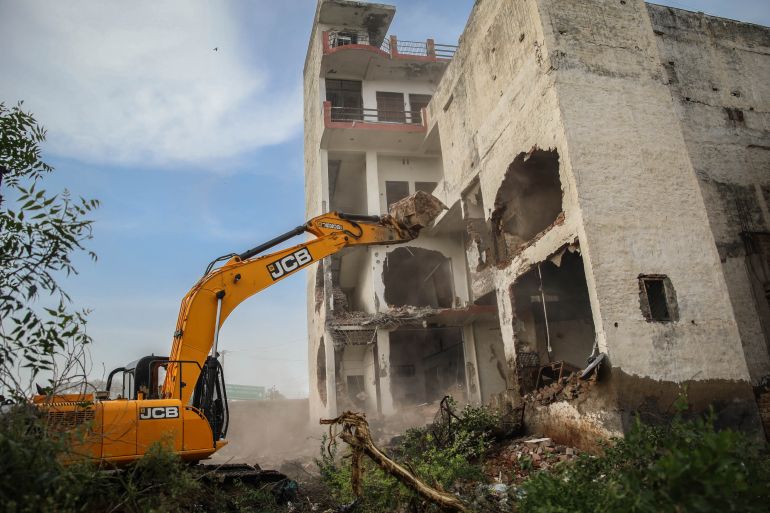
A bulldozer demolishes a Muslim-owned property in Nuh, Haryana, India after violence in the district in early August [Md Meharban/ Al Jazeera]

In early August, the world watched in horror as authorities in the northern Indian state of Haryana demolished more than 300 Muslim-owned homes and businesses in Nuh – the only Muslim-majority district in the state.

Hindu right-wing groups in Haryana followed up the violence with calls to boycott Muslim businesses and for Hindu-owned businesses to fire Muslim employees. Before the demolition drive, clashes broke out between Hindu and Muslim groups in Nuh when a procession led by the far-right Hindu organisation Vishwa Hindu Parishad reached the district.

What we are witnessing is undoubtedly a consequence of the hateful rhetoric encouraged under the current Hindu nationalist regime.

Yet, the large-scale destruction of Muslim homes and properties in parts of the country like Nuh, where the community has lived for centuries, points to something even more sinister: a concerted effort to erase all evidence of Muslim presence and heritage in the country.

Is it paranoid to worry that this, in turn, could be a first step to triggering a full-fledged genocide?

Learning from Israel

Over the years, under Indian Prime Minister Narendra Modi’s leadership, we have seen India increasingly cosying up to Israel. And the Hindu right has been explicit in its aspiration to emulate Israel’s approach to Palestinians.

Specifically, they appear to be inspired by Israel’s effort to systematically erase Palestinian history, legacy and culture from the landscape. They are inspired by the way more than 530 Palestinian villages were systematically destroyed during and after the Nakba of 1948, as well as the way Palestinian homes continue to be demolished across the occupied West Bank and Jerusalem to make way for Israeli settlements considered illegal under international law.

Much like Israel’s Ben Gurion Airport stands adamantly on the remains of Palestinian communities forced from their homes, a new temple to the Hindu god Ram has been built over the debris of the historic Babri Masjid mosque in India, destroyed in December 1992 by extremists gathered by Modi’s party.

There’s more that they probably want to pick up from Israel, such as the way Israeli museum exhibits insistently refused to mention Palestinians or acknowledge Palestinian existence as a distinct national community.

How about laws like Israel’s that deny Palestinians even the right to mourn the loss of ancestral homes and land or seek to reclaim them? This includes Amendment 40 to the Budget Foundations Law that criminalises the commemoration of the Palestinian Nakba.