As international eyes stay locked on Gaza, Tel Aviv is executing its most aggressive campaign of ethnic cleansing and land theft in the occupied West Bank since 1948.

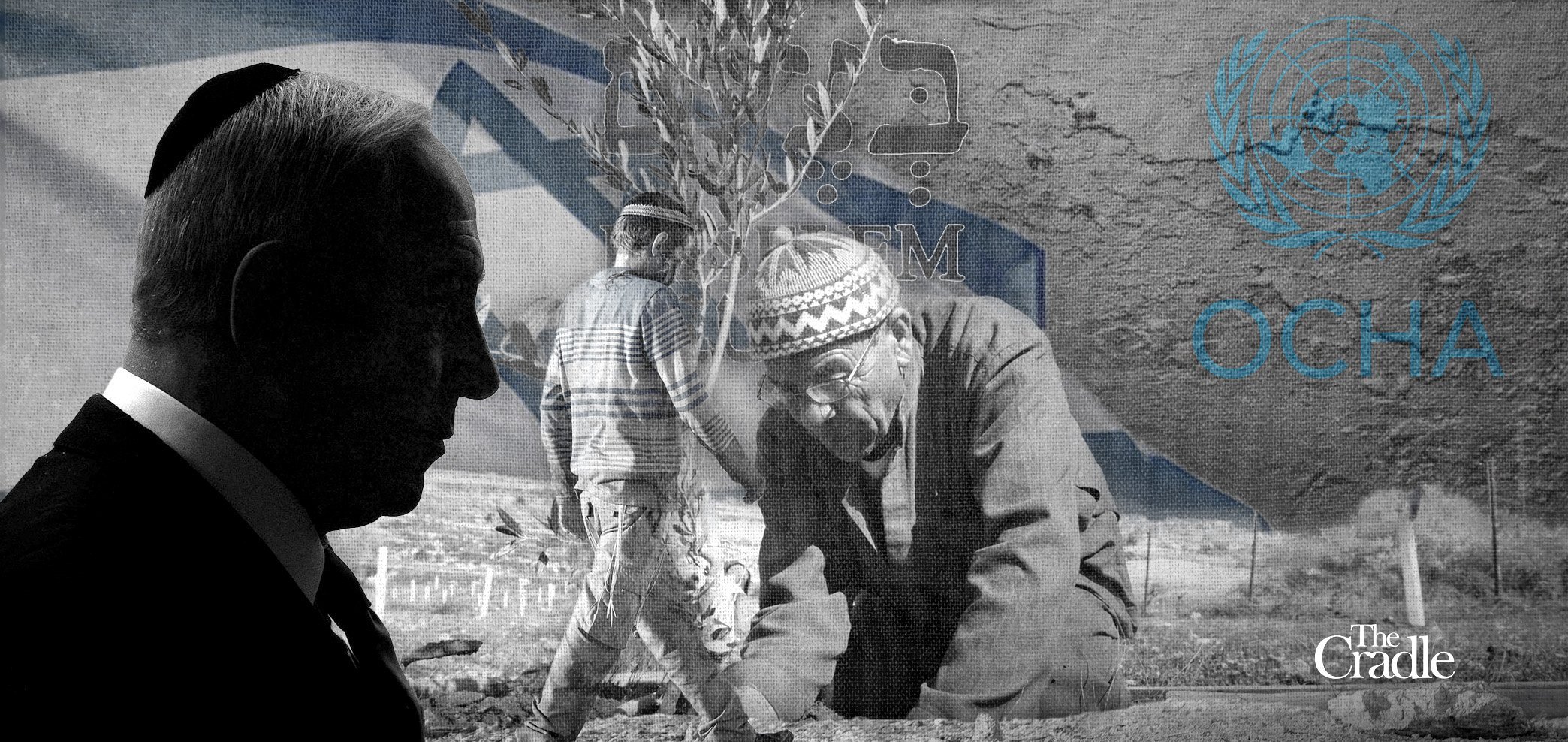 Photo Credit: The Cradle
On the morning of 7 October 2023, while the world braced for the fallout of Operation Al-Aqsa Flood, another front of war opened quietly. Not with airstrikes or artillery, but with bulldozers, laws, and settler militias.
As the bombs pulverized Gaza, the occupied West Bank ignited in a different fire: one of systematic expulsion, violent dispossession, and legal annexation.
The settler state advances
This war does not light up news headlines or trend on social media – unless one follows these developments. But its consequences may prove even more lasting. Under the cover of Gaza's devastation, Israel has accelerated a long-planned campaign to forcibly dismember the occupied West Bank, destroy Palestinian agricultural life, and erase any prospect of a sovereign Palestinian state.
Its instruments are both brutal and bureaucratic, and include armed settlers, water theft, archaeological decrees, economic strangulation, and the political neutering of what is left of the Palestinian Authority (PA).
Settler violence becomes state doctrine
Settler attacks on Palestinians are no longer random or rogue. Once attributed to fringe factions like the “Hilltop Youth,” this violence has, since 7 October, transformed into a semi-official paramilitary extension of the Israeli state. Armed settler mobs now operate in full coordination with the occupation army, acting as enforcers of a policy of forced displacement.
In Areas B and C of the occupied West Bank, Palestinian farmers and villagers have been hunted by these militias who break into homes, destroy solar panels, poison water tanks, and torch crops – not just to intimidate, but to injure, kill, and drive people off their land.
These attacks reflect a strategic shift. According to the UN's Office for the Coordination of Humanitarian Affairs (OCHA), more than 260 settler assaults were recorded in October alone –the highest number since 2006. These assaults, averaging eight per day, are systematic, disproportionately targeting farmers during harvest season and shepherd communities in remote areas.
The real weapon, however, is impunity. Settlers now act with full confidence that the state will protect them, not prosecute them. In one case, settlers torched a mosque in Deir Istiya and graffitied its walls with a defiant message: “We are not afraid of Avi Bluth,” referring to the Israeli army’s Central Command chief. Backed by extremist ministers like Bezalel Smotrich and Itamar Ben Gvir, they feel – and function – as the true sovereigns of the land.
Israeli rights group Yesh Din reports that even before the war, 94 percent of settler violence cases ended without indictment. Since the war began, even the appearance of legal process has evaporated.
Criminalizing olive trees
In the occupied West Bank, Israel's war extends to the roots – literally. The olive tree, lifeblood of rural Palestinian society and economy, is now a frontline target. Tel Aviv has weaponized resource control and environmental laws to dismantle Palestinian agriculture and detach people from their land.
Palestinian farmers, according to Amnesty International, are subjected to a regime of domination that severely restricts access to vital resources. Israel controls 85 percent of the occupied West Bank’s water and bans the digging of wells, forcing many to rely on traditional rain-fed agriculture – a practice rendered unstable by climate change and groundwater theft for the benefit of nearby, lush settler colonies.
This war on agriculture is also waged through Kafkaesque legalities. Israel has criminalized the harvesting of native Palestinian plants like thyme, akkoub, and sage, citing “nature protection” laws. While bulldozers raze thousands of dunams of wild flora to expand settlements, Palestinians gathering akkoub for a family meal are fined and jailed. Experts argue this is part of a broader campaign to sever Palestinians from their land, even controlling what they eat and how they live.
Meanwhile, settlers launch direct assaults on crops, block Palestinian farmers’ access to hundreds of hectares of olive groves, and cripple the local economy. When Palestinians resist, they are charged with terrorism. The goal is to make staying on the land too dangerous, too expensive, and ultimately impossible.
‘Creeping’ or open annexation?
Alongside violence, Israel is pushing a quieter, perhaps more dangerous campaign: the legal absorption of the occupied West Bank into the settler state. This creeping annexation does not rely on declarations or ceremonies. It operates through zoning laws, civilian governance, and strategic archaeology.
One of the most alarming manifestations of this shift is the weaponization of archaeology. The Israeli government seeks to place the occupied West Bank under the authority of its “Israel Antiquities Authority,” stripping jurisdiction from the military administration and handing it to a civilian body – a de facto annexation.
Under the pretext of preserving “biblical heritage,” vast areas are declared “archaeological sites” or “national parks,” creating an exclusively Jewish narrative that automatically bars Palestinians from building or farming on these lands.
This historical fabrication erases the region’s multi-layered past in favor of a singular Jewish mythos designed to justify colonization.
By replacing military rule with civilian law, Israel is reclassifying the occupied West Bank not as occupied territory, but as a sovereign extension. The lines between Tel Aviv and Tulkarem blur, and apartheid becomes formalized.
Dismantling the political center
As bulldozers dig up fields and laws suffocate villages, Tel Aviv is also re-engineering Palestinian political life. The goal is not to dismantle the collaborative PA outright – it still serves an administrative and security function in Area A – but to reduce it to a neutered municipal subcontractor.
Israel is bypassing the PA altogether, striking direct relationships with tribal leaders, village councils, and local power brokers. This is a classic colonial policy of dividing the indigenous polity, elevating local collaborators, and eliminating the possibility of unified national leadership.
This aims to fracture Palestinian cohesion and recast the cause from a national liberation struggle into isolated humanitarian cases – villages like Hebron, Nablus, and Jenin presented as disconnected communities in need of charity.
In parallel, Tel Aviv is choking the PA financially by siphoning off its tax revenues, as permitted under the Oslo Accords. As the “Authority” collapses into dysfunction, the resulting chaos is used to justify further Israeli control.
The new Nakba
The sum of these parts – settler militias, scorched agriculture, illegal land grabs, and political fragmentation – is a campaign of forcible displacement without tanks. In short, it is a silent Nakba (catastrophe).
A B’Tselem report confirms that settler violence alone has displaced 44 Palestinian shepherding communities since the war began. As Yair Dvir from the organization explains: “When you look at what’s happening, there’s an entire system in place. These are not just rogue settlers. They are backed by the Israeli establishment. The goal is clear: forced Palestinian displacement.”
While Gaza’s destruction captures the cameras, the occupied West Bank is being methodically emptied through fear, poverty, and thirst. Israel’s strategic objective is to eliminate the two-state framework and enshrine a one-state reality in which full rights are reserved for Jews, while Palestinians are confined to disconnected enclaves, stripped of sovereignty, and eventually pushed toward the east bank of the Jordan River.
To speak of a “day after” in Gaza without reckoning with what is being cemented in the hills of the occupied West Bank is to miss the heart of the project. The warplanes may go quiet, but the machinery of colonization – the fences, permits, laws, roads, and guns – grinds on. It is here, in the silence, that the erasure is completed. A future where return is denied, justice outlawed, and history repaved with concrete and myth.


No comments:
Post a Comment