Catholic
churches have traditionally erected Nativity scenes outside at
Christmas time. To represent the birth of Jesus, the scenes include the
baby, his mother and father, Mary and Joseph, together with the
shepherds, their animals, and the “wise men from the East” who came to
witness the birth.
Despite the fact that the story is rich in
meaning and symbolism, these Nativity scenes have been stripped of their
deeper meaning and have become quite two-dimensional and shallow. Like
the anodyne carols that have come to define the season, the portrait of
the birth that emerges is “peaceful,” “calm,” and “bright.” There is no
hint of the oppressive Roman occupation that forced this couple to
travel across the country to register in a new census
mandated by the empire. Nor is there a recognition of the many ironies
underlying the story: that this Jewish baby, who is to be a savior, is
born in a cave surrounded by animals, or that the first to come to pay
homage are lowly sheep herders and non-Jewish travelers from afar.
In
fact, it is these various ironies and others like them that truly
define the biblical Christian narrative. It is, in reality, an
upside-down faith. In Jesus’ own words, it is a faith where the first
shall be last and the last shall be first. It is meant not for the rich,
the satisfied, and the powerful. Rather it is first intended for the
poor, the hungry, the downtrodden, and the rejected. And it is for those
who recognize this and who therefore commit themselves to serving “the
least of these.”
With this in mind, it is fascinating to see
how in recent years some Christians have taken to reclaiming the
challenge inherent in their faith.
Just two years ago a
Palestinian clergyman in Bethlehem replaced the stable in the Nativity
scene with rubble in order to portray what was unfolding in Gaza.
His setting of “Jesus in the rubble” eloquently told the story of the
Palestinian people: vulnerable, stripped of their humanity, and
subjected to indignities. As if to more deeply develop this
identification, last year, Pope Francis was shown in quiet prayer before a manger scene in which the baby Jesus was wrapped in a Palestinian keffiyeh.
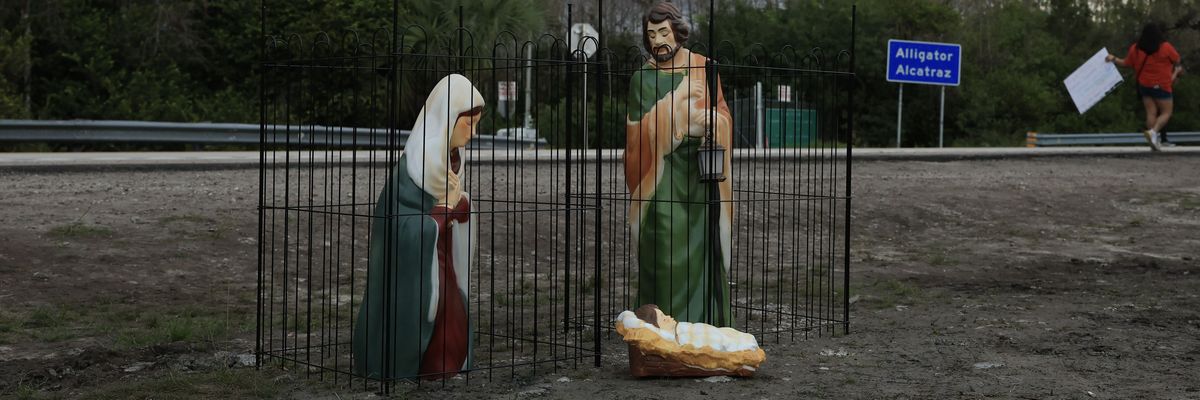
In somewhat the same vein, this year, a Catholic community in Massachusetts, given the threats faced by migrants and refugees in the United States,
found their own deeper meaning in the Christmas story. In the Nativity
scene they erected outside their church, there is no Jesus, Mary, or
Joseph. Instead, there is a sign noting that because of concern that ICE
(the immigration
enforcement police) would be conducting one of their raids, the family
had gone into hiding and was seeking sanctuary inside the church.
There
are reports of other similar efforts by churches to capture the
challenge of the Christmas narrative—with references to ICE, the
detention of immigrants, and the mistreatment of immigrant children figuring prominently in many of these portrayals.
In
the case of the Massachusetts church, Catholic leaders in the state
rebuked the church in question accusing them of playing politics. The
Nativity scene, they said, was to provide opportunities for quiet
prayerful reflection, not divisive politics. What these church leaders
miss, of course, is that if they strip the birth story (and, one might
add, the rest of the biblical narrative and for that matter the rest of
the New Testament and the many radical injunctions Jesus gives to his
followers) of its essential content, then it is they who are playing
divisive politics. By not grounding the Nativity in its real-world
context, there is the danger that the “contemplative prayer” the leaders
are advocating can become shallow and contentless.
After all,
the writers of the biblical stories had a point to convey. They weren’t
just painting a pretty picture to some day appear in pastel tones on a
holiday card. There are reasons why the child was born in a cave and
first welcomed not by the high priests but by the lowest and foreigners.
Why, in the face of repression, his parents had to take him and flee
into Egypt. And why, as he grew, he made every effort to challenge the
stale and corrupt religious hierarchy of his day, providing his
followers with a challenging message of service to the rejected, the
vulnerable, and those in need.
Every year around this time, our
mailboxes are filled with mostly brightly decorated holiday greeting
cards. About a decade ago, I was shocked to open one from a friend in Lebanon.
It featured the anguished and dirtied face of a young boy in a tattered
t-shirt staring out from behind a wire fence. Inside it read “Holiday
Greetings.” At first, I was confused. “Why this card, with this
incongruous message? And why now?”
After reflection, I realized
that the plight of this young Syrian refugee, forced to flee his
homeland, and now trapped in a camp living in squalor, hungry and dirty,
is the perfect image to convey the meaning and challenge of the
Christmas story. That story wasn’t written to give comfort to the rich,
powerful, and clean. It was to give hope to the destitute and the
powerless. And to challenge the rest of us to recognize that.



No comments:
Post a Comment