The Palestine Chronicle, June 27, 2026
By Romana Rubeo
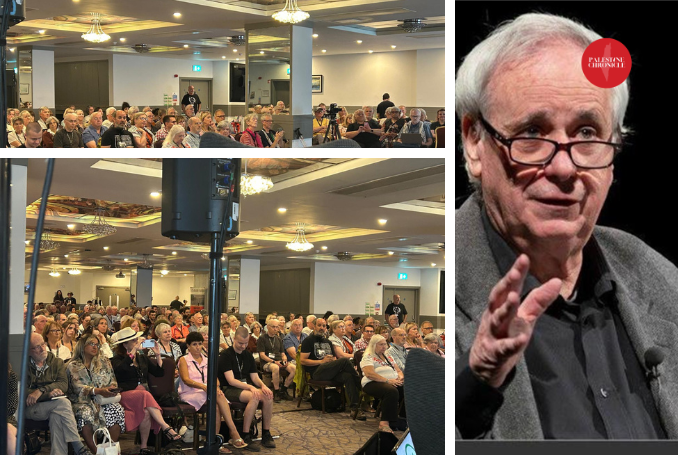
Addressing the Second Jewish Anti-Zionist Congress, Ilan Pappé urged Jewish anti-Zionists to challenge Zionism while advancing Palestinian liberation.
‘Universal Voice for Palestine’
DUBLIN – Opening his keynote address at the Second Jewish Anti-Zionist Congress in Dublin, Israeli historian Ilan Pappé admitted that, after more than four decades of activism, he had often questioned whether a specifically Jewish anti-Zionist movement was necessary at all.
After all, he reflected, the struggle for Palestine should never depend on religious or ethnic identity.
“What we need is a universal voice for Palestine,” Pappé said during his address. “Who cares whether you are Jewish, Muslim or Christian? If you are a human being with even a modicum of decency, how can you remain indifferent to the suffering of the Palestinian people?”
Yet, he acknowledged, recent political developments had convinced him that a distinct Jewish anti-Zionist voice remains indispensable—not because Jews bear greater moral responsibility than others, but because Judaism continues to be invoked to justify Israel’s policies and silence criticism of them.
Referring to the appointment of a prominent pro-Israel lobbyist as chief adviser to Britain’s incoming prime minister, Pappé argued that whether such lobbying networks possess the extraordinary influence often attributed to them is almost secondary. What matters politically, he said, is that governments believe they do.
That perception, he argued, continues to shape Western policy, where accusations of antisemitism are routinely weaponized to shield Israel from accountability despite overwhelming evidence documenting occupation, apartheid and genocide.
“This is abnormal,” Pappé said. “It is unjust. It is immoral.”
For that reason, he argued, Jewish anti-Zionists carry a particular responsibility to dismantle the idea that Zionism represents Judaism itself.
“If we fail to challenge the idea that Zionism represents the only authentic expression of Judaism,” he warned, “we should not be surprised if others eventually conclude that this is what Judaism itself represents.”
Solidarity Begins by Listening
Although much of his address focused on challenging dominant political narratives, Pappé repeatedly returned to a simpler principle: solidarity begins by listening to Palestinians rather than speaking for them.
“This Congress is devoted to action,” he said, referring to its theme, From Words to Action. “Solidarity does not consist of telling Palestinians what they need.”
Instead, he argued, Palestinians themselves must define the priorities of the international solidarity movement.
“Our role is to listen,” Pappé said, expressing concern that even within progressive circles, authentic Palestinian voices are still too often marginalized by what he described as lingering colonial—and sometimes Islamophobic—assumptions.
“The stage belongs to Palestinians,” he insisted, “not only to describe their suffering—but to articulate their political vision.”
That responsibility, he argued, extends beyond immediate solidarity work.
Jewish anti-Zionists must also continue dismantling two narratives that remain deeply entrenched across Western societies: the claim that Zionism is the natural expression of Judaism, and the assertion that anti-Zionism is inherently antisemitic.
Both, he said, require sustained historical education rather than political slogans.
“This requires patience,” Pappé observed. “It requires education. It requires historical work.”
Those conversations, he argued, must move beyond audiences already sympathetic to Palestine and reach ordinary people whose understanding of the conflict has largely been shaped by decades of political mythmaking.
Europe’s Unfinished Reckoning
Moving beyond the present, Pappé devoted much of his address to what he described as Europe’s unresolved historical responsibility for Palestine.
The international order established after the Second World War, he argued, presented itself as universal through institutions such as the United Nations and the Universal Declaration of Human Rights. Yet the people designing that order were almost exclusively representatives of colonial powers, while the colonized world remained absent from the conversation.
That omission, he suggested, became decisive when Europe confronted what it called “the Jewish question.”
“When those same leaders confronted what they called ‘the Jewish question,’ almost none of them proposed the obvious solution,” Pappé said. “Almost nobody said: ‘Let us invite Europe’s Jews back into Europe.’”
Instead, he argued, European governments embraced Zionist colonization in Palestine, transferring the consequences of centuries of European antisemitism onto a people who bore no responsibility for those crimes.
Germany, he said, occupies a central place in that history.
Contrary to the dominant postwar narrative, Pappé argued that Germany “was not denazified” in any meaningful political sense. Instead, he said, the country’s relationship with Israel became a substitute for confronting the deeper structures that had produced Nazism and antisemitism.
According to Pappé, postwar reparations did more than compensate Holocaust survivors. They also helped build Israel’s military establishment, while subsequent German political and military support—including assistance that strengthened Israel’s strategic capabilities—cemented a relationship that continues to shape European policy today.
“This historical relationship still shapes contemporary politics,” he said, arguing that Europe has “never fully reckoned with the consequences of exporting its own historical crimes onto the Palestinian people.”
For Pappé, acknowledging that history does not mean imagining that Israeli Jews should somehow return to Europe. Rather, it requires Europe to recognize that Palestinians paid the price for crimes committed on another continent.
Recovering another forgotten history, he continued, is equally important.
Long before Zionism, Palestine formed part of a broader Arab world in which Muslims, Christians and Jews lived together despite inevitable tensions and inequalities.
“There was a Jewish presence in Palestine,” Pappé recalled. “There were Arab Jews.” Almost nobody, he said, believed that the future required an exclusively Jewish state.
That history of coexistence was fractured by colonialism and Zionism, yet it remains one of the strongest challenges to the ideological foundations of the Israeli state.
“Recovering the history of Arab Jewish life,” he argued, “is one of the most powerful ways of dismantling Zionist mythology,” because it demonstrates that coexistence existed before colonialism intervened—and therefore can exist again.
Returning to the central theme of his address, Pappé rejected the idea that nationalism or ethnic supremacy could ever constitute a meaningful response to centuries of antisemitism.
“The greatest response to antisemitism today,” he concluded, “is the decolonization of Palestine.”
That, he argued, requires dismantling Zionism “as a colonial political project” while allowing Palestinians to live as free people “on their own land.”
(The Palestine Chronicle)

– Romana Rubeo is an Italian writer and the managing editor of The Palestine Chronicle. Her articles appeared in many online newspapers and academic journals. She holds a Master’s Degree in Foreign Languages and Literature and specializes in audio-visual and journalism translation.


No comments:
Post a Comment