I was born in Poonch (Kashmir) and now I live in Norway. I oppose war and violence and am a firm believer in the peaceful co-existence of all nations and peoples. In my academic work I have tried to espouse the cause of the weak and the oppressed in a world dominated by power politics, misleading propaganda and violations of basic human rights. I also believe that all conscious members of society have a moral duty to stand for and further the cause of peace and human rights throughout the world.
State media says Israeli attack on girls' school in the city of Minab in the south of the country kills dozens.
This
image grab taken from Iranian state television broadcasted on February
28, 2026, show what it says is the site of deadly US and Israeli strikes
that hit a girls’ elementary school in Minab, in the southern Iranian
province of Hormozgan near the strategic sea route of the Strait of
Hormuz. [Screengrab/IRIB TV via AFP]
An Israeli strike has hit an elementary
girls’ school in Minab, a city in the Hormozgan province of southern
Iran, killing dozens of people, according to state media, as the
immediate civilian cost from Israel and the United States’s huge bombardment of Iran comes into sharper focus.
Iran’s semiofficial Tasnim News Agency
cited the Judiciary of Minab as saying that the death toll had risen to
85 after Saturday’s strike on the school.
Workers are continuing to clear wreckage
from the site, where 63 others were injured on Saturday, said Iran’s
state-run IRNA news agency. The strike is part of a wave of joint
US-Israeli military attacks across Iran that has triggered an outbreak of regional violence.
Iranian Foreign Minister Abbas Araghchi
shared a photo of the attack, which he said destroyed the girls’ school
and killed “innocent children”.
“These crimes against the Iranian People will not go unanswered,” Araghchi wrote in a post on X.
Iran’s Foreign Ministry spokesperson
Esmaeil Baghaei also slammed the “blatant crime” and urged action from
the United Nations Security Council.
Separately, Iran’s Mehr news agency
reported that at least two students were killed by another Israeli
attack that hit a school east of the capital, Tehran.
People watch as smoke rises on the skyline after an explosion in Tehran, Iran, this morning
Morning Star, 28 Feb 2026
An emergency demonstration has been called
outside Downing Street for 3.30pm today to oppose war on Iran, which
could escalate into regional or even world war.
Iranian media reported strikes nationwide,
and smoke could be seen rising from the capital Tehran. US President
Donald Trump announced the start of “major combat operations” and called
for regime change in the country, urging Iranians to rise up in
collaboration with the attackers.
A huge US armada has built up in the
Middle East in recent weeks, larger than that assembled in the Caribbean
before the US bombed Venezuela and kidnapped its president last month.
Mr Trump suggested the war could be a bloody one, anticipating US
casualties and saying “that often happens in war.”
Talks had been ongoing in Geneva over US
insistence that Iran abandon uranium enrichment for its civil nuclear
power programme, as Washington claims Iran is seeking a nuclear weapon,
something it has always denied.
Mr Trump unilaterally tore up the previous
agreement on Iranian nuclear power (the Joint Comprehensive Plan of
Action, signed in 2015) in 2018, and broke up negotiations on the issue
last year by joining an unprovoked Israeli bombing spree as they were
under way.
This year’s talks may also have been
undertaken in bad faith by the United States, with an Israeli official
briefing Reuters that the attacks had been planned for months and the
launch date decided weeks ago.
Israel reported yesterday morning that retaliatory Iranian missiles had already begun to hit the country.
Tens of thousands of US troops — and about
4,000 British soldiers — are stationed on bases in the Middle East,
which could be targeted by Iran in retaliation.
It is unclear if British bases have been
used in any capacity by the US in the attacks. Reports in recent weeks
have suggested British authorities objected to involvement in any
attack, though Prime Minister Sir Keir Starmer has also indicated he
would be prepared to join US aggression against Iran.
Former Labour leader Jeremy Corbyn said:
“The attacks on Iran by Israel and the United States are illegal,
unprovoked and unjustifiable.
“Peace and diplomacy was possible. Instead, Israel and the United States chose war.
“This is the behaviour of rogue states —
and they have jeopardised the safety of humankind around the world with
this catastrophic act of aggression.
“Our government must condemn this flagrant
breach of international law, and urgently pursue a foreign policy based
on justice, sovereignty and peace.”
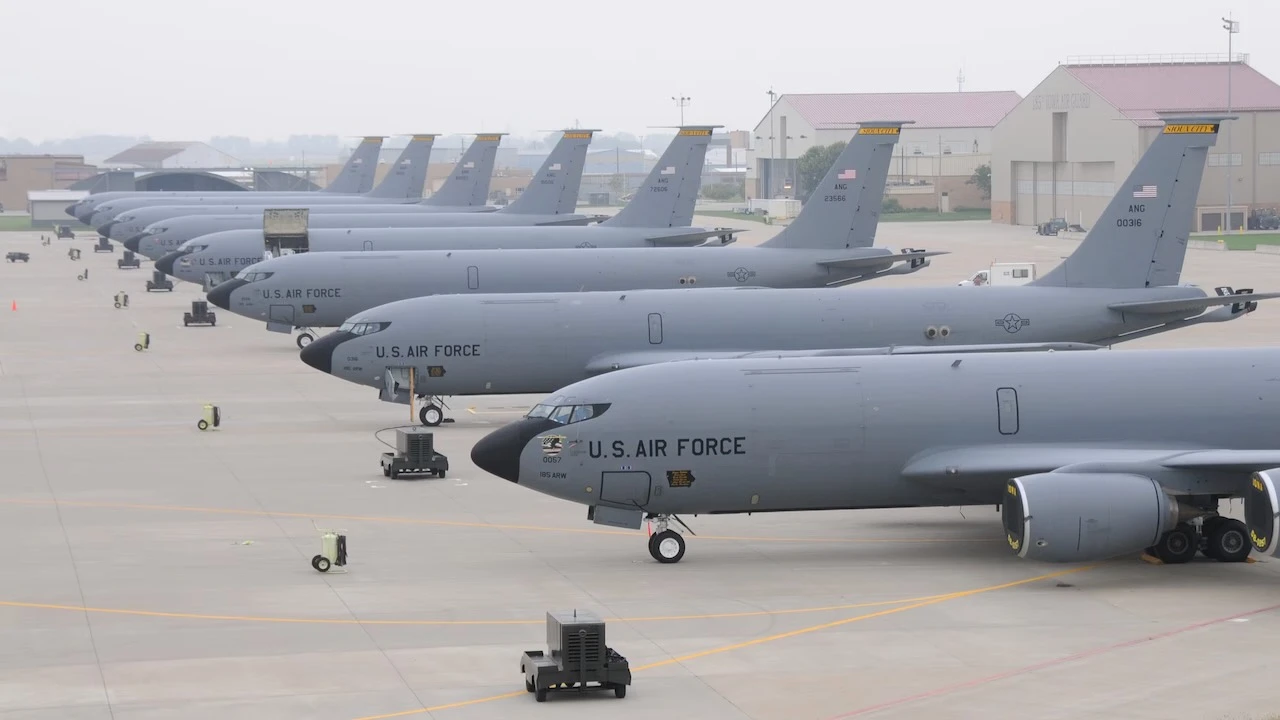
(Photo credit: MSgt Vincent De Groot 185th ARW Public Affairs, Iowa Air National Guard)
Satellite imagery shows an increase in US
military support aircraft, including refueling tankers and surveillance
planes, at a Saudi airbase, Reuters reported on 27 February, amid Washington’s threats to launch a new war on Iran.
A high-resolution satellite image from 21
February showed at least 43 aircraft at Saudi Arabia’s Prince Sultan
Airbase, a facility long used by US forces.
Four days before, satellite images showed
only 27 aircraft visible. By 25 February, the number of aircraft had
fallen slightly to 38.
The buildup comes one month after Riyadh
claimed it would not allow the US to use its territory to stage a
military attack on Iran.
The aircraft visible in the 21 February
image included 13 Boeing KC-135 Stratotankers, used for aerial refueling
of warplanes, and six Boeing E-3 Sentry aircraft (AWACS), used for
surveillance, target detection, and tracking.
Boeing KC-135 Stratotankers were also seen on Friday at Israel’s Ben Gurion Airport in Tel Aviv.
US President Donald Trump last week
threatened Iranian leaders, saying they must agree to a deal within 10
to 15 days. If not, “really bad things” would happen, Trump said.
Chinese commercial satellite imagery has
also confirmed the deployment of 16 KC-135 aerial refueling tankers and
MIM-104 Patriot air defense systems to Al-Udeid Air Base in Qatar.
According to Military Watch Magazine,
US-made warplanes such as the F-16 rely heavily on aerial refueling for
operations against major state adversaries, making the use of KC-135s
critical for any large-scale attack.
Military Watch observed that E-3s
carry the largest airborne radars in the world and have the ability to
guide missiles fired by warplanes, ships, or ground-based systems to
their targets.
However, the viability of the E-3 has
increasingly been called into question, amid claims that its radars and
other avionics are becoming obsolete.
“This limits situational awareness,
particularly against stealth targets such as Iran’s Shahed 191 drones,
while also increasing vulnerability to electronic warfare,” the magazine
added.
Israeli media observed
that one set of Chinese commercial satellite images showed F-22 stealth
fighter jets that the US had deployed the Ovda Air Base in southern
Israel, where a Patriot air defense battery has also been deployed.
Other Chinese satellite images have
documented the movement of US naval destroyers and aircraft carriers
across the region, including the arrival of the USS Gerald R. Ford, the
world’s largest aircraft carrier, in Crete.
Amid the buildup, Iranian and US negotiators met in Geneva this week for a third round of indirect talks.
On Friday, Iranian Foreign Minister Abbas Aragchi wrote on social media: “Further progress has been made in our diplomatic engagement with the United States.”
“This round of negotiations was the most
intensive yet. The talks ended with the mutual understanding that we
will continue to discuss in more detail and precision the issues that
are essential to any agreement, including the lifting of sanctions and
steps related to the nuclear field,” Aragchi added.
The two sides agreed to meet next week in
Vienna to discuss technical details, according to Omani Foreign Minister
Badr Al-Busaidi, who is mediating the talks.
As US and Israeli bombs fell on Tehran,
the Iranian Foreign Ministry on Saturday vowed that the country would
defend itself against “criminal aggression” and implored the United Nations Security Council to take emergency action.
The ministry said in a lengthy statement that Saturday’s attacks, which US President Donald Trump
characterized as the start of a massive military operation aimed at
overthrowing the Iranian government, represent “a violation of Article
2, Paragraph 4, of the United Nations Charter and a clear armed
aggression against the Islamic Republic of Iran.”
“The Islamic Republic of Iran notes the
grave duty of the United Nations and its Security Council to take
immediate action to confront the violation of international peace and
security,” reads the ministry’s statement, which noted that the US and
Israeli assault began “in the midst of a diplomatic process.”
“The Iranian people are now proud that
they did everything they could to prevent war,” the statement continues.
“Now is the time to defend the homeland and confront the enemy’s
military aggression. Just as we were ready for negotiations, we are more
ready than ever for defense. The armed forces of the Islamic Republic
of Iran will respond to the aggressors with authority.”
Ben Saul, the UN special rapporteur on human rights and counterterrorism, condemned US-Israeli “aggression against Iran” in a social media post, calling the assault a “violation of the most fundamental rule of international law—the ban on the use of force.”
“All responsible governments should
condemn this lawlessness from two countries who excel in shredding the
international order,” Saul added.
The Laurel and Hardy
negotiating team of Steve Witkoff and Jared Kushner, coupled with
Trump’s appalling ignorance of world affairs and megalomania, seem set
to push the U.S. into yet another debacle in the Middle East, one the
Congress has not approved, and the public does not want.
The demands imposed on Iran by the Trump
White House are no more acceptable to the regime in Tehran than those
imposed on Hamas in Gaza under Trump’s sham peace plan.
Trump’s demand that Iran shut down its
nuclear program and give up its missile capabilities in return for no
new sanctions is as tone deaf as calling on Hamas to disarm in Gaza.
But since we have long dispensed with
diplomats, who are linguistically, politically and culturally literate,
who can step into the shoes of their adversaries, we are being led to
another war in the Middle East by our newest coterie of buffoons.
The U.S. and Israel foolishly believe they
can bomb their way to decapitating the Iranian government and
installing a client regime. That this non-reality-based belief system
failed in Afghanistan, Iraq and Libya eludes them.
The promise of no new sanctions will not
incentivize Iran to broker an agreement. Iran is already crippled by
onerous sanctions that have gutted its economy.
This will do nothing to break the economic stranglehold.
Iran will not give up its nuclear program,
which has the potential to be weaponized, or its ballistic missile
program, which Israel said it would target in an air attack.
Israel’s reputed nuclear arsenal of some
300 warheads is a powerful incentive for Iran to retain the capacity to
build a nuclear arsenal of its own. Iran, like Hamas, is never going to
render itself defenseless against those seeking its annihilation.
An aerial attack on Iran will not be like
the 12-day assault last June against Iran’s nuclear facilities and state
and security facilities.
Then Iran calibrated its response with
symbolic strikes on Al Udeid air base in Qatar in the hopes that it
would not lead to a wider, protracted conflict.
If an aerial assault is launched, Iran
will have nothing to lose. It will understand that appeasing its
adversaries is impossible.
Iran is not Iraq. Iran is not Afghanistan. Iran is not Lebanon. Iran is not Libya. Iran is not Syria. Iran is not Yemen.
Iran is the seventeenth largest country in
the world, with a land mass equivalent to the size of Western Europe.
It has a population of almost 90 million — 10 times greater than Israel —
and its military resources, as well as alliances with China and Russia,
make it a formidable opponent.
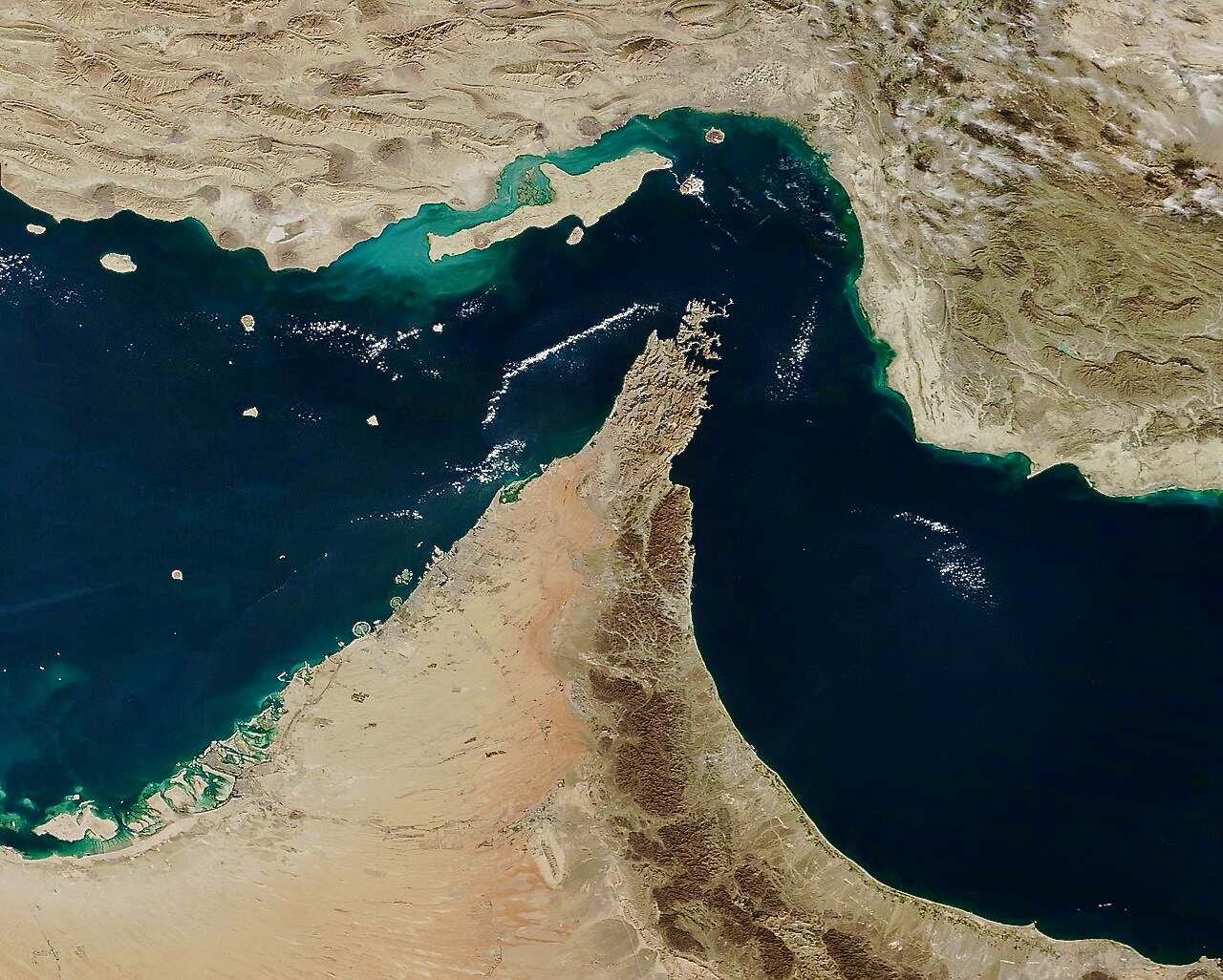
The Strait of Hormuz and the Musandam
Peninsula on Dec. 6, 2018. (MODIS Land Rapid Response Team, NASA GSFC /
Wikimedia Commons / Public Domain)
Despite Iran’s relative military weakness,
when set against the combined forces of the U.S. and Israel, it can
inflict a lot of damage. It will do this as swiftly as possible.
Hundreds of American troops will likely be
killed. Iran will certainly shut down the Strait of Hormuz, the world’s
most important oil chokepoint that facilitates the passage of 20
percent of the world’s oil supply.
This will double or triple the price of
oil and devastate the global economy. It will target oil installations
along with U.S. ships and military bases in the region.
Mounting losses and a huge spike in oil
prices will provide the fodder for Trump, and his vile counterpart in
Israel, to ignite a sustained regional war.
This is the cost of being governed by imbeciles. God help us.
Chris Hedges is a Pulitzer Prize–winning journalist who was a foreign correspondent for 15 years for The New York Times, where he served as the Middle East bureau chief and Balkan bureau chief for the paper. He previously worked overseas for The Dallas Morning News, The Christian Science Monitor and NPR. He is the host of show “The Chris Hedges Report.”
Dr. Muhammad Al-Hindi, Deputy Secretary-General of Palestinian Islamic Jihad, told Al Jazeera Mubasher that with “every door closed,” Palestinians have only steadfastness and resistance left, dismissing Trump’s ceasefire framework and the so-called Board of Peace as political theater that grants “sovereignty for President Trump, security for Israel,” while sidelining Palestinian representation. He accused Israel and the U.S. of blocking the reconstruction of Gaza as a form of “extortion,” and rejected calls for disarmament as an “attempt at deception” that would only invite further displacement—citing the occupied West Bank as an example. Al-Hindi added that the resistance does not trust Washington and entered negotiations only to stop bloodshed. He warned that Israel is pushing for wider regional war, including with Iran, to entrench its dominance, adding that Palestinians have been, “resisting for a century, beforePalestinian resistance official says Trump’s BoP framework is political theater, affirms steadfastness is only option left.
Modi’s Israel visit strengthens military and tech ties, offering Netanyahu political cover amid Gaza genocide and regional tensions.
Key Takeaways
Modi’s two-day visit to Israel centers on defense, technology, and economic cooperation while Gaza remains under devastating assault.
The Knesset address functioned as a high-visibility endorsement of Israel during mounting genocide allegations.
India is one of Israel’s most important defense and trade partners, with bilateral trade reaching $3.62 billion in 2025.
Palestinian solidarity voices and Indian opposition figures condemned the visit as legitimizing Netanyahu’s wartime policies.
The trip carries broader geopolitical implications, intersecting with US-Iran tensions and emerging regional corridors.
The Optics
Indian Prime Minister Narendra Modi
arrived in Israel to a warm public embrace from Benjamin Netanyahu, a
carefully choreographed display underscoring the deepening alignment
between New Delhi and Tel Aviv.
According to the Associated Press, the
two-day visit is focused on strengthening “security, economic and
technological cooperation,” including meetings with Netanyahu and
President Isaac Herzog, an address to the Knesset, and the signing of
multiple agreements.
India–Israel trade reached $3.62 billion in the 2025 fiscal year, reflecting the economic dimension of the partnership.
But the optics matter as much as the
agreements. Modi’s speech to Israel’s parliament comes as Israel
continues its genocidal war on Gaza — a campaign that has killed and
wounded hundreds of thousands of Palestinians and devastated the
besieged territory’s civilian infrastructure. In this context, a
standing ovation in the Knesset is not merely a diplomatic ceremony; it
is political messaging.
Israel’s government, facing growing
international scrutiny over war crimes allegations, benefits enormously
from high-profile visits by major powers. Modi’s appearance signals that
Israel remains far from isolated, even as global outrage over Gaza
intensifies. The Speech
In his Knesset address, Modi emphasized
that India and Israel are “trusted partners” whose relationship is
“vital” for trade and security. He condemned the October 7, 2023 attacks
and declared that “nothing can justify terrorism,” aligning himself
closely with Israeli framing of the conflict.
Reuters reported that Modi reaffirmed
India’s solidarity with Israel and its “firm stance against terrorism,”
while Netanyahu highlighted what he called a “tremendous alliance”
between the two countries. The Israeli prime minister praised India for
“standing by” Israel.
Modi referenced support for a UN-backed
Gaza peace initiative and spoke of dialogue and stability. Yet notably
absent was any strong public criticism of Israel’s genocide in Gaza.
The speech’s structure reflects a broader
shift in Indian foreign policy. Historically, India was among the
strongest supporters of Palestinian self-determination in the Global
South. Diplomatic relations with Israel were only formalized in 1992.
Since Modi’s rise to power in 2014, however, relations with Israel have
moved from cautious pragmatism to overt strategic alignment.
The ‘Partnership’
Behind the rhetoric lies the substance: arms and technology.
India has become one of Israel’s largest
defense customers. Cooperation spans missile systems, surveillance
technologies, air defense, drones, and cybersecurity platforms. Analysts
widely recognize that Israeli defense exports to India have surged over
the past decade, embedding the relationship in concrete military
infrastructure.
The current visit is expected to further
expand collaboration in artificial intelligence, quantum computing,
cybersecurity, and joint defense production. Netanyahu has openly
described the relationship as part of a broader axis of innovation and
security.
For Palestinians, this is not abstract
cooperation. Israel’s military technologies are developed, refined, and
field-tested in the context of occupation and repeated wars on Gaza.
Surveillance systems, drone capabilities, and precision-guided weaponry
are inseparable from the architecture of control imposed on
Palestinians.
Domestic Criticism
Modi’s visit has drawn criticism both
within India and internationally. The Communist Party of India described
the trip as legitimizing Netanyahu during a genocidal assault on Gaza,
framing it as a betrayal of India’s anti-colonial legacy.
The critique extends beyond partisan
politics. For many observers, the visit symbolizes a shift from India’s
historic support for decolonization movements toward a pragmatic
alignment with militarized nationalism.
Regionally, the trip unfolds amid rising
US-Iran tensions and discussions around new economic corridors linking
India to Europe via the Middle East. Israel’s leadership sees India as a
crucial node in this emerging architecture.
But this architecture often sidelines
Palestine. Trade corridors, AI partnerships, and defense agreements are
negotiated at high levels, while Palestinian self-determination is
treated as a peripheral issue.
Our Strategic Assessment
Modi’s visit must be understood not as a standalone diplomatic event but as part of a broader geopolitical recalibration.
First, it provides Israel with visible
diplomatic reinforcement at a moment when accusations of genocide,
ethnic cleansing, and systematic targeting of civilians dominate
international discourse. Each high-level visit chips away at narratives
of isolation.
Second, it reflects India’s long-term
strategic priorities: diversification of defense partnerships,
technological advancement, and regional positioning in a multipolar
world. Israel offers advanced military technology and intelligence
cooperation that New Delhi values deeply.
Third, the visit exposes the fragility of
“balanced” diplomacy. While India continues to voice theoretical support
for a two-state solution, its material alignment tells another story.
Arms transfers, joint ventures, and high-profile endorsements during
wartime weigh more heavily than carefully crafted statements at the
United Nations.
For Palestinians, the message is sobering.
Major powers may condemn settlement expansion in principle, but the
structural partnerships that empower Israel’s military and technological
dominance remain intact.
Finally, the regional context cannot be
ignored. With US-Iran tensions mounting, Israel is eager to solidify
alliances beyond Washington. India’s embrace signals that Tel Aviv
retains powerful friends in Asia, even as European public opinion
shifts.
In this environment, Palestinian rights risk becoming bargaining chips in larger geopolitical calculations.
By Linus Höller, Defense News, Feb 23, 2026, 11:54 AM
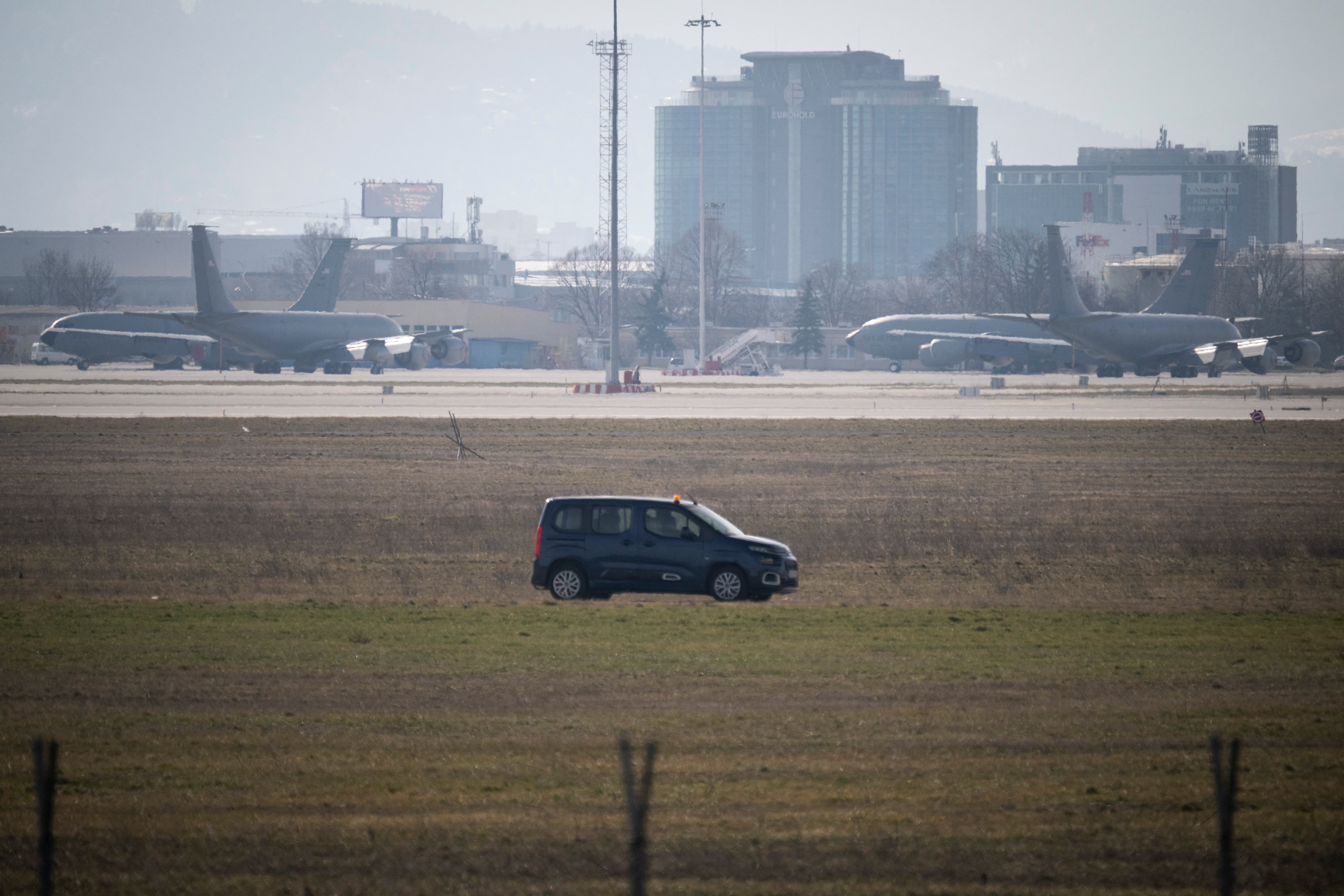
Four U.S. Air Force Boeing KC-135
Stratotanker air refueling aircraft are parked at Sofia’s Vasil Levski
Airport on Feb. 19, 2026. (Nikolay Doychinov/AFP via Getty Images)
BERLIN — Bulgaria’s Sofia International
Airport briefly suspended civilian air operations twice over the weekend
while a fleet of American military aircraft staged at the facility,
fueling speculation that Washington is positioning forces ahead of a
potential strike on Iran.
A Notice to Airmen (NOTAM), verified by the Bulgarian investigative outlet Obektivno.BG,
showed the airport restricted non-military operations on Feb. 23 from
01:15 to 02:50 local time and again on Feb. 24 from 01:05 to 03:35.
Commercial flights are not ordinarily scheduled during this time frame.
Airport authorities attributed the brief
closures to routine runway repairs and explicitly denied any link to the
American military presence.
Photographs circulating on social media
showed at least six KC-135 Stratotanker refueling aircraft from the 6th
Air Refueling Wing at MacDill Air Force Base, Florida, along with C-17
and C-130 cargo planes and Boeing 747s typically used for troop
transport, parked at the airport’s Terminal 1, according to
Obektivno.BG.
Bulgaria’s Ministry of Defense confirmed
the U.S. Air Force presence, describing the deployment as support for
“training related to NATO’s enhanced vigilance activities,” with
American personnel engaged solely in aircraft maintenance. Caretaker
Foreign Minister Nadezhda Neynsky acknowledged her ministry had limited
information and had ordered officials to collect additional details.
The Sofia staging is a small part of a
much larger American military mobilization. The Bulgarian investigative
journalists have tracked more than 120 U.S. Air Force aircraft that
crossed the Atlantic within days, including four dozen F-16s, three
squadrons of F-35A stealth fighters, and 12 F-22 Raptors.
Similar deployments, including F-22s
staged at RAF Lakenheath, preceded last June’s Operation Midnight Hammer
strikes on Iranian nuclear facilities. The USS Gerald R. Ford carrier
strike group is also en route to join the USS Abraham Lincoln, which is already positioned in the Arabian Sea.
U.K. Prime Minister Keir Starmer has
refused to grant Washington permission to use two critical
British-controlled installations − RAF Fairford in Gloucestershire, the
European forward base for U.S. heavy bombers including the B-2 and B-52,
and the joint US-UK facility at Diego Garcia in the Indian Ocean − for
any potential strike on Iran, The Times of London reported.
The buildup coincides with high-stakes
nuclear diplomacy. American President Donald Trump, speaking at the
inaugural meeting of his Board of Peace on Feb. 19, said he had given
Tehran roughly ten days to reach a nuclear agreement, warning that “bad
things will happen” if talks collapse. U.S. envoys Steve Witkoff and
Jared Kushner met an Iranian delegation in Geneva last week, with Iran’s
Foreign Minister Abbas Araghchi describing agreement on a set of
“guiding principles,” though significant gaps remain between the two
sides.
Bulgaria, a NATO member since 2004,
maintains a Defense Cooperation Agreement with Washington signed in 2006
that permits U.S. forces to use Bulgarian military facilities.
Linus Höller is Defense News’ Europe
correspondent and OSINT investigator. He reports on the arms deals,
sanctions, and geopolitics shaping Europe and the world. He holds a
master’s degrees in WMD nonproliferation, terrorism studies, and
international relations, and works in four languages: English, German,
Russian, and Spanish.
The tightening strategic embrace between New Delhi and Tel Aviv could test Pakistan’s security and diplomacy, say analysts.
India’s
Prime Minister Narendra Modi and Israel’s Prime Minister Benjamin
Netanyahu attend a welcome ceremony upon Modi’s arrival at Ben Gurion
International Airport in Lod, near Tel Aviv, Israel, on February 25,
2026 [Shir Torem/Reuters]
Islamabad, Pakistan – When Indian Prime Minister Narendra Modi stepped off the plane
in Tel Aviv on Wednesday for his second visit to Israel, and the first
by any Indian premier since his own landmark trip in 2017, the symbolism
was unmistakable.
He was given a red-carpet welcome by
Israeli Prime Minister Benjamin Netanyahu, a head of government who is
facing an International Criminal Court arrest warrant and prosecuting a
war in Gaza that much of the world has condemned as genocide.
Yet Modi’s visit signalled not hesitation, but a wholehearted endorsement to expand India’s strategic embrace of Israel.
Days before his arrival, Netanyahu announced at a cabinet meeting what he described as a “hexagon of alliances”, a proposed regional framework placing India at its centre alongside Greece, Cyprus and unnamed Arab, African and Asian states.
Its declared purpose was to counter what
he called “radical axes, both the radical Shia axis, which we have
struck very hard, and the emerging radical Sunni axis”.
In a region where Turkiye’s President
Recep Tayyip Erdogan has been among Israel’s most outspoken critics, and
where Saudi Arabia and Pakistan formalised a Strategic Mutual Defence
Agreement in September 2025 – all three Sunni-majority nations – the outline of what Tel Aviv may view as this “axis” is not difficult to discern.
Against that backdrop, India’s deepening
alignment with Israel directly impacts – and could reshape – Islamabad’s
strategic calculus in an already volatile region, say analysts.
Expanding defence and technology ties
The India-Israel relationship has accelerated sharply since Modi’s 2017 visit.
India is now Israel’s largest arms customer, and the agenda this week
spans defence, artificial intelligence, quantum computing and
cybersecurity.
A new classified framework is expected to
open exports from Israel of previously restricted military hardware to
India. Among the systems reportedly under discussion is Israel’s Iron
Beam, a 100kW-class high-energy laser weapon inducted into the Israeli
army in December 2025. Cooperation on Iron Dome missile defence
technology transfer for local manufacturing is also under consideration.
For Masood Khan, Pakistan’s former
ambassador to both the United States and the United Nations, the visit
marks a decisive moment.
“News coming out suggests they are going
to sign a special strategic agreement, one that could be seen as a
counterpart to the agreement signed by Pakistan and Saudi Arabia last
year,” he said. “Israel already has such special agreements with
countries like the US and Germany.”
Masood Khalid, a former Pakistani ambassador to China, pointed to this military dimension.
“We saw how Israeli drones worked in the
India-Pakistan conflict against us last year,” he said, referring to
India’s use of Israeli-origin platforms during the May 2025 strikes
against Pakistan, when the South Asian neighbours waged an intense
four-day aerial war. “Public statements from both sides speak of
strengthening strategic cooperation – particularly in defence,
counterterrorism, cybersecurity and AI.”
India’s defence ties with Israel are no
one-way street any more. During Israel’s war on Gaza in 2024, Indian
arms firms supplied rockets and explosives to Tel Aviv, an Al Jazeera investigation confirmed.
Umer Karim, an associate fellow at the
Riyadh-based King Faisal Center for Research and Islamic Studies, sees
the partnership as part of a wider recalibration.
“It is clear that India has entered into a
strategic partnership with Israel, and at a time when both governments
have been criticised for their actions, this bilateral relationship has
become increasingly important for both,” he told Al Jazeera.
Netanyahu’s ‘hexagon’ and Pakistan
Netanyahu’s hexagon proposal remains undefined. He has promised an “organised presentation” at a later date.
While Israel believes it has weakened what
the Israeli PM described as the “Shia axis” through its 2024-2025
campaign against Iran-aligned groups such as Hezbollah and Hamas, the
“emerging radical Sunni axis” is less clearly articulated.
Analysts suggest it could refer to states
and movements aligned with strands of political Islam and sharply
critical of Israeli policy, including Turkiye and countries that have
strengthened security ties with Riyadh and Ankara, as Pakistan has.
Pakistan is also the only Muslim nation with nuclear weapons – something
that has long worried Israel: In the 1980s, Israel tried to recruit
India for a joint military operation against a nuclear facility in
Pakistan, but backed off the plan after New Delhi abstained.
Karim was convinced about Pakistan’s place in Netanyahu’s crosshairs.
“Absolutely, Pakistan is part of this
so-called radical Sunni axis,” he said, arguing that Pakistan’s
strategic agreement with Riyadh and its close ties with Turkiye directly
affect Israel’s calculations. “In order to counter this, Israel will
increase its defence cooperation and intel sharing with Delhi.”
Khalid pointed to longstanding intelligence links.
“Intelligence sharing between Indian RAW
and Israeli Mossad dates back to the sixties. So their strengthened
interaction in this domain should be of serious concern for us,” he
said, referring to the external intelligence agencies of India and
Israel.
Others urge caution. Gokhan Ereli, an
Ankara-based independent Gulf researcher, argued that Pakistan is
unlikely to be an explicit target within Israel’s framing.
“In this context, Pakistan is more
plausibly affected indirectly, through the alignment of Israeli, Indian
and Western threat narratives, than being singled out as a destabilising
actor in its own right,” he told Al Jazeera.
Khan, the former ambassador, agreed.
“I don’t perceive a direct threat, but the
latent animosity is there. And when Modi is in Tel Aviv, he will try to
poison Netanyahu and other leaders there to think about Pakistan in a
hostile way,” he said.
Muhammad Shoaib, assistant professor of international relations at Quaid-i-Azam University, echoed that assessment.
“India’s close relations with Israel are likely to negatively impact Tel Aviv’s perception and statements on Pakistan,” he said.
The Gulf balancing act
Perhaps the most complex arena for
Pakistan is the Gulf. For decades, it has relied on Gulf partners for
financial support, including rolled-over loans and remittances that form
a crucial pillar of its economy.
Pakistan
signed a mutual defence agreement with Saudi Arabia in September last
year [File: Press Information Department via AP Photo]
After signing the Strategic Mutual Defence
Agreement with Saudi Arabia last September, discussions have
intensified about Turkiye joining a similar framework. Yet the United
Arab Emirates, one of Pakistan’s closest Gulf partners, signed a
strategic agreement with India in January 2026.
Khalid called for deeper economic integration to underpin these ties.
“Pakistan is doing well to strengthen its
bilateral ties with key Middle East countries, Saudi Arabia, UAE, Qatar
and Kuwait,” he said, “but apart from GCC, Pakistan also needs to
promote regional cooperation, particularly with countries of Central
Asia, Turkiye, Iran and Russia. Geoeconomics through greater trade and
connectivity should be the basis of this regional cooperation.” The Gulf
Cooperation Council consists of Bahrain, Kuwait, Oman, Qatar, Saudi
Arabia and the UAE.
Complicating matters further is Iran’s
central role in current regional tensions. With Washington threatening
potential military action against Iran, and Israel pressing for regime
change in Tehran, Pakistan has quietly sought to ease tensions by
arguing for diplomacy.
“But there are two main parties – Iran and
the US – and then, most importantly, Israel, which doesn’t just limit
its demands to a nuclear deal,” Khan, the former diplomat said. “It
wants to expand to Iran’s missile defence capabilities and regional
alliances, and that may well be a sticking point. Pakistan’s aspiration
is to contribute to efforts to find a diplomatic solution.”
Strategic contest
Ultimately, Pakistan’s policymakers must
assess whether ties with Saudi Arabia and Turkiye are strong enough to
offset the expanding India-Israel partnership.
Modi and Netanyahu frame their security
doctrines around countering what they describe as “Islamic radicalism”.
New Delhi has repeatedly accused Pakistan of fomenting violence against
India.
Yet Khan argued that Islamabad is not without leverage.
“We have built a firewall around us by
pushing back Indian aggression in May 2025, and by strengthening our
ties with the US over the last year,” he said.
According to The Washington Post, the US
has shifted at least 150 military aircraft to Europe and the Mideast
over the past week as it prepares for a potential attack on Iran
Twelve US F-22 Raptor fighter jets that
departed the UK on Tuesday have arrived at an Israeli Air Force base in
southern Israel, Ynet has reported, as the US continues its massive military buildup in the Middle East to prepare for a potential attack on Iran.
The F-22s arrived in the UK last week,
part of the more than 150 US military aircraft that have shifted to
Europe and the Middle East since February 17, as tracked by The Washington Post.
An Israeli official speaking to China’s Xinhua news agency
about the US F-22 deployment said that the Israeli military is
preparing for all possible scenarios, including an “Iranian attack or
retaliatory strike.” The US defended Israel from Iranian retaliatory
strikes during the 12-Day War in June 2025, though many missiles got
through US air defenses.
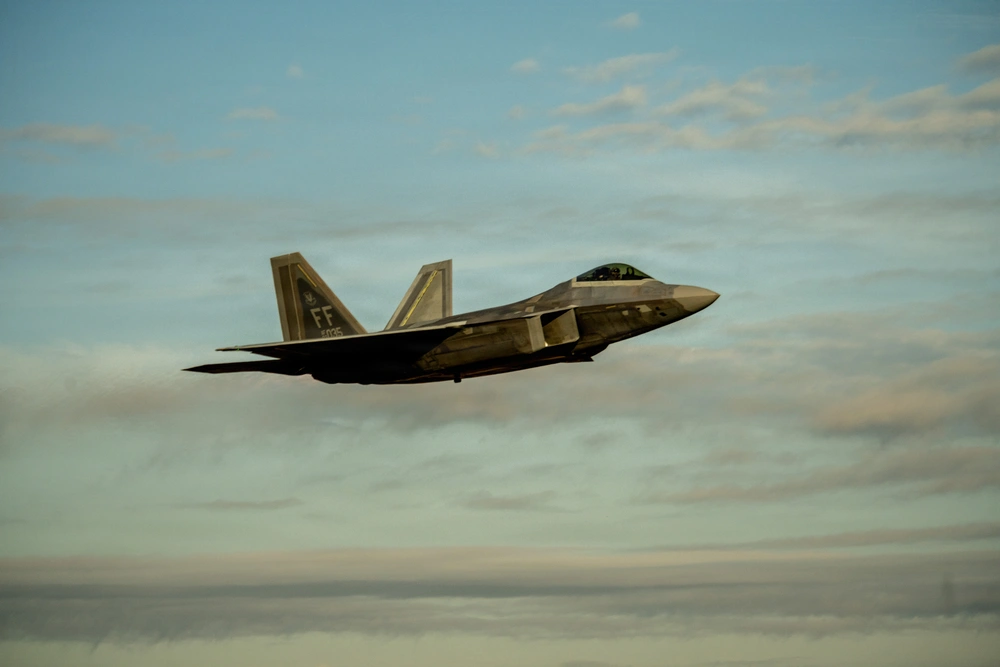
A
US F-22 Raptor fighter jet takes off from the Savannah Air National
Guard Base in Georgia on January 23, 2026 (US Air National Guard photo)
The Ynet report said that the
aircraft carrier USS Gerald Ford is still heading east in the
Mediterranean Sea and has passed Crete. Once it arrives near Israel’s
coast, it will be the second US aircraft carrier positioned in the
region to prepare for an attack on Iran, joining the USS Abraham
Lincoln, which has been operating in the Arabian Sea.
US officials previously told The New York Times
that Ford and its three destroyer escorts are likely to be initially
deployed near the coast of Israel to defend Tel Aviv and other Israeli
cities and towns. The US defended Israel from Iranian counterattacks
during the 12-Day War, though many Iranian missiles got through US air
defenses, which included US Navy destroyers firing SM-3 missiles.
The Ford was deployed to the Mediterranean
after spending several months in the Caribbean, where it supported
“Operation Southern Spear,” the US military mission that involved
bombing small boats and the attack on Venezuela to abduct Venezuelan
President Nicolas Maduro. The crew of the Ford has been on an extended deployment and will break the post-Vietnam War US carrier deployment record if it remains at sea through mid-April.
Israel lobby groups have spread
doctored quotes by UN Special Rapporteur for Human Rights Francesca
Albanese to defame her. Their desperate campaign is a testament to her
work and the threat she poses by holding Israel accountable for
genocide.
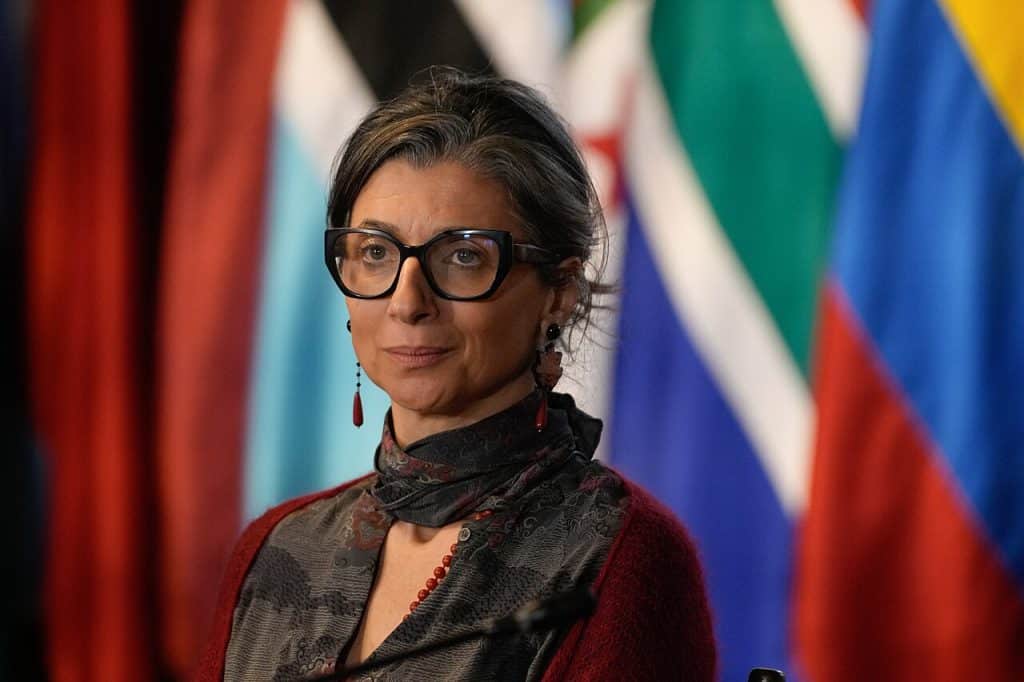
Francesca Albanese in Bogotá, Colombia, July 2025 (Photo: Andrea
Puentes – Joel González/ Presidencia de la República de Columbia)
Mark Twain and Winston Churchill are both
purported to have once said that a lie can travel half-way around the
world before truth has had a chance to put its pants on.
On February 7, Francesca Albanese, the current UN Special Rapporteur for human rights in Palestine, gave a short presentation
by video conference to a media forum in Doha, Qatar, organized by the
Al Jazeera network. She was part of a panel, which included Fatou
Bensouda, the former Prosecutor of the International Criminal Court,
speaking about the role of international law in addressing serious human
rights violations.
In her remarks, Albanese spoke sharply
about the Israeli genocide in Gaza since October 2023. In particular,
she pointed out that many Western states and corporations had not only
armed Israel, but had provided it with economic and diplomatic support
throughout the genocide. She also criticized much of the Western media
for amplifying the rhetoric of Israel’s pro-apartheid and genocidal
narrative. In her presentation, Albanese went on to say that:
“…if international law has been
stabbed in the heart, it is also true that never before has the global
community seen the challenges that we all face. We, who do not control
large amounts of financial capital, algorithms, and weapons, we now see
that we, as a humanity, have a common enemy. And freedoms, the respect
for fundamental freedoms, is the last peaceful avenue, the last peaceful
toolbox that we have to regain our freedom.”
What happened next created a firestorm, based entirely on slander and deception for something she never said.
Albanese’s warning that humanity is facing
a common enemy was clearly directed at the international system of
finance capital, large tech corporations, and weapons manufacturers that
had enabled the genocide in Gaza. She contrasted that system with the
rights-based principles of international law, which are designed to
protect and enhance our personal and collective freedoms.
The following day, a doctored version of Albanese’s presentation was posted on the YouTube site of UN Watch, a notorious private organization headquartered in Geneva whose raison d’être
is to attack the United Nations’ scrutiny of the many human rights
violations committed through Israel’s occupation of the Palestinian
territory. The truncated version by UN Watch had Albanese saying:
“Instead of stopping Israel, most of the world has armed, given it
political excuses, political sheltering, economic and financial
support.” And then the video cuts to: “we now see that we as a humanity
have a common enemy.” The clear implication in the edited video was that
Albanese had called Israel “the common enemy of humanity”.
This doctored UN Watch video spread like
wildfire through the official politico-system of the Global North.
French Foreign Minister Jean-Noël Barrot called
for Albanese’s immediate resignation for her “outrageous and
reprehensible remarks which target not the Israeli government, whose
policies can be criticized, but Israel as a people and as a nation,
which is absolutely unacceptable.”
The German Foreign Minister Johann Wadephul piled on,
stating that: “Ms. Albanese has already made numerous missteps in the
past. I condemn her recent statements on Israel. She cannot hold her
position.” Antonio Tajani, the Italian Foreign Minister, said
that her “behavior, statements and initiatives aren’t appropriate for
the position she holds.” Similar calls were issued by the foreign
ministers of Czechia and Austria.
Antonio Guterres, the United Nations
Secretary General, offered no defence for Albanese, even after the
revelation that her alleged comments on Israel had been doctored. During
a press conference at the UN headquarters in New York on February 12,
Stéphane Dujarric, the official spokesperson for the Secretary General,
was asked about the call by the French Foreign Minister for Albanese’s
resignation. Dujarric replied laconically that: “We don’t agree with much of what she says.”
After this initial wave of denunciations, international civil society began to fight back. Albanese, who had been voted by PassBlue as one of the United Nations’ Persons of the Year for 2024, referred to the full transcript of her presentation, and remarked:
“I have never, ever, ever said ‘Israel is the common enemy of
humanity.’” She pointed to the ongoing campaign of attacks on her by
pro-Israeli organizations following the release of her comprehensive
recent report to the United Nations on the genocide in Gaza and, in a separate report, the naming of large corporations (including Microsoft and Amazon) as potentially complicit in aiding Israel’s atrocities.
On February 13, Agnes Callamard, the Secretary General of Amnesty International, issued a public statement
condemning the five European foreign ministers who had called for
Albanese’s head based on “a deliberately truncated video to misrepresent
and gravely misconstrue her messages.” Callamard then contrasted the
vehemence of these ministers’ attacks on Albanese with their sotto voce approach to the Israeli genocide in Gaza:
“If only these minsters had been as
loud and forceful in confronting a state committing genocide, unlawful
occupation and apartheid as they have in attacking a UN expert. Their
cowardice and refusal to hold Israel accountable stand in stark contrast
to the Special Rapporteur’s unwavering commitment to speaking truth to
power.”
Strong statements of support for Albanese have also been issued by Artists for Palestine
(whose 100+ signatories included the actors Mark Ruffalo and Javier
Bardem, the filmmaker Spike Lee, the British pop singer Annie Lennox,
the Nobel Prize Laurate for Literature Annie Ernaux and the critic
Judith Butler) and through an open letter
signed by 150 former European ambassadors and diplomats and former
United Nations officials. The United Nations Office of the High
Commissioner for Human Rights also defended
Albanese, stating that it was very worried about the rise in personal
attacks, threats, and misinformation directed towards UN officials and
independent human rights experts.
United Nations special rapporteurs are
unpaid human rights experts appointed by the Human Rights Council for
six-year mandates to publicly report on human rights violations and
trends worldwide. Former UN Secretary General Kofi Annan called this
system of human rights experts, known as special procedures, the “crown jewel”
of the UN human rights system. The Special Rapporteur position for
human rights in occupied Palestinian territory is, arguably, the most
challenging of the approximately 60 UN human rights expert mandates,
given the intense attacks that the rapporteurs have recently faced from
Israel, the United States, and a suite of pro-Israel organizations such
as UN Watch and NGO Monitor.
UN Watch, in particular, acts as a ventriloquist for Israel’s justification of its illegal occupation and its genocide in Gaza. While presenting itself
as a non-governmental human rights organization with official status at
the UN, UN Watch’s primary task is to ardently defend Israel,
invariably in incendiary language, through a neo-conservative and
Likudnik perspective. It has consistently refused to reveal who its
funders are, although independent reporting
has named the American Jewish Committee and the Newton and Rochelle
Becker Foundation as major sources. UN Watch’s many targets — including the most recent UN special rapporteurs on Palestine, the UN Independent Commission of Inquiry on Palestine and Israel, Amnesty International, Human Rights Watch, UNRWA,
and countries that are critical of Israel — are frequently labelled as
antisemitic individuals and organizations or, slightly more kindly, as
being ferociously biased against Israel.
Albanese has also been fiercely attacked by Israel. In 2024, it declared her to be persona non grata,
banning her from visiting the occupied Palestinian territory, in part
because of her UN reports concluding that Israel was committing genocide
in Gaza. In 2025, Israel released a report
— drawn largely from UN Watch — where it claimed that she was linked to
terrorism (because she spoke at events organized by the Palestinian
human rights organizations Al-Haq) and because she supposedly spread
“antisemitic rhetoric. And last week, Israel issued an extraordinary tweet
on X, claiming that she is a “mouthpiece for Hamas”. This latest smear
was issued despite the many times that Albanese has condemned the Hamas’
attacks on October 7 2023 as serious violations of international law
because Israel civilians were killed or taken hostage.
For Albanese’s courage in previously
naming the Israeli genocide and warning American corporations that their
weapons and hi-tech sales to Israel might expose them to criminal
liability at the International Criminal Court, American Secretary of
State Marco Rubio formally sanctioned
her in July 2025. He claimed that: “We will not tolerate these
campaigns of political and economic warfare, which threaten our national
interests and sovereignty.”
The American sanctions against a UN human
rights expert are unprecedented. They essentially freeze Albanese out of
the international banking system. The sanctions have also impounded the
condo that she and her husband own in Washington, prevented her from
receiving reimbursement for her medical expenses from American insurance
companies, and prohibited her from traveling to the United Nations
headquarters in New York to deliver her annual reports. Many of her
fellow UN human rights experts have publicly condemned the sanctions, pointing out that they violate international law, including the 1946 Convention on the Privileges and Immunities of the United Nations. The human rights experts added that:
“The targeting of the Special
Rapporteur cannot be separated from the egregious international crimes
and human rights abuses being perpetrated against Palestinians and the
longstanding efforts to delegitimise those who defend their rights.”
An
Air Force E-3 Sentry airborne warning and control system aircraft
conducts aerial operations. [Photo: Air Force Master Sgt. Matthew Plew ]
The Trump administration is assembling the
largest concentration of American military force in the Middle East
since the 2003 invasion of Iraq, placing the United States on the brink
of a massive illegal war against Iran that could last weeks or months
and engulf the entire region.
Robert Pape, a professor of political
science at the University of Chicago and one of the foremost analysts of
American air power, wrote on X Saturday: “This represents 40-50% of the
deployable US air power in the world. Think air power on the order of
the 1991 and 2003 Iraq war. And growing. Never has the US deployed this
much force against a potential enemy and not launched strikes.”
The Jerusalem Post and the Media Line,
in an article published Saturday, reported that there are “now four
American carrier strike groups either in the wider Middle East or moving
toward it. That alone changes the equation. In the surrounding waters,
roughly a dozen guided-missile destroyers are spread out, some near the
Strait of Hormuz, others operating closer to the Red Sea.” These
publications are the only outlets to report that four carrier strike
groups are involved in the buildup.
Col. Richard Kemp, a former commander of British forces in Afghanistan, told the Media Line:
“As I understand it, this is the biggest military buildup in the Middle
East since 2003.” He described the current scale as greater than the
12-day war in June 2025. “It could run into weeks,” he said. “It could
well be a fairly long, sustained bombing campaign against Iran.” Of the
force now assembled, he said: “It’s needed in order to sufficiently
damage the regime. Not a token strike.”
Brig. Gen. Amir Avivi, founder of the
Israel Defense and Security Forum, said the strategic objective had
shifted beyond Iran’s nuclear facilities. “Now we are talking about
taking down the regime. It is something completely different,” he told
the Media Line. “I think in two weeks it could be done.”
The New York Times reported
Sunday that the USS Gerald R. Ford, the world’s largest warship, was
“steaming south of Italy in the Mediterranean Sea” and would soon be off
the coast of Israel. The USS Abraham Lincoln carrier strike group is
already operating in the Arabian Sea. The Times reported that
US President Donald Trump discussed plans for strikes in a White House
Situation Room meeting on Wednesday attended by Vice President JD Vance,
Secretary of State Marco Rubio, Joint Chiefs Chairman Gen. Dan Caine,
CIA Director John Ratcliffe and Chief of Staff Susie Wiles.
According to the Times, Trump has
told advisers that if diplomacy or an initial targeted attack does not
force Iran to capitulate, “he will consider a much bigger attack in
coming months intended to drive that country’s leaders from power.”
Targets under consideration include the
headquarters of Iran’s Islamic Revolutionary Guard Corps, nuclear sites
and the ballistic missile program. Gen. Caine, who told Trump there was
“a high likelihood of success” before the Venezuela operation, has not
been able to deliver the same reassurances about Iran, “in large measure
because it is a far more difficult target.”
Politico reported Thursday that
the buildup had already cost an estimated $350 million to $370 million
and that costs are mounting rapidly. It noted that 17 US warships now
sit in the region, a significant portion of the roughly 68 warships
deployed around the globe. The Wall Street Journal reported
that sailors aboard the Ford have been at sea for eight months, with
morale deteriorating and crew members considering leaving the Navy.
The military escalation takes place amid a
deepening political crisis within the United States. On Thursday, the
Supreme Court ruled 6-3 in Learning Resources, Inc. v. Trump
that the International Emergency Economic Powers Act does not authorize
presidential tariffs, striking down the central pillar of Trump’s trade
war. Trump responded by calling the justices a “disgrace to our nation”
and immediately imposing new tariffs under a different statute. It was
the most significant judicial rebuke of presidential power in decades.
Edward Luce of the Financial Times
commented: “Past performance suggests he could lash out in other ways.
Given his instinct for unfiltered discretion, the Supreme Court’s ruling
could lead to overcompensation in other spheres. US military action is
the one area where the executive branch can almost always count on
judicial forbearance.”
A war against Iran, a country of 90
million people that has not attacked the United States, would constitute
a war of aggression, the “supreme international crime” as defined at
the Nuremberg trials.
This silence is the continuation of a
pattern documented throughout the buildup. Democratic Senator Mark
Warner of Virginia endorsed the military threat, saying he thought it
was “appropriate the president has all the options on the table.”
Democratic Representative Josh Gottheimer of New Jersey explicitly
opposed a bipartisan resolution by Representatives Thomas Massie and Ro
Khanna that would have prohibited the use of military force against Iran
without congressional authorization, declaring that “Congress must not
limit our ability to protect Americans and our allies.”
Democratic Senator John Fetterman of
Pennsylvania went on Newsmax to pledge his support for bombing Iran,
saying of last year’s strikes: “I absolutely was fully supportive and
was cheering for that Midnight Hammer.”
Neither House Minority Leader Hakeem
Jeffries, Senate Minority Leader Chuck Schumer, Bernie Sanders, nor
Representative Alexandria Ocasio-Cortez made any statements over the
weekend on the US threats against Iran. The Democrats funded every
weapon now being assembled for the attack.
The $901 billion National Defense
Authorization Act passed the House in December, with 115 Democrats
voting yes. In the Senate, the vast majority of Democrats voted in
favor. In January, 149 House Democrats voted for $839 billion in defense
appropriations.
The war drive against Iran is the latest
expression of the global eruption of US imperialism. Having seized the
president of Venezuela and installed a puppet regime, having threatened
to seize Greenland and the Panama Canal, the Trump administration is now
preparing to wage aggressive war against a nation of 90 million people
to impose regime change and seize control of the Middle East’s resources
and strategic chokepoints.
The Democratic Party’s complicity in these
preparations exposes once again that both parties represent the
interests of the same ruling class, and that no faction of the political
establishment opposes the escalating global war.


 People watch as smoke rises on the skyline after an explosion in Tehran, Iran, this morning


 (Photo credit: MSgt Vincent De Groot 185th ARW Public Affairs, Iowa Air National Guard)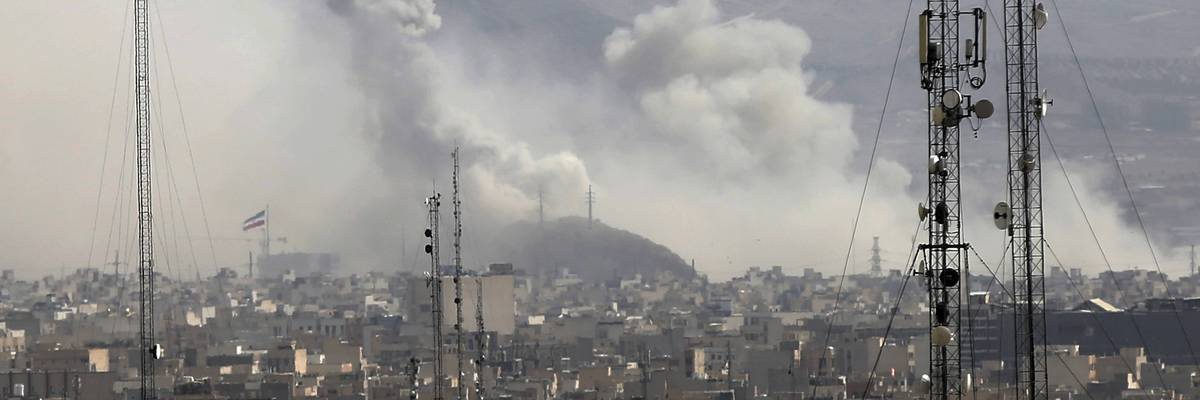



 Francesca Albanese in Bogotá, Colombia, July 2025 (Photo: Andrea
Puentes – Joel González/ Presidencia de la República de Columbia)
Francesca Albanese in Bogotá, Colombia, July 2025 (Photo: Andrea
Puentes – Joel González/ Presidencia de la República de Columbia)