The buildup comes weeks after Riyadh claimed it would not allow the US to use its territory to stage a military attack on Iran
FEB 27, 2026
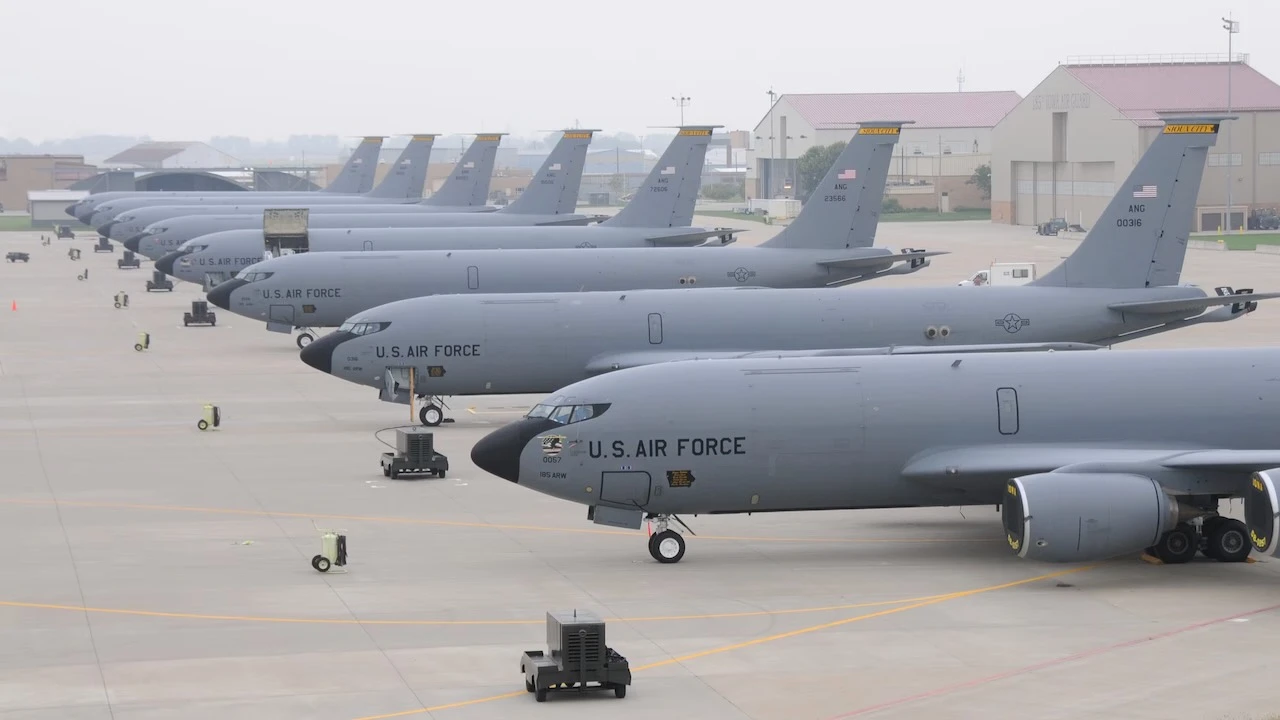 (Photo credit: MSgt Vincent De Groot 185th ARW Public Affairs, Iowa Air National Guard)
Satellite imagery shows an increase in US military support aircraft, including refueling tankers and surveillance planes, at a Saudi airbase, Reuters reported on 27 February, amid Washington’s threats to launch a new war on Iran.
A high-resolution satellite image from 21 February showed at least 43 aircraft at Saudi Arabia’s Prince Sultan Airbase, a facility long used by US forces.
Four days before, satellite images showed only 27 aircraft visible. By 25 February, the number of aircraft had fallen slightly to 38.
The buildup comes one month after Riyadh claimed it would not allow the US to use its territory to stage a military attack on Iran.
The aircraft visible in the 21 February image included 13 Boeing KC-135 Stratotankers, used for aerial refueling of warplanes, and six Boeing E-3 Sentry aircraft (AWACS), used for surveillance, target detection, and tracking.
Boeing KC-135 Stratotankers were also seen on Friday at Israel’s Ben Gurion Airport in Tel Aviv.
US President Donald Trump last week threatened Iranian leaders, saying they must agree to a deal within 10 to 15 days. If not, “really bad things” would happen, Trump said.
Chinese commercial satellite imagery has also confirmed the deployment of 16 KC-135 aerial refueling tankers and MIM-104 Patriot air defense systems to Al-Udeid Air Base in Qatar.
According to Military Watch Magazine, US-made warplanes such as the F-16 rely heavily on aerial refueling for operations against major state adversaries, making the use of KC-135s critical for any large-scale attack.
Military Watch observed that E-3s carry the largest airborne radars in the world and have the ability to guide missiles fired by warplanes, ships, or ground-based systems to their targets.
However, the viability of the E-3 has increasingly been called into question, amid claims that its radars and other avionics are becoming obsolete.
“This limits situational awareness, particularly against stealth targets such as Iran’s Shahed 191 drones, while also increasing vulnerability to electronic warfare,” the magazine added.
Israeli media observed that one set of Chinese commercial satellite images showed F-22 stealth fighter jets that the US had deployed the Ovda Air Base in southern Israel, where a Patriot air defense battery has also been deployed.
Other Chinese satellite images have documented the movement of US naval destroyers and aircraft carriers across the region, including the arrival of the USS Gerald R. Ford, the world’s largest aircraft carrier, in Crete.
Amid the buildup, Iranian and US negotiators met in Geneva this week for a third round of indirect talks.
On Friday, Iranian Foreign Minister Abbas Aragchi wrote on social media: “Further progress has been made in our diplomatic engagement with the United States.”
“This round of negotiations was the most intensive yet. The talks ended with the mutual understanding that we will continue to discuss in more detail and precision the issues that are essential to any agreement, including the lifting of sanctions and steps related to the nuclear field,” Aragchi added.
The two sides agreed to meet next week in Vienna to discuss technical details, according to Omani Foreign Minister Badr Al-Busaidi, who is mediating the talks.


No comments:
Post a Comment